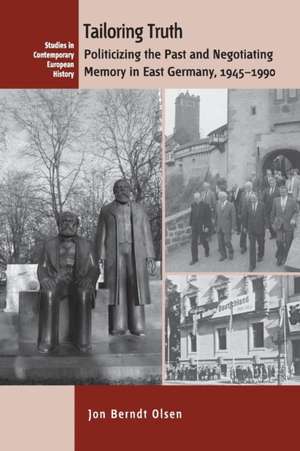
Tailoring Truth: Studies in Contemporary European History, cartea 15
Autor Jon Berndt Olsenen Limba Engleză Paperback – mai 2017
Din seria Studies in Contemporary European History
- 23%
 Preț: 765.64 lei
 -
 Preț: 160.46 lei
 - 23%
 Preț: 848.24 lei
 -
 Preț: 262.69 lei
 - 23%
 Preț: 848.89 lei
 - 23%
 Preț: 849.16 lei
 -
 Preț: 309.43 lei
 - 23%
 Preț: 760.27 lei
 - 23%
 Preț: 765.08 lei
 -
 Preț: 222.11 lei
 -
 Preț: 267.39 lei
 -
 Preț: 306.89 lei
 -
 Preț: 309.91 lei
 -
 Preț: 251.35 lei
 - 23%
 Preț: 758.02 lei
 - 23%
 Preț: 760.64 lei
 - 23%
 Preț: 762.78 lei
 -
 Preț: 159.53 lei
 - 23%
 Preț: 759.24 lei
 - 23%
 Preț: 760.12 lei
 - 23%
 Preț: 763.32 lei
 -
 Preț: 264.64 lei
 - 23%
 Preț: 849.63 lei
 -
 Preț: 268.12 lei
 -
 Preț: 354.00 lei
 - 23%
 Preț: 762.68 lei
Preț: 266.19 lei
Puncte Express: 399
Carte tipărită la comandă
Livrare economică 25 noiembrie-09 decembrie
Livrare prin curier în România Termenul estimat este afișat lângă disponibilitate.
Transport gratuit de la 400.00 lei Plată online sau ramburs, în funcție de opțiunile comenzii.
Retur gratuit în 14 zile Comandă securizată și suport în română.
Specificații
ISBN-13: 9781785335020
ISBN-10: 1785335022
Pagini: 280
Dimensiuni: 152 x 229 x 16 mm
Greutate: 0.41 kg
Editura: BERGHAHN BOOKS
Colecția Studies in Contemporary European History
Seria Studies in Contemporary European History
ISBN-10: 1785335022
Pagini: 280
Dimensiuni: 152 x 229 x 16 mm
Greutate: 0.41 kg
Editura: BERGHAHN BOOKS
Colecția Studies in Contemporary European History
Seria Studies in Contemporary European History
V-ar putea interesa
-
 War Without FrontsBernd GreinerPreț: 125.81 lei
 -
 The Cold WarJohn Lamberton Harper-16%Preț: 215.27 lei257.38 lei
 -
 -12%Preț: 365.05 lei416.46 lei
 -
 The Chechen StruggleI. AkhmadovPreț: 442.87 lei
 -
 Hunting EvilGuy Walters-17%Preț: 92.05 lei110.47 lei
 -
 Manhattan '45Jan MorrisPreț: 91.71 lei
 -
 Building a European IdentityAurélie Élisa Gfeller-23%Preț: 760.37 lei987.50 lei
 -
 A State of Peace in EuropePetri Hakkarainen-23%Preț: 762.76 lei990.60 lei
 -
 Small Town and Village in BavariaPeter H. Merkl-23%Preț: 758.73 lei985.37 lei
 -
 Screening the EastNick HodginPreț: 156.77 lei
 -
 Visions of the End of the Cold War in Europe, 1945-1990Frédéric BozoPreț: 307.03 lei
 -
 Impotent WarriorsSusie KilshawPreț: 159.65 lei
 -
 The Radical Right in SwitzerlandDamir Skenderovic-23%Preț: 992.16 lei1288.52 lei
Descriere
By looking at state-sponsored memory projects, such as memorials, commemorations, and historical museums, this book reveals that the East German communist regime obsessively monitored and attempted to control public representations of the past to legitimize its rule.
Notă biografică
Jon Berndt Olsen is Associate Professor in the Department of History at the University of Massachusetts at Amherst and the Dean of Waldsee, the German language and culture immersion program of Concordia Language Villages. He has been the recipient of awards from the Fulbright Commission, the Robert Bosch Foundation, and the Social Science Research Council's Berlin Program.
Cuprins
List of Tables
List of Illustrations and Maps
Acknowledgments
List of Abbreviations
Introduction
Chapter 1. Mobilizing Memory in the Soviet Occupation Zone
Chapter 2. The Politics of State Memory
Chapter 3. Emotional Bonds
Chapter 4. Broadening the Historical Roots of the State Narrative
Chapter 5. The Erosion of State Memory Culture in the GDR
Conclusion
Bibliography
Index
List of Illustrations and Maps
Acknowledgments
List of Abbreviations
Introduction
Chapter 1. Mobilizing Memory in the Soviet Occupation Zone
Chapter 2. The Politics of State Memory
Chapter 3. Emotional Bonds
Chapter 4. Broadening the Historical Roots of the State Narrative
Chapter 5. The Erosion of State Memory Culture in the GDR
Conclusion
Bibliography
Index