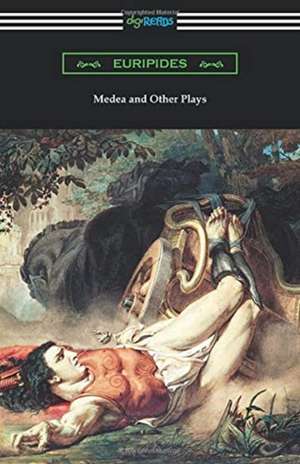
Medea and Other Plays
Autor Euripidesen Limba Engleză Paperback – 9 mar 2020
Four devastating Greek tragedies showing the powerful brought down by betrayal, jealousy, guilt and hatred
The first playwright to depict suffering without reference to the gods, Euripides made his characters speak in human terms and face the consequences of their actions. In Medea, a woman rejected by her lover takes hideous revenge by murdering the children they both love, and Hecabe depicts the former queen of Troy, driven mad by the prospect of her daughter's sacrifice to Achilles. Electra portrays a young woman planning to avenge the brutal death of her father at the hands of her mother, while in Heracles the hero seeks vengeance against the evil king who has caused bloodshed in his family.
Translated with an Introduction by PHILIP VELLACOTT
Preț: 73.98 lei
Puncte Express: 111
Carte tipărită la comandă
Livrare economică 28 noiembrie-12 decembrie
Livrare prin curier în România Termenul estimat este afișat lângă disponibilitate.
Transport gratuit de la 400.00 lei Plată online sau ramburs, în funcție de opțiunile comenzii.
Retur gratuit în 14 zile Comandă securizată și suport în română.
Specificații
ISBN-13: 9781420967470
ISBN-10: 1420967479
Pagini: 180
Dimensiuni: 140 x 216 x 11 mm
Greutate: 0.24 kg
Editura: Digireads.com
ISBN-10: 1420967479
Pagini: 180
Dimensiuni: 140 x 216 x 11 mm
Greutate: 0.24 kg
Editura: Digireads.com
V-ar putea interesa
-
 Six Wives of Henry VIIIAlison Weir-27%Preț: 79.82 lei109.82 lei
 -
 Frederick the GreatNancy Mitford-37%Preț: 58.46 lei92.74 lei
 -
 The Sun KingNancy Mitford-32%Preț: 62.34 lei91.10 lei
 -
 The Theban PlaysSophocles-20%Preț: 57.10 lei71.10 lei
 -
 Electra and Other PlaysEuripides-20%Preț: 73.29 lei91.31 lei
 -
 Zero Degrees of EmpathySimon Baron-Cohen-32%Preț: 63.10 lei92.24 lei
 -
 Preț: 103.85 lei
 -
 The OdysseyHomer-18%Preț: 53.70 lei65.33 lei
 -
 Candide and Other StoriesVoltairePreț: 47.27 lei
 -
 The OdysseyHomer-17%Preț: 60.12 lei72.86 lei
 -
 The IliadHomer-15%Preț: 51.13 lei60.08 lei
 -
 The Love PoemsOvid-19%Preț: 69.94 lei86.16 lei
 -
 Selected PoetryJohn Keats-19%Preț: 52.70 lei64.76 lei
 -
 The IliadHomer-16%Preț: 62.08 lei74.03 lei
 -
 Preț: 124.60 lei
 -
 Preț: 176.89 lei
 -
 -39%Preț: 17.23 lei28.34 lei
 -
 ZamiAudre Lorde-25%Preț: 59.30 lei79.32 lei
 -
 The Black UnicornAudre Lorde-28%Preț: 51.27 lei70.85 lei
 -
 The Cancer JournalsAudre Lorde-36%Preț: 45.08 lei70.40 lei
 -
 When I Dare to Be PowerfulAudre Lorde-20%Preț: 45.02 lei56.59 lei
 -
 Preț: 233.58 lei
 -
 Preț: 232.52 lei
 -
 Preț: 233.22 lei
 -
 Cognitive Psychology For DummiesMichael PakePreț: 154.97 lei
 -
 MedeaEuripides-11%Preț: 78.95 lei89.16 lei
 -
 EuripidesEuripidesPreț: 42.79 lei
 -
 Heracles and Other PlaysEuripidesPreț: 54.20 lei
 -
 The Bacchae and Other PlaysEuripidesPreț: 45.91 lei
 -
 Helen of TroyBettany Hughes-23%Preț: 147.53 lei191.52 lei
Notă biografică
Euripides, the youngest of the three great Athenian playwrights, was born around 485 BC of a family of good standing. He first competed in the dramatic festivals in 455 BC, coming only third; his record of success in the tragic competitions is lower than that of either Aeschylus or Sophocles. There is a tradition that he was unpopular, even a recluse; we are told that he composed poetry in a cave by the sea, near Salamis. What is clear from contemporary evidence, however, is that audiences were fascinated by his innovative and often disturbing dramas. His work was controversial already in his lifetime, and he himself was regarded as a ‘clever’ poet, associated with philosophers and other intellectuals. Towards the end of his life he went to live at the court of Archelaus, king of Macedon. It was during his time there that he wrote what many consider his greates work, the Bacchae. When news of his death reached Athens in early 406 BC, Sophocles appeared publicly in mourning for him. Euripides is thought to have written about ninety-two plays, of which seventeen tragedies and one satyr-play known to be his survive; the other play which is attributed to him, the Rhesus, may in fact be by a later hand.
John Davie is head of classics at St. Paul's School in London.
Richard Rutherford is tutor in Greek and Latin literature at Christ Church, Oxford.
Richard Rutherford is tutor in Greek and Latin literature at Christ Church, Oxford.
John Davie is head of classics at St. Paul's School in London.
Richard Rutherford is tutor in Greek and Latin literature at Christ Church, Oxford.
Richard Rutherford is tutor in Greek and Latin literature at Christ Church, Oxford.
Cuprins
Medea and Other PlaysGeneral Introduction
Note on the Text
Chronological Table
Translator's Note
Preface to Alcestis
Alcestis
Preface to Medea
Medea
Preface to The Children of Heraclea
The Children of Heracles
Preface to Hippolytus
Hippolytus
Notes
Bibliography
Glossary of Mythological and Geographical Names
Note on the Text
Chronological Table
Translator's Note
Preface to Alcestis
Alcestis
Preface to Medea
Medea
Preface to The Children of Heraclea
The Children of Heracles
Preface to Hippolytus
Hippolytus
Notes
Bibliography
Glossary of Mythological and Geographical Names
Descriere
Descriere de la o altă ediție sau format:
`the most tragic of the poets' Aristotle Euripides was one of the most popular and controversial of all Greek tragedians, and his plays are marked by an independence of thought, ingenious dramatic devices, and a subtle variety of register and mood. He is also remarkable for the prominence he gave to female characters, whether heroines of virtue or vice. In the ethically shocking Medea, the first known child-killing mother in Greek myth to perform the deed in cold blood manipulates her world in order to wreak vengeance on her treacherous husband. Hippolytus sees Phaedra's confession of her passion for her stepson herald disaster, while Electra's heroine helps her brother murder their mother in an act that mingles justice and sin. Lastly, lighter in tone, the satyr drama, Helen, is an exploration of the impossibility of certitude as brilliantly paradoxical as the three famous tragedies. This new translation does full justice to Euripides's range of tone and gift for narrative. A lucid introduction provides substantial analysis of each play, complete with vital explanations of the traditions and background to Euripides's world. ABOUT THE SERIES: For over 100 years Oxford World's Classics has made available the widest range of literature from around the globe. Each affordable volume reflects Oxford's commitment to scholarship, providing the most accurate text plus a wealth of other valuable features, including expert introductions by leading authorities, helpful notes to clarify the text, up-to-date bibliographies for further study, and much more.
`the most tragic of the poets' Aristotle Euripides was one of the most popular and controversial of all Greek tragedians, and his plays are marked by an independence of thought, ingenious dramatic devices, and a subtle variety of register and mood. He is also remarkable for the prominence he gave to female characters, whether heroines of virtue or vice. In the ethically shocking Medea, the first known child-killing mother in Greek myth to perform the deed in cold blood manipulates her world in order to wreak vengeance on her treacherous husband. Hippolytus sees Phaedra's confession of her passion for her stepson herald disaster, while Electra's heroine helps her brother murder their mother in an act that mingles justice and sin. Lastly, lighter in tone, the satyr drama, Helen, is an exploration of the impossibility of certitude as brilliantly paradoxical as the three famous tragedies. This new translation does full justice to Euripides's range of tone and gift for narrative. A lucid introduction provides substantial analysis of each play, complete with vital explanations of the traditions and background to Euripides's world. ABOUT THE SERIES: For over 100 years Oxford World's Classics has made available the widest range of literature from around the globe. Each affordable volume reflects Oxford's commitment to scholarship, providing the most accurate text plus a wealth of other valuable features, including expert introductions by leading authorities, helpful notes to clarify the text, up-to-date bibliographies for further study, and much more.
Recenzii
Hellenists and generalists alike have reason to rejoice ... adds to our understanding and appreciation of a poet-playwright who has never ceased to controversial ... comprises four major plays that are wonderful to have together. Edith Hall's introductory essays ... are eloquent and informative, deftly highlighting each play's chief issues ... several new insights into the texts, and sound explanations of the mythical background and ongoing action ... James Morwood's translations ... are extraordinary. In crisp prose ... these may be the easiest-to-read accurate versions that we are likely to see and, in the inexpensive World Classics edition are quite a bargain. No others ... lend themselves to such a ready reading ... The sheer clarity of the English is a considerable achievement.