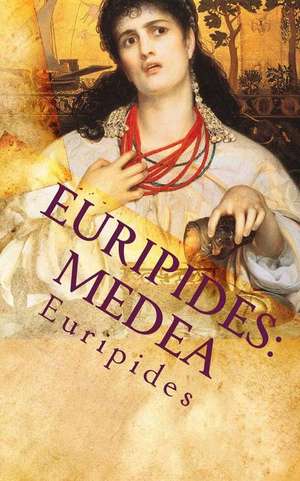
Euripides
Autor Euripides Traducere de E. P. Coleridgeen Limba Engleză Paperback
Preț: 42.79 lei
Puncte Express: 64
Carte disponibilă
Livrare economică 31 octombrie-14 noiembrie
Livrare prin curier în România Termenul estimat este afișat lângă disponibilitate.
Transport gratuit de la 400.00 lei Plată online sau ramburs, în funcție de opțiunile comenzii.
Retur gratuit în 14 zile Comandă securizată și suport în română.
Specificații
ISBN-13: 9781453626054
ISBN-10: 1453626050
Pagini: 58
Dimensiuni: 127 x 203 x 3 mm
Greutate: 0.07 kg
Editura: CreateSpace Independent Publishing Platform
ISBN-10: 1453626050
Pagini: 58
Dimensiuni: 127 x 203 x 3 mm
Greutate: 0.07 kg
Editura: CreateSpace Independent Publishing Platform
V-ar putea interesa
-
 Preț: 100.41 lei
 -
 -25%Preț: 216.71 lei289.99 lei
 -
 -20%Preț: 315.64 lei396.21 lei
 -
 Preț: 115.66 lei
 -
 Preț: 115.30 lei
 -
 Preț: 121.83 lei
 -
 Preț: 176.89 lei
 -
 OCR Anthology for Classical Greek GCSE 2027-2028Christopher BurnandPreț: 109.31 lei
 -
 MedeaEuripides-11%Preț: 78.95 lei89.16 lei
 -
 Euripides IIEuripidesPreț: 59.90 lei
 -
 Euripides IVEuripidesPreț: 52.80 lei
 -
 Euripides VEuripidesPreț: 52.41 lei
 -
 HippolytusEuripidesPreț: 36.69 lei
 -
 Iphigenia at AulisEuripidesPreț: 37.07 lei
 -
 Medea and Other PlaysEuripidesPreț: 43.30 lei
 -
 The Bacchae and Other PlaysEuripidesPreț: 45.91 lei
 -
 ElectraMarianne MacdonaldPreț: 27.78 lei
Cuprins
Preface
Introduction
Contents
FIRST PRODUCTION OF THE PLAY - THE TRILOGY- THE TROADES
THE TEXT - The Manuscript V - The Manuscript P - Harleianus 5743 (Q) - Hazmiensis 417-Neapolitanus II F 9- Papyri-Indirect Sources - NOTES TO
INTRODUCTION
TEXT
Apparatus Criticus
List Of Abbreviations
COMMENTARY
Notes On Metrical Analyses
Addenda
Bibliography
Bibliographical Postscript
Indexes
Introduction
Contents
FIRST PRODUCTION OF THE PLAY - THE TRILOGY- THE TROADES
THE TEXT - The Manuscript V - The Manuscript P - Harleianus 5743 (Q) - Hazmiensis 417-Neapolitanus II F 9- Papyri-Indirect Sources - NOTES TO
INTRODUCTION
TEXT
Apparatus Criticus
List Of Abbreviations
COMMENTARY
Notes On Metrical Analyses
Addenda
Bibliography
Bibliographical Postscript
Indexes
Descriere
Descriere de la o altă ediție sau format:
With its savage indictment of the horrors of war as they affect women and children on the losing side, Euripides Troades has been one of the most regularly read, performed and adapted of Greek tragedies. It was first produced in 415 BC just after the Athenians slaughter of the male population of Melos and at the point where they were sending out the ambitious Sicilian expedition. It therefore has major contemporary political significance. Like Aeschylus Eumenides, it was performed as the third play in a thematically linked trilogy and, though the other two plays survive only in fragments, important inferences can be drawn about our interpretation of the surviving play and Euripides use of the trilogy form.
Lee's edition, first published in the famous "red Macmillan" series in 1976, is the most recent scholarly edition in English. The detailed commentary discusses text, language, interpretation and metre; there is a full introduction and for this paperback edition there is an additional up-to-date bibliography.
With its savage indictment of the horrors of war as they affect women and children on the losing side, Euripides Troades has been one of the most regularly read, performed and adapted of Greek tragedies. It was first produced in 415 BC just after the Athenians slaughter of the male population of Melos and at the point where they were sending out the ambitious Sicilian expedition. It therefore has major contemporary political significance. Like Aeschylus Eumenides, it was performed as the third play in a thematically linked trilogy and, though the other two plays survive only in fragments, important inferences can be drawn about our interpretation of the surviving play and Euripides use of the trilogy form.
Lee's edition, first published in the famous "red Macmillan" series in 1976, is the most recent scholarly edition in English. The detailed commentary discusses text, language, interpretation and metre; there is a full introduction and for this paperback edition there is an additional up-to-date bibliography.
Recenzii
'… predictably fine, thoughtful and polished … a nicely self-contained teaching-tool … Throughout, Mastronarde displays virtues known from his previous activity as a commentator: clarity of exposition; fairness in the treatment of controversial issues; philological acumen; command of the primary and secondary literature … a keen eye for the theatrical dimension of drama; and an openness to engage with broader, and often complex, non-philological aspects of interpretation.' Mouseion, Journal of the Classical Association of Canada
'We may confidently say now that future students will face a less difficult task thanks to the work of D. J. Mastronarde, whose knowledge of Greek theatre and uncommon talent as a teacher have combined to produce a most valuable book. It is easy to foresee that students will be grateful to M. for his admirably concise and useful treatment of language, style and metre … Mastronarde's book is an outstanding contribution to the understanding of Medea and a valuable introduction to Greek tragedy as a whole. It deserves to take pride of place on the shelves of Euripidean scholars beside the time-honoured commentary of Page.' Journal of Hellenic Studies
'… this series has consistently proven itself to provide high quality commentaries for teaching Greek texts in the original. Mastronarde's fine work does not disappoint. … this is a volume which will prove very useful to students of Greek tragedy in the original and will also be a valuable resource for professional colleagues.' Hermathena
'We may confidently say now that future students will face a less difficult task thanks to the work of D. J. Mastronarde, whose knowledge of Greek theatre and uncommon talent as a teacher have combined to produce a most valuable book. It is easy to foresee that students will be grateful to M. for his admirably concise and useful treatment of language, style and metre … Mastronarde's book is an outstanding contribution to the understanding of Medea and a valuable introduction to Greek tragedy as a whole. It deserves to take pride of place on the shelves of Euripidean scholars beside the time-honoured commentary of Page.' Journal of Hellenic Studies
'… this series has consistently proven itself to provide high quality commentaries for teaching Greek texts in the original. Mastronarde's fine work does not disappoint. … this is a volume which will prove very useful to students of Greek tragedy in the original and will also be a valuable resource for professional colleagues.' Hermathena
Notă biografică
Euripides was born near Athens between 485 and 480 BC. His first play was presented in 455 BC and he wrote some hundred altogether of which nineteen survive - a greater number than those of Aeschylus and Sophocles combined - and which include Alkestis, Medea, Bacchae, Hippolytos, Ion and Iphigenia at Aulis. He died in 406 BC.