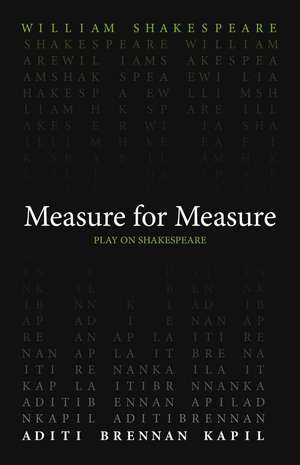
Measure for Measure: Play on Shakespeare
Autor William Shakespeare Traducere de Aditi Brennan Kapilen Limba Engleză Paperback – 7 mar 2024
One of Shakespeare’s most difficult plays, Measure for Measure has long challenged performers and audiences alike. In reworking the play in her translation, Aditi Brennan Kapil honors the structure, rhythms, and themes of Shakespeare’s original. Kapil’s updated language makes this cautionary fable about frailty, power, and the perils of legislating morality accessible for today’s audiences.
This translation of Measure for Measure was written as part of the Oregon Shakespeare Festival’s Play On! project, which commissioned new translations of thirty-nine Shakespeare plays. These translations present the work of “The Bard” in language accessible to modern audiences while never losing the beauty of Shakespeare’s verse. Enlisting the talents of a diverse group of contemporary playwrights, screenwriters, and dramaturges from diverse backgrounds, this project reenvisions Shakespeare for the twenty-first century. These volumes make these works available for the first time in print—a new First Folio for a new era.
Din seria Play on Shakespeare
-
 Preț: 52.86 lei
 -
 Preț: 67.60 lei
 -
 Preț: 67.23 lei
 -
 Preț: 41.39 lei
 -
 Preț: 67.60 lei
 -
 Preț: 67.23 lei
 -
 Preț: 51.29 lei
 -
 Preț: 67.17 lei
 -
 Preț: 67.60 lei
 -
 Preț: 67.60 lei
 -
 Preț: 67.60 lei
 -
 Preț: 67.60 lei
 -
 Preț: 52.86 lei
 -
 Preț: 66.88 lei
 -
 Preț: 67.60 lei
 -
 Preț: 55.26 lei
 -
 Preț: 52.86 lei
 -
 Preț: 50.27 lei
 -
 Preț: 67.94 lei
 -
 Preț: 52.86 lei
 -
 Preț: 52.86 lei
 -
 Preț: 52.86 lei
 -
 Preț: 67.60 lei
 -
 Preț: 51.50 lei
 - 21%
 Preț: 53.71 lei
 - 22%
 Preț: 52.45 lei
 - 21%
 Preț: 53.71 lei
 - 25%
 Preț: 50.23 lei
 - 21%
 Preț: 53.71 lei
 - 21%
 Preț: 53.71 lei
 -
 Preț: 68.28 lei
 - 22%
 Preț: 52.45 lei
 - 22%
 Preț: 52.45 lei
 - 25%
 Preț: 50.23 lei
 - nou
 Preț: 53.71 lei
Preț: 52.86 lei
Puncte Express: 79
Preț estimativ în valută:
9.36€ • 10.87$ • 8.11£
9.36€ • 10.87$ • 8.11£
Carte disponibilă
Livrare economică 10-24 februarie
Livrare express 27-31 ianuarie pentru 32.39 lei
Preluare comenzi: 021 569.72.76
Specificații
ISBN-13: 9780866988315
ISBN-10: 0866988319
Pagini: 130
Dimensiuni: 127 x 197 x 10 mm
Greutate: 0.17 kg
Editura: ACMRS Press
Colecția ACMRS Press
Seria Play on Shakespeare
ISBN-10: 0866988319
Pagini: 130
Dimensiuni: 127 x 197 x 10 mm
Greutate: 0.17 kg
Editura: ACMRS Press
Colecția ACMRS Press
Seria Play on Shakespeare
V-ar putea interesa
-
 HamletWilliam ShakespearePreț: 27.66 lei
 -
 Twelfth NightWilliam ShakespearePreț: 21.38 lei
 -
 SonnetsWilliam ShakespearePreț: 27.81 lei
 -
 The TempestWilliam ShakespearePreț: 24.60 lei
 -
 Measure for MeasureProf. Eric Rasmussen-13%Preț: 62.54 lei71.88 lei
 -
 The Merry Wives Of WindsorWilliam ShakespearePreț: 27.89 lei
 -
 OthelloWilliam ShakespearePreț: 24.03 lei
 -
 The PoemsWilliam ShakespearePreț: 56.40 lei
 -
 Essential Shakespeare: The Arden Guide to Text and InterpretationDr. Pamela Bickley-6%Preț: 154.63 lei164.86 lei
 -
 The Merchant of VeniceWilliam ShakespearePreț: 37.28 lei
 -
 All's Well That Ends WellWilliam ShakespearePreț: 38.47 lei
 -
 King JohnWilliam ShakespearePreț: 37.70 lei
 -
 Pericles: Discover Primary & Early YearsWilliam Shakespeare-18%Preț: 34.54 lei42.00 lei
 -
 Julius CaesarWilliam ShakespearePreț: 24.60 lei
 -
 As You Like ItCedric WattsPreț: 27.03 lei
 -
 The Taming of the ShrewWilliam ShakespearePreț: 27.47 lei
 -
 Winter's TaleWilliam ShakespearePreț: 27.41 lei
 -
 Much ADO about NothingWilliam ShakespearePreț: 24.60 lei
 -
 Romeo and JulietWilliam ShakespearePreț: 29.78 lei
Notă biografică
Aditi Brennan Kapil is a television and theater actress, writer, and director. She works on television and theater projects including American Gods on Starz and a new play titled 1933, commissioned by La Jolla Playhouse. Her plays include Orange and Imogen Says Nothing.
Cuprins
Act 1
Act 2
Act 3
Act 4
Act 5
Act 2
Act 3
Act 4
Act 5
Textul de pe ultima copertă
When Claudio breaks the new laws against vice in Vienna by getting his fiancee, Julietta, pregnant, a series of ethical issues is brought under scrutiny. His sister's virtue is held to ransom by the deputy ruler of the city until justice is done, mercy shown, and order restored.
Descriere
Descriere de la o altă ediție sau format:
George Lyman Kittredge’s insightful editions of Shakespeare have endured in part because of his eclecticism, his diversity of interests, and his wide-ranging accomplishments, all of which are reflected in the valuable notes in each volume.
These new editions have specific emphasis on the performance histories of the plays (on stage and screen).
Features of each edition include:
These new editions have specific emphasis on the performance histories of the plays (on stage and screen).
Features of each edition include:
- The original introduction to the Kittredge Edition
- Editor’s Introduction to the Focus Edition. An overview on major themes of the plays, and sections on the play’s performance history on stage and screen.
- Explanatory Notes. The explanatory notes either expand on Kittredge’s superb glosses, or, in the case of plays for which he did not write notes, give the needed explanations for Shakespeare’s sometimes demanding language.
- Performance notes. These appear separately and immediately below the textual footnotes and include discussions of noteworthy stagings of the plays, issues of interpretation, and film and stage choices.
- How to read the play as Performance Section. A discussion of the written play vs. the play as performed and the various ways in which Shakespeare’s words allow the reader to envision the work "off the page."
- Comprehensive Timeline. Covering major historical events (with brief annotations) as well as relevant details from Shakespeare’s life. Some of the Chronologies include time chronologies within the plays.
- Topics for Discussion and Further Study Section. Critical Issues: Dealing with the text in a larger context and considerations of character, genre, language, and interpretative problems. Performance Issues: Problems and intricacies of staging the play connected to chief issues discussed in the Focus Editions’ Introduction.
- Select Bibliography & Filmography
- Each New Kittredge edition also includes film stills from major productions, for comparison and scene study.
Recenzii
“This most problematic of Shakespeare's plays, a comedy filled with dark corners, has been beautifully presented by Laury Magnus and the late Bernice Kliman. Scholars will admire their editorial skill while students will benefit greatly from their ample notes, useful timeline of the play's plot, and cogent performance history. As the editors explain, the fiercely interlocked themes of the play—sex, money, justice, and religion—make this play a measure not only of Shakespeare's time but of our own.”
—Anthony DiMatteo, New York Institute of Technology
—Anthony DiMatteo, New York Institute of Technology
Even as the New Kittredge Shakespeare series glances back to George Lyman Kittredge's student editions of the plays, it is very much of our current moment: the slim editions are targeted largely at high school and first-year college students who are more versed in visual than in print culture. Not only are the texts of the plays accompanied by photographs or stills from various stage and cinema performances: the editorial contributions are performance-oriented, offering surveys of contemporary film interpretations, essays on the plays as performance pieces, and an annotated filmography. Traditional editorial issues (competing versions of the text, cruxes, editorial emendation history) are for the most part excluded; the editions focus instead on clarifying the text with an eye to performing it. There is no disputing the pedagogic usefulness of the New Kittredge Shakespeare's performance-oriented approach. At times, however, it can run the risk of treating textual issues as impediments, rather than partners, to issues of performance. This is particularly the case with a textually vexed play such as Pericles: Prince of Tyre. In the introduction to the latter, Jeffrey Kahan notes the frequent unintelligibility of the play as originally published: "the chances of a reconstructed text matching what Shakespeare actually wrote are about 'nil'" (p. xiii) But his solution — to use a "traditional text" rather than one corrected as are the Oxford and Norton Pericles — obscures how this "traditional text," including its act and scene division, is itself a palimpsest produced through three centuries of editorial intervention. Nevertheless, the series does a service to its target audience with its emphasis on performance and dramaturgy. Kahan's own essay about his experiences as dramaturge for a college production of Pericles is very good indeed, particularly on the play's inability to purge the trace of incestuous desire that Pericles first encounters in Antioch. Other plays' cinematic histories: Annalisa Castaldo's edition of Henry V contrasts Laurence Oliver's and Branagh's film productions; Samuel Crowl's and James Wells's edition of (respectively) I and 2 Henry IV concentrate on Welle's Chimes at Midnight and Gus Van Sant's My Own Private Idaho; Patricia Lennox's edition of As You Like It offers an overview of four Hollywood and British film adaptations; and John R. Ford's edition of A Midsummer Night's Dream provides a spirited survey of the play's rich film history.
The differences between, and comparative merits of, various editorial series are suggested by the three editions of The Taming of the Shrew published this year. Laury Magnus's New Kittredge Shakespeare edition is, like the other New Kittredge volumes, a workable text for high school and first year college students interested in film and theater. The introduction elaborates on one theme — Elizabethan constructions of gender — and offers a very broad performance history, focusing on Sam Taylor's and Zeffirelli's film versions as well as adaptations such as Kiss Me Kate and Ten Things I Hate About You (accompanied by a still of ten hearthtrobs Heath Ledger and Julia Stiles). The volume is determined to eradicate any confusion that a first time reader of the play might experience: the dramatis personae page explains that "Bianca Minola" is "younger daughter to Baptista, wooed by Lucentio-in-disguise (as Cambio) and then wife to him, also wooed by the elderly Gremio and Hortensio-in-disguise (as Licio)" (p.1). Other editorial notes, based on Kittredge's own, are confined mostly to explaining individual words and phrases: additional footnotes discuss interpretive choices made by film and stage productions. Throughout, the editorial emphasis is on the play less as text than as performance piece, culminating in fifteen largely performance-oriented "study questions" on topics such as disguise, misogyny, and violence.
Studies in English Literature, Tudor and Stuart Drama, Volume 51, Spring 2011, Number 2, pages 497-499.
The differences between, and comparative merits of, various editorial series are suggested by the three editions of The Taming of the Shrew published this year. Laury Magnus's New Kittredge Shakespeare edition is, like the other New Kittredge volumes, a workable text for high school and first year college students interested in film and theater. The introduction elaborates on one theme — Elizabethan constructions of gender — and offers a very broad performance history, focusing on Sam Taylor's and Zeffirelli's film versions as well as adaptations such as Kiss Me Kate and Ten Things I Hate About You (accompanied by a still of ten hearthtrobs Heath Ledger and Julia Stiles). The volume is determined to eradicate any confusion that a first time reader of the play might experience: the dramatis personae page explains that "Bianca Minola" is "younger daughter to Baptista, wooed by Lucentio-in-disguise (as Cambio) and then wife to him, also wooed by the elderly Gremio and Hortensio-in-disguise (as Licio)" (p.1). Other editorial notes, based on Kittredge's own, are confined mostly to explaining individual words and phrases: additional footnotes discuss interpretive choices made by film and stage productions. Throughout, the editorial emphasis is on the play less as text than as performance piece, culminating in fifteen largely performance-oriented "study questions" on topics such as disguise, misogyny, and violence.
Studies in English Literature, Tudor and Stuart Drama, Volume 51, Spring 2011, Number 2, pages 497-499.
“This most problematic of Shakespeare's plays, a comedy filled with dark corners, has been beautifully presented by Laury Magnus and the late Bernice Kliman. Scholars will admire their editorial skill while students will benefit greatly from their ample notes, useful timeline of the play's plot, and cogent performance history. As the editors explain, the fiercely interlocked themes of the play—sex, money, justice, and religion—make this play a measure not only of Shakespeare's time but of our own.”
—Anthony DiMatteo, New York Institute of Technology
George Lyman Kittredge’s insightful editions of Shakespeare have endured in part because of this eclecticism, his diversity of interests, and his wide-ranging accomplishments—all of which are reflected in the valuable notes in each volume. The plays in the New Kittredge Shakespeare series retain the original Kittredge notes and introductions, changed or augmented only when some modernization seems necessary. These new editions also include introductory essays by contemporary editors, notes on the plays as they have been performed on stage and film, and additional student materials.
These plays are being made available by Focus Publishing with the permission of the Kittredge heirs.
Laury Magnus is Professor of Humanities at the United States Merchant Marine Academy in Kings Point, New York. She is editor of New Kittredge editions of The Comedy of Errors and The Taming of the Shrew, and co-editor of Romeo and Juliet.
Bernice W. Kliman (1933–2011) edited New Kittredge editions of Hamlet, Romeo and Juliet, and Measure for Measure and of The Enfolded Hamlets, and co-editor of The Three-Text Hamlet. In addition to books and articles on performance history, she published numerous notes and essays about the early history of editing. She was the coordinating editor of hamletworks.org.
—Anthony DiMatteo, New York Institute of Technology
George Lyman Kittredge’s insightful editions of Shakespeare have endured in part because of this eclecticism, his diversity of interests, and his wide-ranging accomplishments—all of which are reflected in the valuable notes in each volume. The plays in the New Kittredge Shakespeare series retain the original Kittredge notes and introductions, changed or augmented only when some modernization seems necessary. These new editions also include introductory essays by contemporary editors, notes on the plays as they have been performed on stage and film, and additional student materials.
These plays are being made available by Focus Publishing with the permission of the Kittredge heirs.
Laury Magnus is Professor of Humanities at the United States Merchant Marine Academy in Kings Point, New York. She is editor of New Kittredge editions of The Comedy of Errors and The Taming of the Shrew, and co-editor of Romeo and Juliet.
Bernice W. Kliman (1933–2011) edited New Kittredge editions of Hamlet, Romeo and Juliet, and Measure for Measure and of The Enfolded Hamlets, and co-editor of The Three-Text Hamlet. In addition to books and articles on performance history, she published numerous notes and essays about the early history of editing. She was the coordinating editor of hamletworks.org.
Extras
Act 1 Scene 1 running scene 1
Enter Duke, Escalus, Lords [and Attendants]
DUKE Escalus.
ESCALUS My lord.
DUKE Of government the properties to unfold
Would seem in me t'affect speech and discourse,
Since I am put to know that your own science
Exceeds, in that, the lists of all advice
My strength can give you. Then no more remains
But that to your sufficiency as your worth is able,
And let them work. The nature of our people,
Our city's institutions, and the terms
For common justice, you're as pregnant in
As art and practice hath enrichèd any
That we remember. There is our commission, Hands him a paper
From which we would not have you warp. Call hither,
I say, bid come before us Angelo. [Exit an Attendant]
What figure of us think you he will bear?
For you must know, we have with special soul
Elected him our absence to supply;
Lent him our terror, dressed him with our love,
And given his deputation all the organs
Of our own power. What think you of it?
ESCALUS If any in Vienna be of worth
To undergo such ample grace and honour,
It is Lord Angelo.
DUKE Look where he comes.
Enter Angelo
ANGELO Always obedient to your grace's will,
I come to know your pleasure.
DUKE Angelo,
There is a kind of character in thy life
That to th'observer doth thy history
Fully unfold. Thyself and thy belongings
Are not thine own so proper as to waste
Thyself upon thy virtues, they on thee.
Heaven doth with us as we with torches do,
Not light them for themselves: for if our virtues
Did not go forth of us, 'twere all alike
As if we had them not. Spirits are not finely touched
But to fine issues, nor nature never lends
The smallest scruple of her excellence
But, like a thrifty goddess, she determines
Herself the glory of a creditor,
Both thanks and use. But I do bend my speech
To one that can my part in him advertise.
Hold therefore, Angelo.
In our remove be thou at full ourself:
Mortality and mercy in Vienna
Live in thy tongue and heart. Old Escalus,
Though first in question, is thy secondary.
Take thy commission. Offers a paper
ANGELO Now, good my lord,
Let there be some more test made of my mettle,
Before so noble and so great a figure
Be stamped upon it.
DUKE No more evasion.
We have with a leavened and preparèd choice
Proceeded to you: therefore take your honours. Angelo takes
Our haste from hence is of so quick condition paper
That it prefers itself and leaves unquestioned
Matters of needful value. We shall write to you,
As time and our concernings shall importune,
How it goes with us, and do look to know
What doth befall you here. So, fare you well:
To th'hopeful execution do I leave you
Of your commissions.
ANGELO Yet give leave, my lord,
That we may bring you something on the way.
DUKE My haste may not admit it,
Nor need you, on mine honour, have to do
With any scruple. Your scope is as mine own,
So to enforce or qualify the laws
As to your soul seems good. Give me your hand,
I'll privily away. I love the people,
But do not like to stage me to their eyes:
Though it do well, I do not relish well
Their loud applause and aves vehement,
Nor do I think the man of safe discretion
That does affect it. Once more, fare you well.
ANGELO The heavens give safety to your purposes!
ESCALUS Lead forth and bring you back in happiness!
DUKE I thank you. Fare you well. Exit
ESCALUS I shall desire you, sir, to give me leave
To have free speech with you; and it concerns me
To look into the bottom of my place.
A power I have, but of what strength and nature
I am not yet instructed.
ANGELO 'Tis so with me. Let us withdraw together,
And we may soon our satisfaction have
Touching that point.
ESCALUS I'll wait upon your honour. Exeunt
Act 1 Scene 2 running scene 2
Enter Lucio and two other Gentlemen
LUCIO If the duke with the other dukes come not to composition with the King of Hungary, why then all the dukes fall upon the king.
FIRST GENTLEMAN Heaven grant us its peace, but not the King of Hungary's!
SECOND GENTLEMAN Amen.
LUCIO Thou concludest like the sanctimonious pirate, that went to sea with the Ten Commandments, but scraped one out of the table.
SECOND GENTLEMAN 'Thou shalt not steal'?
LUCIO Ay, that he razed.
FIRST GENTLEMAN Why, 'twas a commandment to command the captain and all the rest from their functions: they put forth to steal. There's not a soldier of us all that, in the thanksgiving before meat, do relish the petition well that prays for peace.
SECOND GENTLEMAN I never heard any soldier dislike it.
LUCIO I believe thee; for I think thou never wast where grace was said.
SECOND GENTLEMAN No? A dozen times at least.
FIRST GENTLEMAN What, in metre?
LUCIO In any proportion or in any language.
FIRST GENTLEMAN I think, or in any religion.
LUCIO Ay, why not? Grace is grace, despite of all controversy: as for example, thou thyself art a wicked villain, despite of all grace.
FIRST GENTLEMAN Well, there went but a pair of shears between us.
LUCIO I grant, as there may between the lists and the velvet. Thou art the list.
FIRST GENTLEMAN And thou the velvet. Thou art good velvet; thou'rt a three-piled piece, I warrant thee. I had as lief be a list of an English kersey as be piled, as thou art piled, for a French velvet. Do I speak feelingly now?
LUCIO I think thou dost, and indeed, with most painful feeling of thy speech. I will, out of thine own confession, learn to begin thy health, but, whilst I live, forget to drink after thee.
FIRST GENTLEMAN I think I have done myself wrong, have I not?
SECOND GENTLEMAN Yes, that thou hast, whether thou art tainted or free.
Enter Bawd [Mistress Overdone]
LUCIO Behold, behold, where Madam Mitigation comes! I have purchased as many diseases under her roof as come to-
SECOND GENTLEMAN To what, I pray?
LUCIO Judge.
SECOND GENTLEMAN To three thousand dolours a year.
FIRST GENTLEMAN Ay, and more.
LUCIO A French crown more.
FIRST GENTLEMAN Thou art always figuring diseases in me, but thou art full of error, I am sound.
LUCIO Nay, not as one would say, healthy: but so sound as things that are hollow; thy bones are hollow, impiety has made a feast of thee.
FIRST GENTLEMAN How now! Which of your To Mistress Overdone
hips has the most profound sciatica?
MISTRESS OVERDONE Well, well. There's one yonder arrested and carried to prison was worth five thousand of you all.
SECOND GENTLEMAN Who's that, I pray thee?
MISTRESS OVERDONE Marry, sir, that's Claudio, Signior Claudio.
FIRST GENTLEMAN Claudio to prison? 'Tis not so.
MISTRESS OVERDONE Nay, but I know 'tis so. I saw him arrested, saw him carried away, and, which is more, within these three days his head to be chopped off.
LUCIO But, after all this fooling, I would not have it so. Art thou sure of this?
MISTRESS OVERDONE I am too sure of it. And it is for getting Madam Julietta with child.
LUCIO Believe me, this may be: he promised to meet me two hours since, and he was ever precise in promise-keeping.
SECOND GENTLEMAN Besides, you know, it draws something near to the speech we had to such a purpose.
FIRST GENTLEMAN But most of all agreeing with the proclamation.
LUCIO Away! Let's go learn the truth of it.
Exeunt [Lucio and Gentlemen]
MISTRESS OVERDONE Thus, what with the war, what with the sweat, what with the gallows and what with poverty, I am custom-shrunk.
Enter Clown [Pompey]
How now? What's the news with you?
POMPEY Yonder man is carried to prison.
MISTRESS OVERDONE Well, what has he done?
POMPEY A woman.
MISTRESS OVERDONE But what's his offence?
POMPEY Groping for trouts in a peculiar river.
MISTRESS OVERDONE What, is there a maid with child by him?
POMPEY No, but there's a woman with maid by him. You have not heard of the proclamation, have you?
MISTRESS OVERDONE What proclamation, man?
POMPEY All houses in the suburbs of Vienna must be plucked down.
MISTRESS OVERDONE And what shall become of those in the city?
POMPEY They shall stand for seed: they had gone down too, but that a wise burgher put in for them.
MISTRESS OVERDONE But shall all our houses of resort in the suburbs be pulled down?
POMPEY To the ground, mistress.
MISTRESS OVERDONE Why, here's a change indeed in the commonwealth! What shall become of me?
POMPEY Come, fear you not: good counsellors lack no clients. Though you change your place, you need not change your trade: I'll be your tapster still. Courage! There will be pity taken on you; you that have worn your eyes almost out in the service, you will be considered.
MISTRESS OVERDONE What's to do here, Thomas tapster? Let's withdraw.
POMPEY Here comes Signior Claudio, led by the provost to prison, and there's Madam Juliet. Exeunt
Act 1 Scene 3 running scene 2 continues
Enter Provost, Claudio, Juliet, Officers; Lucio and the two Gentlemen [follow]
CLAUDIO Fellow, why dost thou show me thus to th'world?
Bear me to prison, where I am committed.
PROVOST I do it not in evil disposition,
But from Lord Angelo by special charge.
CLAUDIO Thus can the demigod Authority
Make us pay down for our offence by weight
The words of heaven; on whom it will, it will,
On whom it will not, so. Yet still 'tis just.
LUCIO Why, how now, Claudio? Whence comes this restraint?
CLAUDIO From too much liberty, my Lucio, liberty:
As surfeit is the father of much fast,
So every scope by the immoderate use
Turns to restraint. Our natures do pursue,
Like rats that ravin down their proper bane,
A thirsty evil, and when we drink we die.
LUCIO If I could speak so wisely under an arrest, I would send for certain of my creditors: and yet, to say the truth, I had as lief have the foppery of freedom as the morality of imprisonment. What's thy offence, Claudio?
CLAUDIO What but to speak of would offend again.
LUCIO What, is't murder?
CLAUDIO No.
LUCIO Lechery?
CLAUDIO Call it so.
PROVOST Away, sir. You must go.
CLAUDIO One word, good friend. Lucio, a word with you.
LUCIO A hundred, if they'll do you any good.
Is lechery so looked after?
CLAUDIO Thus stands it with me: upon a true contract
I got possession of Julietta's bed.
You know the lady, she is fast my wife,
Save that we do the denunciation lack
Of outward order. This we came not to
Only for propagation of a dower
Remaining in the coffer of her friends,
From whom we thought it meet to hide our love
Till time had made them for us. But it chances
The stealth of our most mutual entertainment
With character too gross is writ on Juliet.
LUCIO With child, perhaps?
CLAUDIO Unhappily, even so.
And the new deputy now for the duke -
Whether it be the fault and glimpse of newness,
Or whether that the body public be
A horse whereon the governor doth ride,
Who, newly in the seat, that it may know
He can command, lets it straight feel the spur:
Whether the tyranny be in his place,
Or in his eminence that fills it up,
I stagger in - but this new governor
Awakes me all the enrollèd penalties
Which have, like unscoured armour, hung by th'wall
So long that nineteen zodiacs have gone round
And none of them been worn; and, for a name,
Now puts the drowsy and neglected act
Freshly on me. 'Tis surely for a name.
LUCIO I warrant it is: and thy head stands so tickle on thy shoulders that a milkmaid, if she be in love, may sigh it off. Send after the duke and appeal to him.
CLAUDIO I have done so, but he's not to be found.
I prithee, Lucio, do me this kind service:
This day my sister should the cloister enter
And there receive her approbation.
Acquaint her with the danger of my state,
Implore her, in my voice, that she make friends
To the strict deputy: bid herself assay him.
I have great hope in that, for in her youth
There is a prone and speechless dialect,
Such as move men. Beside, she hath prosperous art
When she will play with reason and discourse,
And well she can persuade.
LUCIO I pray she may; as well for the encouragement of the like, which else would stand under grievous imposition, as for the enjoying of thy life, who I would be sorry should be thus foolishly lost at a game of tick-tack. I'll to her.
CLAUDIO I thank you, good friend Lucio.
LUCIO Within two hours.
CLAUDIO Come, officer, away! Exeunt
Act 1 Scene 4 running scene 3
Enter Duke and Friar Thomas
DUKE No, holy father, throw away that thought:
Believe not that the dribbling dart of love
Can pierce a complete bosom. Why I desire thee
To give me secret harbour hath a purpose
More grave and wrinkled than the aims and ends
Of burning youth.
FRIAR THOMAS May your grace speak of it?
DUKE My holy sir, none better knows than you
How I have ever loved the life removed,
And held in idle price to haunt assemblies
Where youth and cost and witless bravery keeps.
I have delivered to Lord Angelo -
A man of stricture and firm abstinence -
My absolute power and place here in Vienna,
And he supposes me travelled to Poland,
For so I have strewed it in the common ear,
And so it is received. Now, pious sir,
You will demand of me why I do this.
FRIAR THOMAS Gladly, my lord.
DUKE We have strict statutes and most biting laws,
The needful bits and curbs to headstrong weeds,
Which for this fourteen years we have let slip,
Even like an o'ergrown lion in a cave
That goes not out to prey. Now, as fond fathers,
Having bound up the threat'ning twigs of birch,
Only to stick it in their children's sight
For terror, not to use, in time the rod
Becomes more mocked than feared: so our decrees,
Dead to infliction, to themselves are dead,
And liberty plucks justice by the nose,
The baby beats the nurse, and quite athwart
Goes all decorum.
FRIAR THOMAS It rested in your grace
To unloose this tied-up justice when you pleased:
And it in you more dreadful would have seemed
Than in Lord Angelo.
DUKE I do fear, too dreadful.
Sith 'twas my fault to give the people scope,
'Twould be my tyranny to strike and gall them
For what I bid them do, for we bid this be done,
When evil deeds have their permissive pass
And not the punishment. Therefore indeed, my father,
I have on Angelo imposed the office,
Who may in th'ambush of my name strike home,
And yet my nature never in the fight
To do in slander. And to behold his sway,
I will, as 'twere a brother of your order,
Visit both prince and people: therefore, I prithee,
Supply me with the habit and instruct me
How I may formally in person bear me
Like a true friar. More reasons for this action
At our more leisure shall I render you;
Only, this one: Lord Angelo is precise,
Stands at a guard with envy, scarce confesses
That his blood flows, or that his appetite
Is more to bread than stone. Hence shall we see,
If power change purpose, what our seemers be. Exeunt
Enter Duke, Escalus, Lords [and Attendants]
DUKE Escalus.
ESCALUS My lord.
DUKE Of government the properties to unfold
Would seem in me t'affect speech and discourse,
Since I am put to know that your own science
Exceeds, in that, the lists of all advice
My strength can give you. Then no more remains
But that to your sufficiency as your worth is able,
And let them work. The nature of our people,
Our city's institutions, and the terms
For common justice, you're as pregnant in
As art and practice hath enrichèd any
That we remember. There is our commission, Hands him a paper
From which we would not have you warp. Call hither,
I say, bid come before us Angelo. [Exit an Attendant]
What figure of us think you he will bear?
For you must know, we have with special soul
Elected him our absence to supply;
Lent him our terror, dressed him with our love,
And given his deputation all the organs
Of our own power. What think you of it?
ESCALUS If any in Vienna be of worth
To undergo such ample grace and honour,
It is Lord Angelo.
DUKE Look where he comes.
Enter Angelo
ANGELO Always obedient to your grace's will,
I come to know your pleasure.
DUKE Angelo,
There is a kind of character in thy life
That to th'observer doth thy history
Fully unfold. Thyself and thy belongings
Are not thine own so proper as to waste
Thyself upon thy virtues, they on thee.
Heaven doth with us as we with torches do,
Not light them for themselves: for if our virtues
Did not go forth of us, 'twere all alike
As if we had them not. Spirits are not finely touched
But to fine issues, nor nature never lends
The smallest scruple of her excellence
But, like a thrifty goddess, she determines
Herself the glory of a creditor,
Both thanks and use. But I do bend my speech
To one that can my part in him advertise.
Hold therefore, Angelo.
In our remove be thou at full ourself:
Mortality and mercy in Vienna
Live in thy tongue and heart. Old Escalus,
Though first in question, is thy secondary.
Take thy commission. Offers a paper
ANGELO Now, good my lord,
Let there be some more test made of my mettle,
Before so noble and so great a figure
Be stamped upon it.
DUKE No more evasion.
We have with a leavened and preparèd choice
Proceeded to you: therefore take your honours. Angelo takes
Our haste from hence is of so quick condition paper
That it prefers itself and leaves unquestioned
Matters of needful value. We shall write to you,
As time and our concernings shall importune,
How it goes with us, and do look to know
What doth befall you here. So, fare you well:
To th'hopeful execution do I leave you
Of your commissions.
ANGELO Yet give leave, my lord,
That we may bring you something on the way.
DUKE My haste may not admit it,
Nor need you, on mine honour, have to do
With any scruple. Your scope is as mine own,
So to enforce or qualify the laws
As to your soul seems good. Give me your hand,
I'll privily away. I love the people,
But do not like to stage me to their eyes:
Though it do well, I do not relish well
Their loud applause and aves vehement,
Nor do I think the man of safe discretion
That does affect it. Once more, fare you well.
ANGELO The heavens give safety to your purposes!
ESCALUS Lead forth and bring you back in happiness!
DUKE I thank you. Fare you well. Exit
ESCALUS I shall desire you, sir, to give me leave
To have free speech with you; and it concerns me
To look into the bottom of my place.
A power I have, but of what strength and nature
I am not yet instructed.
ANGELO 'Tis so with me. Let us withdraw together,
And we may soon our satisfaction have
Touching that point.
ESCALUS I'll wait upon your honour. Exeunt
Act 1 Scene 2 running scene 2
Enter Lucio and two other Gentlemen
LUCIO If the duke with the other dukes come not to composition with the King of Hungary, why then all the dukes fall upon the king.
FIRST GENTLEMAN Heaven grant us its peace, but not the King of Hungary's!
SECOND GENTLEMAN Amen.
LUCIO Thou concludest like the sanctimonious pirate, that went to sea with the Ten Commandments, but scraped one out of the table.
SECOND GENTLEMAN 'Thou shalt not steal'?
LUCIO Ay, that he razed.
FIRST GENTLEMAN Why, 'twas a commandment to command the captain and all the rest from their functions: they put forth to steal. There's not a soldier of us all that, in the thanksgiving before meat, do relish the petition well that prays for peace.
SECOND GENTLEMAN I never heard any soldier dislike it.
LUCIO I believe thee; for I think thou never wast where grace was said.
SECOND GENTLEMAN No? A dozen times at least.
FIRST GENTLEMAN What, in metre?
LUCIO In any proportion or in any language.
FIRST GENTLEMAN I think, or in any religion.
LUCIO Ay, why not? Grace is grace, despite of all controversy: as for example, thou thyself art a wicked villain, despite of all grace.
FIRST GENTLEMAN Well, there went but a pair of shears between us.
LUCIO I grant, as there may between the lists and the velvet. Thou art the list.
FIRST GENTLEMAN And thou the velvet. Thou art good velvet; thou'rt a three-piled piece, I warrant thee. I had as lief be a list of an English kersey as be piled, as thou art piled, for a French velvet. Do I speak feelingly now?
LUCIO I think thou dost, and indeed, with most painful feeling of thy speech. I will, out of thine own confession, learn to begin thy health, but, whilst I live, forget to drink after thee.
FIRST GENTLEMAN I think I have done myself wrong, have I not?
SECOND GENTLEMAN Yes, that thou hast, whether thou art tainted or free.
Enter Bawd [Mistress Overdone]
LUCIO Behold, behold, where Madam Mitigation comes! I have purchased as many diseases under her roof as come to-
SECOND GENTLEMAN To what, I pray?
LUCIO Judge.
SECOND GENTLEMAN To three thousand dolours a year.
FIRST GENTLEMAN Ay, and more.
LUCIO A French crown more.
FIRST GENTLEMAN Thou art always figuring diseases in me, but thou art full of error, I am sound.
LUCIO Nay, not as one would say, healthy: but so sound as things that are hollow; thy bones are hollow, impiety has made a feast of thee.
FIRST GENTLEMAN How now! Which of your To Mistress Overdone
hips has the most profound sciatica?
MISTRESS OVERDONE Well, well. There's one yonder arrested and carried to prison was worth five thousand of you all.
SECOND GENTLEMAN Who's that, I pray thee?
MISTRESS OVERDONE Marry, sir, that's Claudio, Signior Claudio.
FIRST GENTLEMAN Claudio to prison? 'Tis not so.
MISTRESS OVERDONE Nay, but I know 'tis so. I saw him arrested, saw him carried away, and, which is more, within these three days his head to be chopped off.
LUCIO But, after all this fooling, I would not have it so. Art thou sure of this?
MISTRESS OVERDONE I am too sure of it. And it is for getting Madam Julietta with child.
LUCIO Believe me, this may be: he promised to meet me two hours since, and he was ever precise in promise-keeping.
SECOND GENTLEMAN Besides, you know, it draws something near to the speech we had to such a purpose.
FIRST GENTLEMAN But most of all agreeing with the proclamation.
LUCIO Away! Let's go learn the truth of it.
Exeunt [Lucio and Gentlemen]
MISTRESS OVERDONE Thus, what with the war, what with the sweat, what with the gallows and what with poverty, I am custom-shrunk.
Enter Clown [Pompey]
How now? What's the news with you?
POMPEY Yonder man is carried to prison.
MISTRESS OVERDONE Well, what has he done?
POMPEY A woman.
MISTRESS OVERDONE But what's his offence?
POMPEY Groping for trouts in a peculiar river.
MISTRESS OVERDONE What, is there a maid with child by him?
POMPEY No, but there's a woman with maid by him. You have not heard of the proclamation, have you?
MISTRESS OVERDONE What proclamation, man?
POMPEY All houses in the suburbs of Vienna must be plucked down.
MISTRESS OVERDONE And what shall become of those in the city?
POMPEY They shall stand for seed: they had gone down too, but that a wise burgher put in for them.
MISTRESS OVERDONE But shall all our houses of resort in the suburbs be pulled down?
POMPEY To the ground, mistress.
MISTRESS OVERDONE Why, here's a change indeed in the commonwealth! What shall become of me?
POMPEY Come, fear you not: good counsellors lack no clients. Though you change your place, you need not change your trade: I'll be your tapster still. Courage! There will be pity taken on you; you that have worn your eyes almost out in the service, you will be considered.
MISTRESS OVERDONE What's to do here, Thomas tapster? Let's withdraw.
POMPEY Here comes Signior Claudio, led by the provost to prison, and there's Madam Juliet. Exeunt
Act 1 Scene 3 running scene 2 continues
Enter Provost, Claudio, Juliet, Officers; Lucio and the two Gentlemen [follow]
CLAUDIO Fellow, why dost thou show me thus to th'world?
Bear me to prison, where I am committed.
PROVOST I do it not in evil disposition,
But from Lord Angelo by special charge.
CLAUDIO Thus can the demigod Authority
Make us pay down for our offence by weight
The words of heaven; on whom it will, it will,
On whom it will not, so. Yet still 'tis just.
LUCIO Why, how now, Claudio? Whence comes this restraint?
CLAUDIO From too much liberty, my Lucio, liberty:
As surfeit is the father of much fast,
So every scope by the immoderate use
Turns to restraint. Our natures do pursue,
Like rats that ravin down their proper bane,
A thirsty evil, and when we drink we die.
LUCIO If I could speak so wisely under an arrest, I would send for certain of my creditors: and yet, to say the truth, I had as lief have the foppery of freedom as the morality of imprisonment. What's thy offence, Claudio?
CLAUDIO What but to speak of would offend again.
LUCIO What, is't murder?
CLAUDIO No.
LUCIO Lechery?
CLAUDIO Call it so.
PROVOST Away, sir. You must go.
CLAUDIO One word, good friend. Lucio, a word with you.
LUCIO A hundred, if they'll do you any good.
Is lechery so looked after?
CLAUDIO Thus stands it with me: upon a true contract
I got possession of Julietta's bed.
You know the lady, she is fast my wife,
Save that we do the denunciation lack
Of outward order. This we came not to
Only for propagation of a dower
Remaining in the coffer of her friends,
From whom we thought it meet to hide our love
Till time had made them for us. But it chances
The stealth of our most mutual entertainment
With character too gross is writ on Juliet.
LUCIO With child, perhaps?
CLAUDIO Unhappily, even so.
And the new deputy now for the duke -
Whether it be the fault and glimpse of newness,
Or whether that the body public be
A horse whereon the governor doth ride,
Who, newly in the seat, that it may know
He can command, lets it straight feel the spur:
Whether the tyranny be in his place,
Or in his eminence that fills it up,
I stagger in - but this new governor
Awakes me all the enrollèd penalties
Which have, like unscoured armour, hung by th'wall
So long that nineteen zodiacs have gone round
And none of them been worn; and, for a name,
Now puts the drowsy and neglected act
Freshly on me. 'Tis surely for a name.
LUCIO I warrant it is: and thy head stands so tickle on thy shoulders that a milkmaid, if she be in love, may sigh it off. Send after the duke and appeal to him.
CLAUDIO I have done so, but he's not to be found.
I prithee, Lucio, do me this kind service:
This day my sister should the cloister enter
And there receive her approbation.
Acquaint her with the danger of my state,
Implore her, in my voice, that she make friends
To the strict deputy: bid herself assay him.
I have great hope in that, for in her youth
There is a prone and speechless dialect,
Such as move men. Beside, she hath prosperous art
When she will play with reason and discourse,
And well she can persuade.
LUCIO I pray she may; as well for the encouragement of the like, which else would stand under grievous imposition, as for the enjoying of thy life, who I would be sorry should be thus foolishly lost at a game of tick-tack. I'll to her.
CLAUDIO I thank you, good friend Lucio.
LUCIO Within two hours.
CLAUDIO Come, officer, away! Exeunt
Act 1 Scene 4 running scene 3
Enter Duke and Friar Thomas
DUKE No, holy father, throw away that thought:
Believe not that the dribbling dart of love
Can pierce a complete bosom. Why I desire thee
To give me secret harbour hath a purpose
More grave and wrinkled than the aims and ends
Of burning youth.
FRIAR THOMAS May your grace speak of it?
DUKE My holy sir, none better knows than you
How I have ever loved the life removed,
And held in idle price to haunt assemblies
Where youth and cost and witless bravery keeps.
I have delivered to Lord Angelo -
A man of stricture and firm abstinence -
My absolute power and place here in Vienna,
And he supposes me travelled to Poland,
For so I have strewed it in the common ear,
And so it is received. Now, pious sir,
You will demand of me why I do this.
FRIAR THOMAS Gladly, my lord.
DUKE We have strict statutes and most biting laws,
The needful bits and curbs to headstrong weeds,
Which for this fourteen years we have let slip,
Even like an o'ergrown lion in a cave
That goes not out to prey. Now, as fond fathers,
Having bound up the threat'ning twigs of birch,
Only to stick it in their children's sight
For terror, not to use, in time the rod
Becomes more mocked than feared: so our decrees,
Dead to infliction, to themselves are dead,
And liberty plucks justice by the nose,
The baby beats the nurse, and quite athwart
Goes all decorum.
FRIAR THOMAS It rested in your grace
To unloose this tied-up justice when you pleased:
And it in you more dreadful would have seemed
Than in Lord Angelo.
DUKE I do fear, too dreadful.
Sith 'twas my fault to give the people scope,
'Twould be my tyranny to strike and gall them
For what I bid them do, for we bid this be done,
When evil deeds have their permissive pass
And not the punishment. Therefore indeed, my father,
I have on Angelo imposed the office,
Who may in th'ambush of my name strike home,
And yet my nature never in the fight
To do in slander. And to behold his sway,
I will, as 'twere a brother of your order,
Visit both prince and people: therefore, I prithee,
Supply me with the habit and instruct me
How I may formally in person bear me
Like a true friar. More reasons for this action
At our more leisure shall I render you;
Only, this one: Lord Angelo is precise,
Stands at a guard with envy, scarce confesses
That his blood flows, or that his appetite
Is more to bread than stone. Hence shall we see,
If power change purpose, what our seemers be. Exeunt
Caracteristici
Lengthy introduction explores the play's complex issues of sexuality and power