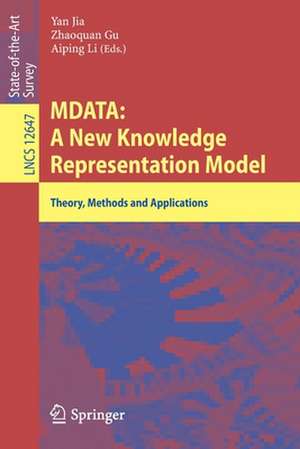
MDATA: A New Knowledge Representation Model: Lecture Notes in Computer Science, cartea 12647
Editat de Yan Jia, Zhaoquan Gu, Aiping Lien Limba Engleză Paperback – 7 mar 2021
The MDATA model should be of interest to readers from many research fields, such as database, cyberspace security, and social network, as the need for the knowledge representation arises naturally in many practical scenarios.
Din seria Lecture Notes in Computer Science
- 20%
 Preț: 558.53 lei
 - 20%
 Preț: 617.17 lei
 - 20%
 Preț: 571.88 lei
 - 20%
 Preț: 1020.28 lei
 - 20%
 Preț: 851.78 lei
 - 20%
 Preț: 560.93 lei
 - 20%
 Preț: 633.70 lei
 - 20%
 Preț: 675.83 lei
 - 20%
 Preț: 1359.66 lei
 - 20%
 Preț: 620.33 lei
 - 20%
 Preț: 733.68 lei
 - 18%
 Preț: 945.44 lei
 - 15%
 Preț: 558.12 lei
 - 20%
 Preț: 793.92 lei
 - 20%
 Preț: 560.93 lei
 - 20%
 Preț: 748.63 lei
 - 20%
 Preț: 562.49 lei
 - 20%
 Preț: 1032.47 lei
 - 20%
 Preț: 731.82 lei
 - 20%
 Preț: 556.96 lei
 - 20%
 Preț: 1022.15 lei
 - 20%
 Preț: 562.49 lei
 - 20%
 Preț: 560.93 lei
 - 20%
 Preț: 313.10 lei
 - 20%
 Preț: 828.44 lei
 - 20%
 Preț: 560.93 lei
 - 20%
 Preț: 314.86 lei
 - 20%
 Preț: 1033.45 lei
 - 20%
 Preț: 563.29 lei
 - 20%
 Preț: 733.68 lei
 - 20%
 Preț: 1137.10 lei
 - 20%
 Preț: 735.28 lei
 - 20%
 Preț: 1079.23 lei
 - 20%
 Preț: 584.42 lei
 - 20%
 Preț: 854.16 lei
 - 15%
 Preț: 672.87 lei
 - 20%
 Preț: 606.22 lei
 - 20%
 Preț: 1246.46 lei
 - 20%
 Preț: 449.81 lei
 - 20%
 Preț: 984.64 lei
 - 20%
 Preț: 620.33 lei
 - 20%
 Preț: 402.28 lei
 - 20%
 Preț: 316.28 lei
 - 20%
 Preț: 663.69 lei
 - 20%
 Preț: 320.24 lei
 - 20%
 Preț: 343.12 lei
 - 20%
 Preț: 313.87 lei
Preț: 504.54 lei
Preț vechi: 630.68 lei
-20%
Puncte Express: 757
Carte tipărită la comandă
Livrare economică 27 noiembrie-11 decembrie
Livrare prin curier în România Termenul estimat este afișat lângă disponibilitate.
Transport gratuit pentru acest produs Plată online sau ramburs, în funcție de opțiunile comenzii.
Retur gratuit în 14 zile Comandă securizată și suport în română.
Specificații
ISBN-13: 9783030715892
ISBN-10: 3030715892
Pagini: 268
Ilustrații: X, 255 p. 23 illus.
Dimensiuni: 155 x 235 x 15 mm
Greutate: 0.38 kg
Ediția:1st edition 2021
Editura: Springer
Colecția Lecture Notes in Computer Science
Seria Lecture Notes in Computer Science
Locul publicării:Cham, Switzerland
ISBN-10: 3030715892
Pagini: 268
Ilustrații: X, 255 p. 23 illus.
Dimensiuni: 155 x 235 x 15 mm
Greutate: 0.38 kg
Ediția:1st edition 2021
Editura: Springer
Colecția Lecture Notes in Computer Science
Seria Lecture Notes in Computer Science
Locul publicării:Cham, Switzerland
V-ar putea interesa
-
 Data Mining: Concepts and TechniquesJiawei Han-40%Preț: 423.98 lei711.99 lei
 -
 The Infinite AlphabetCésar A. HidalgoPreț: 191.23 lei
 -
 -39%Preț: 394.79 lei646.62 lei
 -
 Knowledge Co-Construction in Online Learning: Applying Social Learning Analytic Methods and Artificial IntelligenceCharlotte Nirmalani GunawardenaPreț: 425.20 lei
 -
 Preț: 384.83 leiRecomandat
 -
 -20%Preț: 339.99 lei424.99 lei
 -
 -20%Preț: 323.70 lei404.62 lei
 -
 -9%Preț: 581.31 lei638.79 lei
 -
 The Data Hero PlaybookMalcolm HawkerPreț: 202.67 lei
 -
 Generative Knowledge: Think, Learn, Create with AIPaolo Granata-20%Preț: 173.14 lei216.43 lei
 -
 Agentic AI For DummiesPam Baker-20%Preț: 145.95 lei182.44 lei
 -
 Graph-Powered Machine LearningAlessandro Nego-20%Preț: 391.75 lei489.69 lei
 -
 Knowledge Graphs and LLMs in ActionAlessandro Negro-20%Preț: 350.04 lei437.55 lei
 -
 Further with Knowledge GraphsM. Alam-20%Preț: 617.07 lei771.34 lei
 -
 Deep Learning Crash CourseGiovanni Volpe-35%Preț: 290.84 lei445.88 lei
 -
 The Semantic WebAlbert Meroño Peñuela-20%Preț: 437.83 lei547.29 lei
 -
 Conceptual Knowledge StructuresInma P. Cabrera-20%Preț: 434.33 lei542.91 lei
 -
 Database and Expert Systems ApplicationsChristine Strauß-20%Preț: 392.54 lei490.68 lei
 -
 -20%Preț: 286.18 lei357.73 lei
 -
 Data-Driven Cyber Physical SystemsFangyu Li-18%Preț: 1046.51 lei1276.23 lei
Cuprins
Introduction to the MDATA Model.- The Framework of the MDATA Computing Model.- Spatiotemporal Data Cleaning and Knowledge Fusion.- Chinese Named Entity Recognition: Applications and Challenges.- Joint Extraction of Entities and Relations: An Advanced BERT-based Decomposition Method.- Entity Alignment: Optimization by Seed Selection.- Knowledge Extraction: Automatic Classification of Matching Rules.- Network Embedding Attack: An Euclidean Distance based Method.- Few-Shot Knowledge Reasoning: An Attention Mechanism based Method.- Applications of Knowledge Representation Learning.- Detection and Defense Methods of Cyber Attacks.- A Distributed Framework for APT Attack Analysis.- Social Unrest Events Prediction by Contextual Gated Graph Convolutional Networks.- Information Cascading in Social Networks.
Textul de pe ultima copertă
Knowledge representation is an important task in understanding how humans think and learn. Although many representation models or cognitive models have been proposed, such as expert systems or knowledge graphs, they cannot represent procedural knowledge, i.e., dynamic knowledge, in an efficient way. This book introduces a new knowledge representation model called MDATA (Multi-dimensional Data Association and inTelligent Analysis). By modifying the representation of entities and relations in knowledge graphs, dynamic knowledge can be efficiently described with temporal and spatial characteristics. The MDATA model can be regarded as a high-level temporal and spatial knowledge graph model, which has strong capabilities for knowledge representation. This book introduces some key technologies in the MDATA model, such as entity recognition, relation extraction, entity alignment, and knowledge reasoning with spatiotemporal factors. The MDATA model can be applied in many critical applications and this book introduces some typical examples, such as network attack detection, social network analysis, and epidemic assessment.
The MDATA model should be of interest to readers from many research fields such as database, cyberspace security, and social network, as the need for the knowledge representation arises naturally in many practical scenarios.
The MDATA model should be of interest to readers from many research fields such as database, cyberspace security, and social network, as the need for the knowledge representation arises naturally in many practical scenarios.
Caracteristici
Introduces a new knowledge representation model called MDATA Explores some key technologies of the MDATA model Written by experts in the field