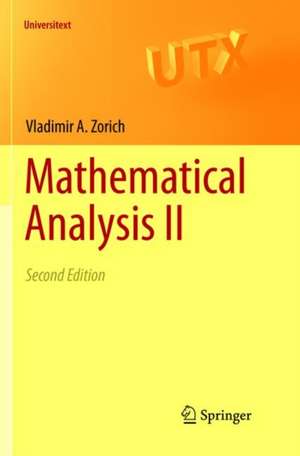
Mathematical Analysis II: Universitext
Autor V. A. Zorich Traducere de Roger Cooke, Octavio Paniaguaen Limba Engleză Paperback – 13 mar 2019
Considerăm Mathematical Analysis II o resursă fundamentală pentru studenții și cercetătorii care vizează excelența în examenele de licență și acreditările academice din domeniul matematicii și fizicii teoretice. Această a doua ediție în limba engleză, tradusă de Roger Cooke și Octavio Paniagua, rafinează un curs riguros care face tranziția de la numere reale la concepte complexe precum formele diferențiale pe varietăți și funcțiile eliptice. Relevanța sa este susținută de includerea explicită a unor secțiuni de probleme pentru examenele de mijloc de semestru și finale, oferind un suport pedagogic structurat pentru parcursul universitar. Comparabil cu Analysis II de Roger Godement în rigurozitate, volumul lui V. A. Zorich se distinge prin orientarea sa marcată către științele naturii și prin actualizarea materialului pentru a reflecta conexiunile moderne dintre analiză, algebră și geometria diferențială. Structura cărții urmărește o progresie logică, pornind de la aplicații continue și calcul diferențial general (capitolele 9-10), trecând prin integrale multiple și teoria câmpurilor (capitolele 11-15), până la serii Fourier și expansiuni asimptotice. Un element distinctiv al acestei ediții este adăugarea celor cinci anexe, care funcționează ca punți conceptuale între analiza clasică și ramurile moderne ale matematicii, precum geometria funcțiilor cu un număr foarte mare de variabile. Lucrarea completează perfect Mathematical Analysis I, consolidând abordarea autorului de a prezenta analiza nu ca pe o disciplină izolată, ci ca pe o componentă vitală a unui sistem matematic unificat. Stilul de expunere îmbină precizia formală cu o explorare informală a rădăcinilor conceptelor de bază, facilitând înțelegerea intuitivă a teoremelor fundamentale.
Din seria Universitext
- 13%
 Preț: 398.41 lei
 - 15%
 Preț: 576.20 lei
 - 15%
 Preț: 402.83 lei
 -
 Preț: 404.03 lei
 -
 Preț: 433.98 lei
 - 15%
 Preț: 522.85 lei
 -
 Preț: 406.96 lei
 -
 Preț: 415.00 lei
 - 13%
 Preț: 395.54 lei
 -
 Preț: 376.18 lei
 -
 Preț: 508.41 lei
 -
 Preț: 469.31 lei
 - 15%
 Preț: 511.22 lei
 -
 Preț: 458.21 lei
 - 15%
 Preț: 513.38 lei
 - 19%
 Preț: 469.00 lei
 -
 Preț: 490.45 lei
 - 15%
 Preț: 603.75 lei
 - 15%
 Preț: 459.73 lei
 -
 Preț: 491.89 lei
 -
 Preț: 383.79 lei
 - 20%
 Preț: 319.60 lei
 - 15%
 Preț: 620.17 lei
 - 15%
 Preț: 504.56 lei
 -
 Preț: 482.65 lei
 - 15%
 Preț: 609.03 lei
 - 15%
 Preț: 534.10 lei
 - 15%
 Preț: 529.04 lei
 - 15%
 Preț: 544.31 lei
 -
 Preț: 383.03 lei
 - 15%
 Preț: 477.44 lei
 -
 Preț: 402.52 lei
 - 15%
 Preț: 525.92 lei
 - 15%
 Preț: 616.59 lei
 - 20%
 Preț: 533.29 lei
 - 15%
 Preț: 605.99 lei
 -
 Preț: 401.63 lei
 -
 Preț: 476.65 lei
 -
 Preț: 442.80 lei
 - 15%
 Preț: 529.50 lei
 - 15%
 Preț: 476.18 lei
 - 15%
 Preț: 563.39 lei
 - 15%
 Preț: 656.08 lei
 -
 Preț: 494.60 lei
 -
 Preț: 454.23 lei
 - 15%
 Preț: 453.29 lei
 -
 Preț: 395.89 lei
 -
 Preț: 404.56 lei
 -
 Preț: 392.51 lei
 -
 Preț: 411.21 lei
Preț: 485.17 lei
Carte tipărită la comandă
Livrare economică 27 noiembrie-11 decembrie
Specificații
ISBN-10: 3662569663
Pagini: 740
Ilustrații: XX, 720 p. 42 illus. in color.
Dimensiuni: 155 x 235 x 40 mm
Greutate: 1.1 kg
Ediția:Softcover reprint of the original 2nd edition 2016
Editura: Springer
Colecția Universitext
Seria Universitext
Locul publicării:Berlin, Heidelberg, Germany
De ce să citești această carte
Recomandăm această lucrare studenților la matematică și fizică ce doresc o bază teoretică solidă pentru studii avansate. Cititorul câștigă nu doar o stăpânire tehnică a analizei pe varietăți și a metodelor asimptotice, ci și capacitatea de a aplica aceste concepte în contextul științelor naturii. Este un instrument esențial pentru pregătirea examenelor, oferind probleme de sinteză și anexe care clarifică legăturile complexe dintre analiza modernă și alte ramuri ale matematicii.
Despre autor
V. A. Zorich este un matematician rus de renume, profesor la Universitatea de Stat din Moscova, cunoscut pentru contribuțiile sale în analiza matematică și aplicațiile acesteia. Opera sa, reprezentată central prin tratatul în două volume „Mathematical Analysis”, este recunoscută internațional pentru claritate și profunzime, fiind tradusă în numeroase limbi. Abordarea sa pedagogică pune accent pe unitatea matematicii și pe interacțiunea constantă dintre teorie și fenomenele fizice, reflectând tradiția de excelență a școlii matematice ruse în formarea academică de nivel înalt.
Cuprins
Textul de pe ultima copertă
This second volumepresents classical analysis in its current form as part of a unifiedmathematics. It shows how analysis interacts with other modern fields ofmathematics such as algebra, differential geometry, differential equations,complex analysis, and functional analysis. This book provides a firm foundationfor advanced work in any of these directions.
“The textbook of Zorich seems to me the mostsuccessful of the available comprehensive textbooks of analysis formathematicians and physicists. It differs from the traditional exposition intwo major ways: on the one hand in its closer relation to natural-scienceapplications (primarily to physics and mechanics) and on the other hand in a greater-than-usualuse of the ideas and methods of modern mathematics, that is, algebra, geometry,and topology. The course is unusually rich in ideas and shows clearly the powerof the ideas and methods of modern mathematics in the study of particularproblems. Especially unusual is the second volume, which includes vectoranalysis, the theory of differential forms on manifolds, an introduction to thetheory of generalized functions and potential theory, Fourier series and the Fouriertransform, and the elements of the theory of asymptotic expansions. At presentsuch a way of structuring the course must be considered innovative. It wasnormal in the time of Goursat, but the tendency toward specialized courses, noticeableover the past half century, has emasculated the course of analysis, almost reducingit to mere logical justifications. The need to return to more substantive coursesof analysis now seems obvious, especially in connection with the applied characterof the future activity of the majority of students.
...In my opinion, this course is the best of theexisting modern courses of analysis.”
From areview by V.I.Arnold
VLADIMIR A. ZORICH is professor of mathematics at Moscow State University. His areas of specialization are analysis, conformal geometry, quasiconformal mappings, and mathematical aspects of thermodynamics. He solved the problem of global homeomorphism for space quasiconformal mappings. He holds a patent in the technology of mechanical engineering, and he is also known by his book Mathematical Analysis of Problems in the Natural Sciences.