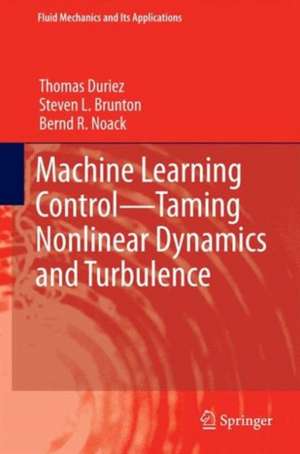
Machine Learning Control - Taming Nonlinear Dynamics and Turbulence: Fluid Mechanics and Its Applications, cartea 116
Autor Thomas Duriez, Steven L. Brunton, Bernd R. Noacken Limba Engleză Hardback – 15 noi 2016
Observăm că volumul Machine Learning Control - Taming Nonlinear Dynamics and Turbulence debutează cu o resursă tehnică esențială: coduri Matlab integrate pentru a asigura reproductibilitatea completă a rezultatelor prezentate, completate de materiale video pe YouTube. Această abordare practică transformă lucrarea dintr-un simplu manual teoretic într-un instrument de lucru activ pentru inginerii care se confruntă cu dinamica neliniară complexă.
Structura volumului este organizată progresiv pentru a construi o înțelegere solidă a Machine Learning Control (MLC). Primele capitole fundamentează strategia de control, în timp ce capitolul 3 revizuiește metodele clasice ale teoriei controlului liniar. Un punct critic al cărții apare în capitolele 4 și 5, unde autorii, printre care se numără Steven L. Brunton și Bernd R. Noack, demonstrează capacitatea MLC de a reproduce legi de control optimal cunoscute (LQR, LQG) și, mai important, de a depăși limitările metodelor liniare în sisteme cu acționare puternic neliniară. Abordarea diferă de Principles of Turbulence Control prin faptul că este mai puțin abstractă și mult mai aplicabilă, punând accent pe utilizarea algoritmilor de învățare automată pentru a „îmblânzi” turbulența, în loc să se bazeze exclusiv pe modele matematice tradiționale.
Găsim în această carte și o componentă rară în literatura tehnică: interviuri cu experți de renume care oferă un context istoric și vizionar asupra domeniului. De asemenea, capitolul 6 trece în revistă demonstrații experimentale riguroase, oferind bune practici pentru configurarea testelor de laborator, ceea ce face din acest titlu o resursă de referință în seria Fluid Mechanics and Its Applications.
Din seria Fluid Mechanics and Its Applications
- 15%
 Preț: 499.32 lei
 - 23%
 Preț: 749.41 lei
 - 18%
 Preț: 975.17 lei
 - 15%
 Preț: 623.27 lei
 - 18%
 Preț: 759.08 lei
 - 18%
 Preț: 750.58 lei
 - 15%
 Preț: 679.97 lei
 - 18%
 Preț: 915.13 lei
 - 18%
 Preț: 1523.29 lei
 - 18%
 Preț: 1069.04 lei
 - 18%
 Preț: 1078.15 lei
 - 15%
 Preț: 622.73 lei
 - 24%
 Preț: 1155.84 lei
 - 23%
 Preț: 819.68 lei
 - 18%
 Preț: 806.93 lei
 - 18%
 Preț: 912.69 lei
 - 18%
 Preț: 972.89 lei
 - 15%
 Preț: 572.73 lei
 - 15%
 Preț: 631.12 lei
 - 15%
 Preț: 621.67 lei
 - 15%
 Preț: 633.98 lei
 - 18%
 Preț: 1084.63 lei
 - 18%
 Preț: 1595.87 lei
 - 18%
 Preț: 721.37 lei
 - 15%
 Preț: 622.37 lei
 - 24%
 Preț: 850.47 lei
 - 18%
 Preț: 1520.64 lei
 - 18%
 Preț: 920.88 lei
 - 18%
 Preț: 1327.75 lei
 - 18%
 Preț: 966.38 lei
 - 15%
 Preț: 616.63 lei
Preț: 565.88 lei
Preț vechi: 665.73 lei
-15%
Carte disponibilă
Livrare economică 07-21 mai
Livrare express 23-29 aprilie pentru 37.35 lei
Specificații
ISBN-10: 331940623X
Pagini: 232
Ilustrații: XX, 211 p. 73 illus., 58 illus. in color.
Dimensiuni: 160 x 241 x 18 mm
Greutate: 0.56 kg
Ediția:1st edition 2017
Editura: Springer
Colecția Fluid Mechanics and Its Applications
Seria Fluid Mechanics and Its Applications
Locul publicării:Cham, Switzerland
V-ar putea interesa
-
 Stick and Rudder: An Explanation of the Art of FlyingWolfgang Langewiesche-28%Preț: 140.93 lei196.15 lei
 -
 Fluid MechanicsPijush K. Kundu-33%Preț: 625.81 lei934.76 lei
 -
 Turbulence: An Introduction for Scientists and EngineersPeter Davidson-21%Preț: 491.66 lei619.14 lei
 -
 -32%Preț: 581.46 lei858.61 lei
 -
 Control System DesignBernard Friedland-25%Preț: 163.77 lei217.15 lei
 -
 Optimal Control and EstimationRobert F. Stengel-21%Preț: 198.77 lei252.43 lei
 -
 Fluid Mechanics: Volume 4David TongPreț: 238.84 lei
 -
 Data-Driven Science and EngineeringSteven L. Brunton-19%Preț: 358.05 lei442.28 lei
 -
 Linear Multivariable Control SystemsShankar P Bhattacharyya-11%Preț: 594.53 lei668.01 lei
 -
 Aircraft Control and SimulationBrian L Stevens-23%Preț: 911.47 lei1183.73 lei
 -
 -15%Preț: 661.68 lei778.45 lei
 -
 Linear Parameter-Varying ControlOlivier Sename-23%Preț: 686.05 lei890.97 lei
 -
 Machine Learning For DummiesJohn Paul Mueller-20%Preț: 142.78 lei178.48 lei
 -
 Optimization AlgorithmsAlaa Khamis-20%Preț: 377.84 lei472.31 lei
 -
 -18%Preț: 864.31 lei1054.04 lei
 -
 Robust and Adaptive ControlEugene LavretskyPreț: 516.65 lei
 -
 Machine Learning for Cyber-Physical SystemsOliver NiggemannPreț: 302.87 lei
 -
 Advanced Control Methods for Industrial ProcessesPablo A. López-Pérez-23%Preț: 652.97 lei848.02 lei
 -
 -18%Preț: 1191.98 lei1453.63 lei
De ce să citești această carte
Această carte se adresează inginerilor și cercetătorilor care doresc să aplice inteligența artificială în mecanica fluidelor. Cititorul câștigă acces la o strategie de control universală pentru sisteme neliniare complexe, susținută de coduri Matlab gata de utilizare. Este un ghid esențial pentru trecerea de la controlul liniar teoretic la aplicații experimentale reale în controlul turbulenței.
Despre autor
Thomas Duriez, Steven L. Brunton și Bernd R. Noack sunt cercetători de marcă la intersecția dintre mecanica fluidelor și procesarea datelor. Steven L. Brunton este recunoscut pentru contribuțiile sale în controlul sistemelor complexe și utilizarea metodelor data-driven, fiind profesor la Universitatea din Washington. Bernd R. Noack este un pionier în modelarea de ordin redus și controlul turbulenței, activând în instituții de prestigiu din Europa și China. Expertiza lor combinată oferă acestui volum o autoritate incontestabilă atât în zona matematică, cât și în cea experimentală.
Descriere scurtă
Cuprins
Notă biografică
Steven L. Brunton is an Assistant Professor in Mechanical Engineering and an Adjunct Assistant Professor in Applied Mathematics at the University of Washington in Seattle. Hegraduated with a B.S. in Mathematics from the California Institute of Technology and received his PhD in Mechanical and Aerospace Engineering from Princeton University. Currently, his research interests include data-driven modeling and control of complex dynamical systems using machine learning, compressed sensing, uncertainty quantification, and equation-free modeling; Flow control of unsteady aerodynamics, transport phenomena, and turbulent mixing enhancement; Adaptive and robust control techniques for energy optimization and conversion. He is a Data Science Fellow with the eScience Institute at UW.
Bernd R. Noack is Director of Research CNRS at LIMSI-CNRS, Paris-Saclay, and Professor and Chair of 'Flow Modeling and Control' at TU Braunschweig, Germany. Prof. Noack develops closed-loop flow control solutions for cars, airplanes and transport systems in an interdisciplinary effort with an international network of leading researchers. He received a degree as diplom physicist and his physics doctorate from the Georg-August-University Göttingen in 1989 and 1992, respectively. Positions followed at the Max-Planck-Institut für Strömungsforschung, Göttingen, the German Aerospace Center, Göttingen, the Göttingen University, the United Technologies Research Center (East Hartford, CT, USA) and the Berlin Institute of Technology, where he was Professor and Chair of 'Reduced-Order Modeling for Flow Control'. In 2009 he joined the Institute PPRIME, Poitiers, France as Director of Research CNRS. He also became Head of the Senior ANR Chair of Excellence ''Closed-Loop Control of Turbulent Shear Flows using Reduced-Order Models (TUCOROM)''. His work on turbulence control was honored by national and international awards, including a Fellowship of the American Physical Society.