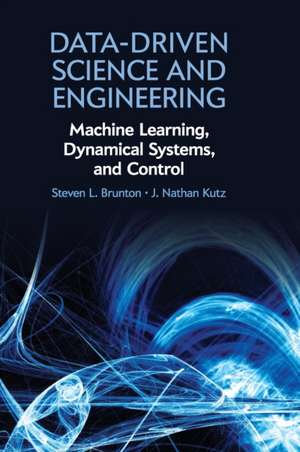
Data-Driven Science and Engineering
Autor Steven L. Brunton, J. Nathan Kutzen Limba Engleză Hardback – 28 feb 2019
Urgența adoptării metodelor bazate pe date în inginerie nu a fost niciodată mai critică; tranziția de la modelarea pur teoretică la descoperirea bazată pe date revoluționează modul în care controlăm sistemele complexe chiar în acest moment. Subliniem faptul că Data-Driven Science and Engineering nu este doar un manual teoretic, ci un ghid de supraviețuire tehnică pentru inginerul modern. Steven L. Brunton și J. Nathan Kutz elimină bariera dintre metodele clasice de fizică matematică și universul machine learning, oferind un cadru riguros pentru predicția și controlul sistemelor dinamice.
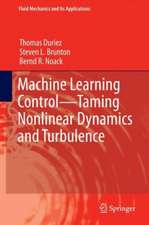
Reținem structura logică a lucrării, organizată în patru părți esențiale: începe cu bazele matematice ale descompunerii valorilor singulare și transformatelor Fourier (Partea I), trece prin regresie și rețele neuronale (Partea II), pentru a culmina cu teoria controlului liniar și modelarea avansată (Părțile III și IV). Față de lucrarea anterioară a lui Steven L. Brunton, Machine Learning Control – Taming Nonlinear Dynamics and Turbulence, care se concentra specific pe turbulențe, acest volum extinde spectrul de aplicabilitate la nivelul întregii discipline de inginerie. Cititorul care a aplicat ideile din Data-Driven Modeling & Scientific Computation va găsi aici completarea necesară pentru trecerea de la simpla analiză a datelor la controlul activ și automatizarea sistemelor prin reinforcement learning.
Merită menționat că autorii au integrat capitole de ultimă oră despre „physics-informed machine learning”, o metodă care forțează algoritmii să respecte legile fizicii, rezolvând astfel problema „cutiei negre” din inteligența artificială. Această ediție a doua, publicată de Cambridge University Press, devine un instrument indispensabil prin accesul la cod sursă în multiple limbaje de programare, asigurând o aplicabilitate imediată în cercetare sau industrie.
Preț: 358.05 lei
Preț vechi: 442.28 lei
-19%
Carte indisponibilă temporar
Specificații
ISBN-10: 1108422098
Pagini: 496
Dimensiuni: 183 x 260 x 31 mm
Greutate: 1.13 kg
Editura: Cambridge University Press
Locul publicării:New York, United States
V-ar putea interesa
-
 Just Enough Data Science and Machine LearningMark LevenePreț: 327.99 lei
 -
 Machine Learning for EconometricsChristophe Gaillac-13%Preț: 259.50 lei298.12 lei
 -
 Preț: 424.94 lei
 -
 Machine LearningKevin P. Murphy-22%Preț: 684.02 lei875.14 lei
 -
 The Elements of Statistical LearningJerome Friedman-20%Preț: 513.14 lei641.42 lei
 -
 -40%Preț: 370.93 lei621.33 lei
 -
 -32%Preț: 581.46 lei858.78 lei
 -
 Computational Science and EngineeringGilbert Strang-9%Preț: 641.69 lei705.15 lei
 -
 Fundamentals of Data EngineeringJoe Reis-20%Preț: 367.09 lei458.86 lei
 -
 -20%Preț: 296.77 lei370.96 lei
 -
 Practical Deep Learning, 2nd Edition: A Python-Based IntroductionRonald T. Kneusel-37%Preț: 313.62 lei495.57 lei
 -
 Data Engineering with PythonPaul Crickard-20%Preț: 278.54 lei348.18 lei
 -
 -17%Preț: 389.73 lei469.56 lei
 -
 Robust and Adaptive ControlEugene LavretskyPreț: 516.65 lei
 -
 Preț: 433.14 lei
 -
 Materials Data ScienceStefan Sandfeld-15%Preț: 573.37 lei674.56 lei
 -
 -15%Preț: 399.86 lei470.42 lei
 -
 -15%Preț: 565.88 lei665.73 lei
 -
 Model Reduction of Parametrized SystemsPeter Benner-18%Preț: 865.96 lei1056.04 lei
 -
 -5%Preț: 1122.07 lei1181.12 lei
 -
 Mathematical Introduction to Data ScienceSven A. Wegner-20%Preț: 545.29 lei681.61 lei
 -
 Data-Driven Cyber Physical SystemsFangyu Li-18%Preț: 969.72 lei1182.58 lei
De ce să citești această carte
Această carte este esențială pentru inginerii și cercetătorii care vor să treacă dincolo de simulările tradiționale. Veți învăța cum să utilizați machine learning pentru a modela sisteme fizice reale, câștigând abilitatea de a extrage modele matematice direct din date. Este resursa definitivă care îmbină rigoarea fizicii clasice cu puterea computațională modernă, oferind totodată suportul practic (cod și video) pentru implementare imediată.
Descriere scurtă
Cuprins
Recenzii
'Professors Kutz and Brunton bring both passion and rigor to this most timely subject matter. Data analytics is the important topic for engineering in the twenty-first century and this book covers the far-reaching subject matter with clarity and code examples. Bravo!' Steve M. Legensky, Founder and General Manager, Intelligent Light
'Brunton and Kutz provide a lively and comprehensive treatise on machine learning and data mining algorithms as applied to physical systems arising in science and engineering and their control. They provide an abundance of examples and wisdom that will be of great value to students and practitioners alike.' Tim Colonius, California Institute of Technology
'This is a cleanly bound, compact book with medium weight coated paper and crisp text. There are many well-composed figures, most of them in color, with good explanatory captions, and sample code for almost all computational examples. While the code is for MATLAB, it is well commented and should not be too difficult to translate to Python or other computer languages … This is a fine book, and quite good for a first edition. It is clearly written with many examples and informative figures has a very useful bibliography and many good programming examples. I would use it for a course without reservation, and it has a permanent place on my bookshelf as a reference.' John Starrett, Mathematical Association of America Reviews
'Throughout, topics are discussed with theoretical depth and accompanied by a substantial bibliography. The authors also make use of software code snips.' R. S. Stansbury, Choice