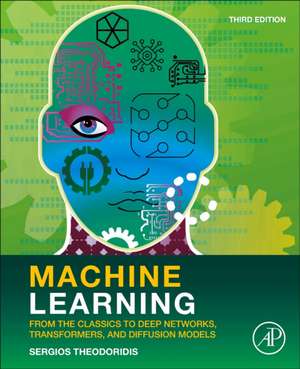
Machine Learning: From the Classics to Deep Networks, Transformers, and Diffusion Models
Autor Sergios Theodoridisen Limba Engleză Paperback – 19 mar 2025
Focusing on the physical reasoning behind the mathematics, without sacrificing rigor, all methods and techniques are explained in depth, supported by examples and problems, providing an invaluable resource to the student and researcher for understanding and applying machine learning concepts.
- Provides a number of case studies and applications on a variety of topics, such as target localization, channel equalization, image denoising, audio characterization, text authorship identification, visual tracking, change point detection, hyperspectral image unmixing, fMRI data analysis, machine translation, and text-to-image generation
- Most chapters include a number of computer exercises in both MatLab and Python, and the chapters dedicated to deep learning include exercises in PyTorch
- The new material includes an extended coverage of attention transformers, large language models, self-supervised learning and diffusion models
Preț: 607.05 lei
Preț vechi: 885.58 lei
-31%
Puncte Express: 911
Carte disponibilă
Livrare economică 03-17 noiembrie
Livrare express 24-30 octombrie pentru 144.73 lei
Livrare prin curier în România Termenul estimat este afișat lângă disponibilitate.
Transport gratuit pentru acest produs Plată online sau ramburs, în funcție de opțiunile comenzii.
Retur gratuit în 14 zile Comandă securizată și suport în română.
Specificații
ISBN-13: 9780443292385
ISBN-10: 0443292388
Pagini: 1200
Dimensiuni: 191 x 235 x 44 mm
Greutate: 2 kg
Ediția:3. Auflage
Editura: ELSEVIER SCIENCE
ISBN-10: 0443292388
Pagini: 1200
Dimensiuni: 191 x 235 x 44 mm
Greutate: 2 kg
Ediția:3. Auflage
Editura: ELSEVIER SCIENCE
V-ar putea interesa
-
 Machine LearningKevin P. Murphy-20%Preț: 731.65 lei918.37 lei
 -
 Deep LearningIan Goodfellow-21%Preț: 684.46 lei865.01 lei
 -
 Probabilistic Machine LearningKevin P. Murphy-21%Preț: 854.63 lei1080.57 lei
 -
 Understanding Deep LearningSimon J. D. Prince-20%Preț: 636.22 lei795.27 lei
 -
 Gaussian Processes for Machine LearningCarl Edward Rasmussen-26%Preț: 350.95 lei477.34 lei
 -
 -20%Preț: 655.10 lei818.88 lei
 -
 A First Course in Machine LearningSimon RogersPreț: 424.01 lei
 -
 Pattern Recognition and Machine LearningChristopher M Bishop-20%Preț: 646.10 lei807.62 lei
 -
 The Elements of Statistical LearningTrevor Hastie-20%Preț: 547.10 lei683.87 lei
 -
 -39%Preț: 394.79 lei646.62 lei
 -
 Linear Algebra and Learning from DataGilbert Strang-8%Preț: 528.40 lei574.35 lei
 -
 -23%Preț: 1746.05 lei2267.60 lei
 -
 Machine Learning: An Algorithmic Perspective, Second EditionStephen Marsland-20%Preț: 625.22 lei781.53 lei
 -
 Math and Architectures of Deep LearningKrishnendu Chaudhury-20%Preț: 410.21 lei512.76 lei
 -
 Machine Learning Algorithms in DepthVadim Smolyakov-20%Preț: 445.58 lei556.96 lei
 -
 -20%Preț: 249.08 lei311.36 lei
 -
 Deep Learning Crash CourseGiovanni Volpe-35%Preț: 290.92 lei445.81 lei
 -
 Practical Deep Learning, 2nd Edition: A Python-Based IntroductionRonald T. Kneusel-35%Preț: 333.73 lei515.68 lei
 -
 Materials Data ScienceStefan Sandfeld-15%Preț: 591.20 lei695.53 lei
 -
 Probability and Statistics for Machine LearningCharu C. Aggarwal-20%Preț: 445.19 lei556.49 lei
Cuprins
1. Introduction
2. Probability and Stochastic Processes
3. Learning in Parametric Modelling: Basic Concepts and Directions
4. Mean-Square Error Linear Estimation
5. Stochastic Gradient Descent: the LMS Algorithm and its Family
6. The Least-Squares Family
7. Classification: A Tour of the Classics
8. Parameter Learning: A Convex Analytic Path
9. Sparsity-Aware Learning: Concepts and Theoretical Foundations
10. Sparsity-Aware Learning: Algorithms and Applications
11. Learning in Reproducing Kernel Hilbert Spaces
12. Bayesian Learning: Inference and the EM Algorithm
13. Bayesian Learning: Approximate Inference and Nonparametric Models
14. Monte Carlo Methods
15. Probabilistic Graphical Models: Part 1
16. Probabilistic Graphical Models: Part 2
17. Particle Filtering
18. Neural Networks and Deep Learning: Part 1
19. Neural Networks and Deep Learning: Part 2
20. Dimensionality Reduction and Latent Variables Modeling
2. Probability and Stochastic Processes
3. Learning in Parametric Modelling: Basic Concepts and Directions
4. Mean-Square Error Linear Estimation
5. Stochastic Gradient Descent: the LMS Algorithm and its Family
6. The Least-Squares Family
7. Classification: A Tour of the Classics
8. Parameter Learning: A Convex Analytic Path
9. Sparsity-Aware Learning: Concepts and Theoretical Foundations
10. Sparsity-Aware Learning: Algorithms and Applications
11. Learning in Reproducing Kernel Hilbert Spaces
12. Bayesian Learning: Inference and the EM Algorithm
13. Bayesian Learning: Approximate Inference and Nonparametric Models
14. Monte Carlo Methods
15. Probabilistic Graphical Models: Part 1
16. Probabilistic Graphical Models: Part 2
17. Particle Filtering
18. Neural Networks and Deep Learning: Part 1
19. Neural Networks and Deep Learning: Part 2
20. Dimensionality Reduction and Latent Variables Modeling
Recenzii
This excellent book offers a rare blend of breadth, depth, and clarity, serving equally well as a textbook, research monograph, and reference guide. It presents a unified view of modern
Machine Learning by dedicating a full chapter to recent breakthroughs such as Transformers, Self-supervision, and Diffusion models, while also providing a solid foundation in classical topics including regression, classification, sparse modeling, kernel methods, Bayesian learning, and graphical models. Neural networks are introduced through their historical evolution, beginning with the perceptron and progressing through convolutional and recurrent architectures, generative adversarial networks, and variational autoencoders. The exposition balances conceptual insight with analytical precision and is enriched with case studies, examples, problems, and computational exercises that illuminate both theory and practice. Written by a distinguished author with deep expertise in the field, this book is a timely and indispensable resource for educators, students, and researchers who seek more than a black box treatment and want to understand the principles that drive advances in Machine Learning. - Georgios Giannakis, McKnight Presidential Chair, ECE Dept., University of Minnesota.
Machine Learning (Third Edition) by Theodoridis provides a rigorous and conceptually unified treatment that situates modern ML methods within the broader framework of statistical inference, optimization, and probabilistic modeling. The text excels in its integration of classical pattern-recognition foundations with contemporary advances including variational inference, generative models, kernelized learning, and deep learning. It is a rare text that can serve simultaneously as a research companion, a teaching resource, and a bridge between statistical ML theory and practical algorithmic design. If you are a student looking for a machine-learning textbook that is clear, friendly, and genuinely helpful, Theodoridis’s Machine Learning (Third Edition) is an excellent choice. - Rama Chellapa, Bloomberg Distinguished Professor, Johns Hopkins University
The book offers a comprehensive treatment of Machine Learning, ranging from the classics of classification and regression to modern deep learning. There is a detailed exposition of convex analysis, compressed sensing and sparsity-aware learning. Subsequently the book gets into Bayesian analysis and a detailed coverage of graphical models, providing an excellent exposition of classical unsupervised learning. The last part covers neural networks including modern research topics like GANs, Diffusions and Transformers. Overall, this is a comprehensive and insightful resource for anyone seeking depth and breadth in Machine Learning. - Alexandros G Dimakis, EECS, UC Berkeley
Machine Learning by dedicating a full chapter to recent breakthroughs such as Transformers, Self-supervision, and Diffusion models, while also providing a solid foundation in classical topics including regression, classification, sparse modeling, kernel methods, Bayesian learning, and graphical models. Neural networks are introduced through their historical evolution, beginning with the perceptron and progressing through convolutional and recurrent architectures, generative adversarial networks, and variational autoencoders. The exposition balances conceptual insight with analytical precision and is enriched with case studies, examples, problems, and computational exercises that illuminate both theory and practice. Written by a distinguished author with deep expertise in the field, this book is a timely and indispensable resource for educators, students, and researchers who seek more than a black box treatment and want to understand the principles that drive advances in Machine Learning. - Georgios Giannakis, McKnight Presidential Chair, ECE Dept., University of Minnesota.
Machine Learning (Third Edition) by Theodoridis provides a rigorous and conceptually unified treatment that situates modern ML methods within the broader framework of statistical inference, optimization, and probabilistic modeling. The text excels in its integration of classical pattern-recognition foundations with contemporary advances including variational inference, generative models, kernelized learning, and deep learning. It is a rare text that can serve simultaneously as a research companion, a teaching resource, and a bridge between statistical ML theory and practical algorithmic design. If you are a student looking for a machine-learning textbook that is clear, friendly, and genuinely helpful, Theodoridis’s Machine Learning (Third Edition) is an excellent choice. - Rama Chellapa, Bloomberg Distinguished Professor, Johns Hopkins University
The book offers a comprehensive treatment of Machine Learning, ranging from the classics of classification and regression to modern deep learning. There is a detailed exposition of convex analysis, compressed sensing and sparsity-aware learning. Subsequently the book gets into Bayesian analysis and a detailed coverage of graphical models, providing an excellent exposition of classical unsupervised learning. The last part covers neural networks including modern research topics like GANs, Diffusions and Transformers. Overall, this is a comprehensive and insightful resource for anyone seeking depth and breadth in Machine Learning. - Alexandros G Dimakis, EECS, UC Berkeley