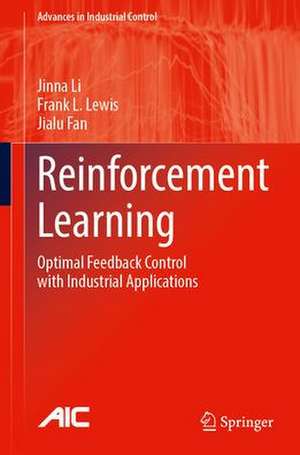
Reinforcement Learning: Optimal Feedback Control with Industrial Applications: Advances in Industrial Control
Autor Jinna Li, Frank L. Lewis, Jialu Fanen Limba Engleză Hardback – 25 iul 2023
În volumul Reinforcement Learning, autorii Jinna Li, Frank L. Lewis și Jialu Fan explorează convergența dintre controlul feedback optim și inovațiile tehnologice din sfera învățării prin recompensă (RL). Considerăm că această lucrare este esențială pentru inginerii care activează în automatizări, deoarece nu se limitează la mediile simulate, ci abordează direct complexitatea sistemelor neliniare și a celor în rețea (networked systems), unde dinamica este adesea necunoscută sau parțial observabilă. Notăm cu interes tranziția de la arhitecturile clasice de control la algoritmi avansați de tip data-driven, capabili să optimizeze eficiența învățării în sisteme multi-agent.
Structura cărții, publicată în seria Advances in Industrial Control, reflectă o progresie riguroasă. Primele capitole stabilesc fundamentul teoretic prin programare dinamică, fiind urmate de secțiuni tehnice dedicate controlului H-infinity și reglării output-ului. Abordarea diferă de Reinforcement Learning for Optimal Feedback Control de Rushikesh Kamalapurkar prin faptul că este mai puțin orientată spre identificarea modelelor în timp real și mai mult axată pe implementarea practică a algoritmilor de tip „Off-Policy Game RL” pentru industriile de proces. În timp ce Handbook of Reinforcement Learning and Control oferă o perspectivă enciclopedică, volumul de față este mai aplicat, oferind exemple numerice ilustrative pentru sincronizarea sistemelor multi-agent și optimizarea proceselor chimice sau miniere.
Fiecare capitol, de la designul observatorilor la Q-Learning-ul intercalat, este conceput pentru a oferi soluții la provocări industriale reale. Credem că echilibrul între analiza teoretică și studiile de caz din industria de putere sau prelucrare face din această ediție din 2023 un instrument de lucru indispensabil pentru cercetătorii care doresc să implementeze controlul adaptiv într-un cadru formal, dar pragmatic.
Din seria Advances in Industrial Control
- 15%
 Preț: 650.40 lei
 - 18%
 Preț: 959.01 lei
 - 18%
 Preț: 757.72 lei
 - 18%
 Preț: 1116.89 lei
 - 18%
 Preț: 968.71 lei
 - 18%
 Preț: 905.80 lei
 - 18%
 Preț: 790.01 lei
 - 18%
 Preț: 734.94 lei
 - 18%
 Preț: 1411.69 lei
 - 18%
 Preț: 735.52 lei
 - 15%
 Preț: 645.35 lei
 - 15%
 Preț: 619.14 lei
 - 15%
 Preț: 647.27 lei
 - 18%
 Preț: 896.57 lei
 - 18%
 Preț: 775.66 lei
 - 18%
 Preț: 951.24 lei
 - 18%
 Preț: 947.30 lei
 - 15%
 Preț: 620.38 lei
 - 15%
 Preț: 644.70 lei
 - 18%
 Preț: 920.42 lei
 - 15%
 Preț: 622.37 lei
 - 18%
 Preț: 1338.83 lei
 - 18%
 Preț: 954.32 lei
 - 18%
 Preț: 913.01 lei
 - 18%
 Preț: 956.50 lei
 - 18%
 Preț: 954.74 lei
 - 18%
 Preț: 1088.00 lei
 - 15%
 Preț: 624.95 lei
 - 15%
 Preț: 626.31 lei
 - 18%
 Preț: 953.95 lei
 - 18%
 Preț: 952.09 lei
 - 18%
 Preț: 1116.92 lei
 - 15%
 Preț: 622.30 lei
 - 18%
 Preț: 924.19 lei
 - 18%
 Preț: 914.35 lei
 - 15%
 Preț: 616.15 lei
 - 15%
 Preț: 626.31 lei
 - 20%
 Preț: 652.86 lei
 - 18%
 Preț: 1074.84 lei
 - 20%
 Preț: 975.70 lei
 - 15%
 Preț: 650.40 lei
 - 24%
 Preț: 1072.58 lei
 - 18%
 Preț: 923.28 lei
 - 18%
 Preț: 1342.56 lei
 - 15%
 Preț: 659.02 lei
 - 15%
 Preț: 649.72 lei
 - 20%
 Preț: 620.99 lei
 - 18%
 Preț: 1018.67 lei
Preț: 864.31 lei
Preț vechi: 1054.04 lei
-18%
Carte disponibilă
Livrare economică 21 octombrie-04 noiembrie
Specificații
ISBN-10: 3031283937
Pagini: 310
Ilustrații: XVI, 310 p. 114 illus., 110 illus. in color.
Dimensiuni: 155 x 235 mm
Greutate: 0.68 kg
Ediția:1st ed. 2023
Editura: Springer International Publishing
Colecția Springer
Seria Advances in Industrial Control
Locul publicării:Cham, Switzerland
V-ar putea interesa
-
 Reinforcement LearningRichard S. Sutton-34%Preț: 667.84 lei1018.35 lei
 -
 Multi-Agent Reinforcement LearningFilippos Christianos-20%Preț: 479.43 lei599.29 lei
 -
 Formal Methods for Multi-Agent Feedback Control SystemsDimos V. Dimarogonas-20%Preț: 600.65 lei750.82 lei
 -
 Optimal Control TheoryDonald E. KirkPreț: 204.53 lei
 -
 Optimal Control and EstimationRobert F. Stengel-20%Preț: 207.26 lei259.96 lei
 -
 The ScoreC. Thi NguyenPreț: 189.06 lei
 -
 Data-Driven Science and EngineeringSteven L. Brunton-23%Preț: 375.38 lei488.59 lei
 -
 Grokking Deep Reinforcement LearningMiguel Morales-20%Preț: 344.71 lei430.89 lei
 -
 Optimization AlgorithmsAlaa Khamis-20%Preț: 392.66 lei490.83 lei
 -
 An Introduction to Optimal Control TheoryOnésimo Hernández-LermaPreț: 466.37 lei
 -
 -20%Preț: 345.48 lei431.85 lei
 -
 Robust and Adaptive ControlEugene LavretskyPreț: 533.14 lei
 -
 -15%Preț: 645.30 lei759.17 lei
 -
 -15%Preț: 565.88 lei665.73 lei
 -
 -18%Preț: 1411.69 lei1721.57 lei
 -
 Advanced Control Methods for Industrial ProcessesPablo A. López-Pérez-23%Preț: 689.32 lei895.22 lei
 -
 -24%Preț: 854.23 lei1123.99 lei
 -
 Distributed Coordination Control SystemYongnan Jia-18%Preț: 757.42 lei923.69 lei
 -
 -18%Preț: 1239.08 lei1511.08 lei
 -
 -20%Preț: 604.66 lei755.83 lei
De ce să citești această carte
Această lucrare se adresează specialiștilor în automatică și AI care caută să aplice învățarea prin recompensă în contexte industriale riguroase. Cititorul câștigă o înțelegere profundă a modului în care algoritmii RL pot gestiona sisteme cu parametri necunoscuți, oferind un avantaj competitiv în optimizarea proceselor complexe, de la rețele energetice la sisteme multi-agent, fără a sacrifica stabilitatea matematică a controlului feedback.
Despre autor
Autorii sunt cercetători de prestigiu în domeniul sistemelor de control. Frank L. Lewis este o figură proeminentă în ingineria sistemelor, fiind recunoscut pentru contribuțiile sale vaste în controlul feedback și sistemele inteligente. Alături de Jinna Li și Jialu Fan, acesta aduce o expertiză vastă în dezvoltarea algoritmilor de învățare pentru controlul robust și jocurile diferențiale. Activitatea lor colectivă, reflectată în numeroase publicații la Springer International Publishing, se concentrează pe aplicabilitatea practică a inteligenței artificiale în ingineria electrică și automatizarea proceselor industriale complexe.
Descriere scurtă
A concise description of classical reinforcement learning (RL), the basics of optimal control with dynamic programming and network control architectures, and a brief introduction to typical algorithms build the foundation for the remainder of the book. Extensive research on data-driven robust control for nonlinear systems with unknown dynamics and multi-player systems follows. Data-driven optimal control of networked single- and multi-player systems leads readers into the development of novel RL algorithms with increased learning efficiency. The book concludes with a treatment of how these RL algorithms can achieve optimal synchronization policies for multi-agentsystems with unknown model parameters and how game RL can solve problems of optimal operation in various process industries. Illustrative numerical examples and complex process control applications emphasize the realistic usefulness of the algorithms discussed.
The combination of practical algorithms, theoretical analysis and comprehensive examples presented in Reinforcement Learning will interest researchers and practitioners studying or using optimal and adaptive control, machine learning, artificial intelligence, and operations research, whether advancing the theory or applying it in mineral-process, chemical-process, power-supply or other industries.