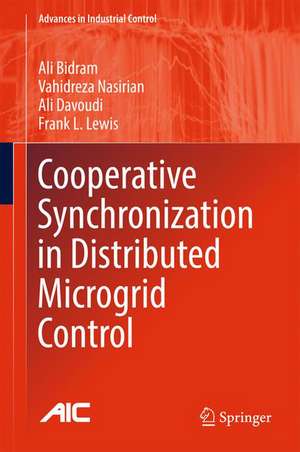
Cooperative Synchronization in Distributed Microgrid Control: Advances in Industrial Control
Autor Ali Bidram, Vahidreza Nasirian, Ali Davoudi, Frank L. Lewisen Limba Engleză Hardback – 3 mar 2017
În volumul Cooperative Synchronization in Distributed Microgrid Control, descoperim o abordare tehnică riguroasă a arhitecturilor de control pentru rețelele energetice moderne. Metodologia centrală se concentrează pe tranziția de la sistemele de control centralizate, vulnerabile la puncte unice de defecțiune, către sisteme multi-agent capabile de auto-organizare și sincronizare cooperativă. Subliniem faptul că autorii nu se limitează la o descriere conceptuală, ci fundamentează fiecare algoritm prin demonstrații matematice stricte și simulări care confirmă stabilitatea sistemului în scenarii reale de operare. Structura lucrării este una progresivă, facilitând înțelegerea mecanismelor complexe prin etape logice. Începem cu fundamentele modelării microrețelelor și bazele sistemelor multi-agent, piloni esențiali pentru a înțelege capitolele ulterioare dedicate controlului distribuit în AC. Un element distinctiv îl reprezintă secțiunile despre metodele avansate, precum controlul de tip „droop-free”, și extinderea acestor paradigme către microrețelele de curent continuu (DC). Ca și Magdi S. Mahmoud în Microgrid, autorii de față distilează experiența de cercetare în principii acționabile, însă pun un accent mult mai pronunțat pe sincronizarea matematică a agenților distribuiți pentru a asigura flexibilitatea și configurabilitatea rețelei. Găsim în această carte un echilibru între teoria sistemelor de control și aplicațiile practice în integrarea surselor de energie regenerabilă, oferind soluții pentru optimizarea sarcinii și menținerea stabilității tensiunii fără intervenție centralizată.
Din seria Advances in Industrial Control
- 15%
 Preț: 670.62 lei
 - 18%
 Preț: 986.31 lei
 - 18%
 Preț: 812.62 lei
 - 18%
 Preț: 1155.07 lei
 - 18%
 Preț: 996.30 lei
 - 18%
 Preț: 931.50 lei
 - 18%
 Preț: 932.22 lei
 - 18%
 Preț: 812.11 lei
 - 18%
 Preț: 755.41 lei
 - 18%
 Preț: 1458.15 lei
 - 15%
 Preț: 663.00 lei
 - 15%
 Preț: 663.48 lei
 - 15%
 Preț: 664.95 lei
 - 18%
 Preț: 925.33 lei
 - 18%
 Preț: 775.66 lei
 - 18%
 Preț: 951.24 lei
 - 18%
 Preț: 987.51 lei
 - 15%
 Preț: 666.44 lei
 - 15%
 Preț: 664.72 lei
 - 18%
 Preț: 983.57 lei
 - 15%
 Preț: 663.58 lei
 - 18%
 Preț: 1436.95 lei
 - 18%
 Preț: 980.03 lei
 - 18%
 Preț: 984.66 lei
 - 18%
 Preț: 982.24 lei
 - 18%
 Preț: 985.21 lei
 - 18%
 Preț: 1148.21 lei
 - 15%
 Preț: 669.91 lei
 - 15%
 Preț: 663.58 lei
 - 18%
 Preț: 979.63 lei
 - 18%
 Preț: 982.74 lei
 - 18%
 Preț: 1153.23 lei
 - 15%
 Preț: 664.01 lei
 - 18%
 Preț: 982.58 lei
 - 18%
 Preț: 980.78 lei
 - 15%
 Preț: 660.75 lei
 - 15%
 Preț: 663.58 lei
 - 20%
 Preț: 669.73 lei
 - 18%
 Preț: 1148.59 lei
 - 20%
 Preț: 1029.39 lei
 - 15%
 Preț: 667.27 lei
 - 24%
 Preț: 1082.44 lei
 - 18%
 Preț: 978.15 lei
 - 18%
 Preț: 1342.56 lei
 - 15%
 Preț: 676.08 lei
 - 15%
 Preț: 666.52 lei
 - 20%
 Preț: 620.99 lei
 - 18%
 Preț: 1080.75 lei
Preț: 758.73 lei
Preț vechi: 925.28 lei
-18%
Carte disponibilă
Livrare economică 10-24 noiembrie
Specificații
ISBN-10: 3319508075
Pagini: 260
Ilustrații: XVI, 242 p. 129 illus., 68 illus. in color.
Dimensiuni: 160 x 241 x 19 mm
Greutate: 0.55 kg
Ediția:1st edition 2017
Editura: Springer
Colecția Advances in Industrial Control
Seria Advances in Industrial Control
Locul publicării:Cham, Switzerland
V-ar putea interesa
-
 -23%Preț: 1108.02 lei1438.99 lei
 -
 -23%Preț: 1294.93 lei1681.72 lei
 -
 -26%Preț: 2304.02 lei3134.06 lei
 -
 -27%Preț: 1217.16 lei1659.29 lei
 -
 Model Predictive Control of MicrogridsCarlos Bordons-24%Preț: 883.23 lei1162.15 lei
 -
 Advances in Control Power Systems and Emerging TechnologiesMohamed Bendaoud-18%Preț: 1908.84 lei2327.86 lei
 -
 -18%Preț: 924.59 lei1127.54 lei
 -
 Sustainable Power SystemsNava Raj Karki-24%Preț: 775.92 lei1020.96 lei
 -
 Planning of Hybrid Renewable Energy Systems, Electric Vehicles and MicrogridAashish Kumar Bohre-24%Preț: 1130.79 lei1487.89 lei
 -
 Control Applications in Modern Power SystemsJitendra Kumar-24%Preț: 1288.42 lei1695.29 lei
 -
 Renewable Energy Optimization, Planning and ControlAnita Khosla-20%Preț: 1810.37 lei2262.96 lei
 -
 Distributed Coordination Control SystemYongnan Jia-18%Preț: 812.36 lei990.69 lei
 -
 -18%Preț: 930.31 lei1134.53 lei
 -
 Recent Advances in Power SystemsJitendra Kumar-18%Preț: 1158.14 lei1412.36 lei
 -
 Community Energy and MicrogridsJiefeng Hu-18%Preț: 1152.19 lei1405.12 lei
 -
 Microgrids and Virtual Power PlantsFarhad Shahnia-18%Preț: 1058.74 lei1291.15 lei
 -
 -18%Preț: 980.42 lei1195.64 lei
 -
 -24%Preț: 875.50 lei1151.97 lei
 -
 Decarbonisation and Digitization of the Energy SystemAshwani Kumar-18%Preț: 1170.53 lei1427.47 lei
 -
 Control Applications in Modern Power SystemsShailendra Kumar-18%Preț: 1064.06 lei1297.63 lei
De ce să citești această carte
Această lucrare este esențială pentru inginerii electrici și cercetătorii care dezvoltă infrastructuri energetice reziliente. Cititorul câștigă o înțelegere profundă a modului în care algoritmii cooperativi pot gestiona generarea și stocarea energiei la nivel local. Este o resursă valoroasă deoarece oferă atât cadrul teoretic, cât și instrumentele de simulare necesare pentru a proiecta sisteme de control care nu colapsează la defectarea unei singure unități.
Despre autor
Echipa de autori este formată din experți recunoscuți în inginerie electrică și sisteme de control. Ali Bidram, Vahidreza Nasirian și Ali Davoudi au contribuții semnificative în domeniul electronicii de putere și al rețelelor inteligente. Frank L. Lewis este un nume de referință în teoria controlului, fiind membru IEEE și autor al unor lucrări fundamentale despre sisteme de control adaptiv și optim. Expertiza lor colectivă, reflectată în seria Advances in Industrial Control de la Springer, garantează o abordare academică de înalt nivel, ancorată în provocările actuale ale distribuției energiei.
Cuprins
Notă biografică
Vahidreza Nasirian has joined TeraDiode, Inc. in 2016 as High-power Electrical Engineer, where he is currently appointed as the Product Manager for high-power laser diode drivers. He received Ph.D. from the University of Texas at Arlington in 2015. His research interests include the modeling and control of power electronics, control development for microgrids, renewable/ sustainable energy systems, transportation electrification, and control of multi-agent dynamic systems. Dr. Nasirian received IEEE Power and Energy Society Prize Paper Award in Jul. 2016, Best Paper Award from IEEE Transactions on Energy Conversion in Dec. 2015, and Best Symposium Paper Award from 8th Int’l Symposium on Resilient Control Systems in Aug. 2015. He was also the recipient of the UT-Arlington Graduate Dissertation Fellowship for summer 2015, the Carrizo Oil and Gas Inc. Graduate Research Fellowship for 2011–2013, and Iranian National Elites Foundation Fellowship for 2008–2010.
Ali Davoudi received his Ph.D. in Electrical and Computer Engineering from the University of Illinois, Urbana-Champaign, IL, USA, in 2010. He is currently an Associate Professor in the Electrical Engineering Department, University of Texas, Arlington, TX, USA. He was with Solar Bridge Technologies, Texas Instruments Inc., and Royal Philips Electronics. His research interests include various aspects of analysis and control of complex power electronics systems. Dr. Davoudi is an Associate Editor for the IEEE Transactions on Transportation Electrification and IEEE Transactions on Energy Conversion. He has received 2014 Ralph H. Lee Prize Paper Award from IEEE Transactions on Industry Applications, Best Paper Award from 2015 IEEE International Symposium on Resilient Control Systems, 2014-2015 Best Paper Award from IEEE Transactions on Energy Conversion, and 2016 Prize Paper Award from the IEEE Power and Energy Society.
Frank L. Lewis, Member, National Academy of Inventors. Fellow IEEE, Fellow IFAC, Fellow U.K. Institute of Measurement & Control, PE Texas, U.K. Chartered Engineer. UTA Distinguished Scholar Professor, UTA Distinguished Teaching Professor, and Moncrief-O’Donnell Chair at the University of Texas at Arlington Research Institute. Qian Ren Thousand Talents Consulting Professor, Northeastern University, Shenyang, China. He obtained the Bachelor's Degree in Physics/EE and the MSEE at Rice University, the MS in Aeronautical Engineering from Univ. W. Florida, and the Ph.D. at Ga. Tech. He works in feedback control, intelligent systems, cooperative control systems, and nonlinear systems. He is author of 7 U.S. patents, numerous journal special issues, journal papers, and 20 books, including Optimal Control, Aircraft Control, Optimal Estimation, and Robot Manipulator Control which are used as university textbooks worldwide. He received the Fulbright Research Award, NSF Research Initiation Grant, ASEE Terman Award, Int. Neural Network Soc. Gabor Award, U.K. Inst Measurement & Control Honeywell Field Engineering Medal, IEEE Computational Intelligence Society Neural Networks Pioneer Award, AIAA Intelligent Systems Award. Received Outstanding Service Award from Dallas IEEE Section, selected as Engineer of the year by Ft. Worth IEEE Section. Was listed in Ft. Worth Business Press Top 200 Leaders in Manufacturing. Texas Regents Outstanding Teaching Award 2013. He is Distinguished Visiting Professor at Nanjing University of Science & Technology and Project 111 Professor at Northeastern University in Shenyang, China. Founding Member of the Board of Governors of the Mediterranean Control Association.