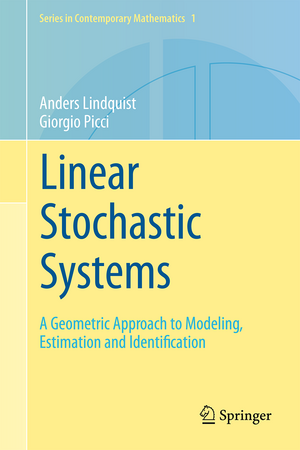
Linear Stochastic Systems
Autor Anders Lindquist, Giorgio Piccien Limba Engleză Hardback – 11 mai 2015
Prin integrarea unor exerciții de modelare și studii de caz ce vizează procesele staționare de ordinul doi, Linear Stochastic Systems se impune ca o resursă fundamentală pentru cercetarea avansată în inginerie și științe aplicate. Putem afirma că rigoarea acestei lucrări rezidă în abordarea geometrică inedită, care înlocuiește coordonatele clasice cu intuiția oferită de geometria spațiilor Hilbert. Această metodă permite o viziune unificată asupra unor concepte complexe precum filtrarea, estimarea și identificarea sistemelor, transformând teoria realizării stocastice într-un cadru logic coerent. Structura volumului reflectă o progresie didactică și analitică meticulos planificată. Primele capitole pun bazele geometrice și spectrale, continuând cu descompunerea Wold și factorizarea spectrală, atât în timp discret, cât și continuu. Ulterior, autorii Anders Lindquist și Giorgio Picci explorează teme de frontieră, precum echilibrarea stocastică, reducerea modelului și identificarea subspațiilor pentru serii temporale. Această ediție din 2015 însumează peste trei decenii de contribuții teoretice ale autorilor, oferind instrumentele matematice necesare pentru a analiza algoritmi moderni de control și semnal. Comparabil cu Stochastic Processes in Engineering Systems de E. Wong în ceea ce privește rigoarea tratării proceselor staționare, volumul de față este actualizat pentru complexitatea sistemelor stocastice contemporane, punând un accent mai mare pe spațiul stărilor și pe structura geometrică a subspațiilor de divizare. Față de lucrarea colectivă New Directions and Applications in Control Theory, unde Lindquist a contribuit în contextul unei conferințe, acest tratat oferă o sinteză monografică mult mai structurată și unitară. Suntem de părere că includerea anexelor despre algebra liniară și teoria realizării deterministe face din acest volum o referință de sine stătătoare pentru orice laborator de cercetare în cibernetică.
Preț: 1067.99 lei
Preț vechi: 1302.42 lei
-18%
Carte tipărită la comandă
Livrare economică 27 noiembrie-11 decembrie
Specificații
ISBN-10: 3662457490
Pagini: 800
Ilustrații: XV, 781 p. 37 illus.
Dimensiuni: 160 x 241 x 48 mm
Greutate: 1.3 kg
Ediția:2015
Editura: Springer
Locul publicării:Berlin, Heidelberg, Germany
V-ar putea interesa
-
 The Mathematical Theory of CommunicationClaude E ShannonPreț: 170.90 lei
 -
 -29%Preț: 459.36 lei645.23 lei
 -
 Adaptive Filter TheorySimon Haykin-11%Preț: 693.61 lei779.33 lei
 -
 Signals and Systems Using MATLAB®Aydin Akan-32%Preț: 669.76 lei981.55 lei
 -
 -28%Preț: 530.42 lei738.22 lei
 -
 -19%Preț: 430.60 lei531.60 lei
 -
 -23%Preț: 175.25 lei227.99 lei
 -
 Linear System Theory: The State Space ApproachLofti A. ZadehPreț: 207.90 lei
 -
 Optimal Control and EstimationRobert F. Stengel-20%Preț: 212.35 lei264.50 lei
 -
 Optimal Estimation of Dynamic SystemsJohn L. Crassidis-8%Preț: 504.66 lei548.54 lei
 -
 Kalman Filtering: Theory and Practice with MATLABMohinder S. Grewal-5%Preț: 662.84 lei697.72 lei
 -
 Linear SystemsGordon BlowerPreț: 428.24 lei
 -
 Robust and Adaptive ControlEugene LavretskyPreț: 533.14 lei
 -
 State Estimation for Nonlinear Continuous-Discrete Stochastic SystemsGennady Yu. Kulikov-18%Preț: 762.47 lei929.85 lei
 -
 Probability Theory IIAndrea PascucciPreț: 470.50 lei
 -
 An Introduction to the Modern Martingale Theory and ApplicationsWilfredo Urbina-Romero-13%Preț: 398.10 lei457.59 lei
 -
 Stochastic Models, Statistics and Their ApplicationsAnsgar Steland-20%Preț: 1175.30 lei1469.13 lei
 -
 Preț: 458.21 lei
 -
 Markov ChainsRandal Douc-15%Preț: 603.62 lei710.14 lei
Public țintă
ResearchDe ce să citești această carte
Recomandăm această carte cercetătorilor care doresc să stăpânească fundamentele geometrice ale modelării stocastice. Cititorul câștigă o înțelegere profundă a sistemelor liniare prin prisma spațiilor Hilbert, depășind simpla aplicare a unor formule. Este o investiție intelectuală esențială pentru cei care lucrează în identificarea sistemelor și procesarea semnalelor, oferind o bază teoretică ce va rămâne relevantă pentru deceniile următoare.