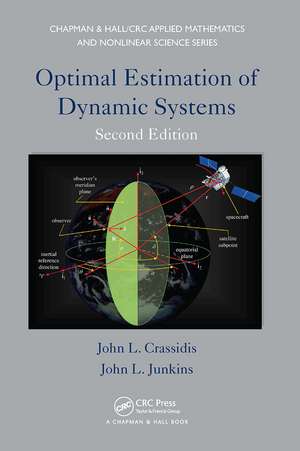
Optimal Estimation of Dynamic Systems: Advances in Applied Mathematics
Autor John L. Crassidis, John L. Junkinsen Limba Engleză Paperback – 14 oct 2024
New to the Second Edition
With more than 100 pages of new material, this reorganized edition expands upon the best-selling original to include comprehensive developments and updates. It incorporates new theoretical results, an entirely new chapter on advanced sequential state estimation, and additional examples and exercises.
An ideal self-study guide for practicing engineers as well as senior undergraduate and beginning graduate students, the book introduces the fundamentals of estimation and helps newcomers to understand the relationships between the estimation and modeling of dynamical systems. It also illustrates the application of the theory to real-world situations, such as spacecraft attitude determination, GPS navigation, orbit determination, and aircraft tracking.
Din seria Advances in Applied Mathematics
- 9%
 Preț: 2021.28 lei
 - 8%
 Preț: 591.96 lei
 - 18%
 Preț: 900.57 lei
 - 18%
 Preț: 723.81 lei
 - 15%
 Preț: 485.34 lei
 - 18%
 Preț: 944.32 lei
 - 18%
 Preț: 734.28 lei
 - 18%
 Preț: 734.28 lei
 - 15%
 Preț: 630.34 lei
 - 18%
 Preț: 1465.22 lei
 - 9%
 Preț: 977.87 lei
 - 15%
 Preț: 559.16 lei
 - 18%
 Preț: 853.65 lei
 - 15%
 Preț: 617.08 lei
 - 18%
 Preț: 890.63 lei
 - 18%
 Preț: 723.11 lei
 - 20%
 Preț: 618.96 lei
 - 20%
 Preț: 484.86 lei
 - 18%
 Preț: 912.44 lei
 - 15%
 Preț: 575.76 lei
 - 18%
 Preț: 1070.67 lei
 - 15%
 Preț: 693.08 lei
 - 15%
 Preț: 615.38 lei
 - 18%
 Preț: 964.66 lei
 - 15%
 Preț: 488.59 lei
 - 15%
 Preț: 472.67 lei
 - 15%
 Preț: 694.89 lei
 - 18%
 Preț: 1073.49 lei
 - 8%
 Preț: 428.03 lei
 - 18%
 Preț: 780.31 lei
 - 18%
 Preț: 894.05 lei
 - 18%
 Preț: 981.07 lei
 - 18%
 Preț: 792.76 lei
 - 15%
 Preț: 468.72 lei
 - 18%
 Preț: 833.98 lei
Preț: 504.66 lei
Preț vechi: 548.54 lei
-8%
Puncte Express: 757
Carte disponibilă
Livrare economică 09-23 noiembrie
Livrare express 24-30 octombrie pentru 57.75 lei
Livrare prin curier în România Termenul estimat este afișat lângă disponibilitate.
Transport gratuit pentru acest produs Plată online sau ramburs, în funcție de opțiunile comenzii.
Retur gratuit în 14 zile Comandă securizată și suport în română.
Specificații
ISBN-13: 9781032917610
ISBN-10: 103291761X
Pagini: 750
Ilustrații: 117
Dimensiuni: 156 x 234 x 42 mm
Greutate: 1.08 kg
Ediția:2nd edition
Editura: CRC Press
Colecția Chapman and Hall/CRC
Seria Advances in Applied Mathematics
Locul publicării:Boca Raton, United States
ISBN-10: 103291761X
Pagini: 750
Ilustrații: 117
Dimensiuni: 156 x 234 x 42 mm
Greutate: 1.08 kg
Ediția:2nd edition
Editura: CRC Press
Colecția Chapman and Hall/CRC
Seria Advances in Applied Mathematics
Locul publicării:Boca Raton, United States
V-ar putea interesa
-
 Dynamics of FlightBernard Etkin-27%Preț: 1698.82 lei2327.15 lei
 -
 Dynamics of Atmospheric FlightBernard EtkinPreț: 142.85 lei
 -
 Atmospheric and Space Flight DynamicsAshish Tewari-18%Preț: 727.98 lei887.78 lei
 -
 -15%Preț: 711.74 lei837.35 lei
 -
 Civil Avionics Systems 2eAllan Seabridge-23%Preț: 719.04 lei933.81 lei
 -
 -23%Preț: 792.96 lei1029.81 lei
 -
 -20%Preț: 1168.36 lei1460.45 lei
 -
 Fundamentals of Aerospace MedicineDr. Jeffrey Davis MD-18%Preț: 2014.07 lei2455.94 lei
Public țintă
AcademicCuprins
Least Squares Approximation. Probability Concepts in Least Squares. Sequential State Estimation. Advanced Topics in Sequential State Estimation. Batch State Estimation. Parameter Estimation: Applications. Estimation of Dynamic Systems: Applications. Optimal Control and Estimation Theory. Appendices. Index.
Recenzii
Praise for the First Edition
A nice feature of this book is that it makes the effort to explain the underlying principles behind the formula for each algorithm; the relationship between different algorithms is equally well addressed. … The text is a good combination of theory and practice. It will be a valuable addition to references for academic researchers and industrial engineers working in the field of estimation. It will also serve as a useful reference for graduate courses in control and estimation.
—AIAA Journal, Vol. 43, No. 1, January 2005
A nice feature of this book is that it makes the effort to explain the underlying principles behind the formula for each algorithm; the relationship between different algorithms is equally well addressed. … The text is a good combination of theory and practice. It will be a valuable addition to references for academic researchers and industrial engineers working in the field of estimation. It will also serve as a useful reference for graduate courses in control and estimation.
—AIAA Journal, Vol. 43, No. 1, January 2005
Notă biografică
John L. Crassidis, Ph.D., is a professor of mechanical and aerospace engineering and the associate director of the Center for Multisource Information Fusion at the University at Buffalo, State University of New York. He previously worked at Texas A&M University, the Catholic University of America, and NASA’s Goddard Space Flight Center, where he contributed to attitude determination and control schemes for numerous spacecraft missions.
John L. Junkins, Ph.D., is a distinguished professor of aerospace engineering and the founder and director of the Center for Mechanics and Control at Texas A&M University. In addition to his historical contributions in analytical dynamics and spacecraft GNC, Dr. Junkins and his team have designed, developed, and demonstrated several new electro-optical sensing technologies.
John L. Junkins, Ph.D., is a distinguished professor of aerospace engineering and the founder and director of the Center for Mechanics and Control at Texas A&M University. In addition to his historical contributions in analytical dynamics and spacecraft GNC, Dr. Junkins and his team have designed, developed, and demonstrated several new electro-optical sensing technologies.
Descriere
An ideal self-study guide for practicing engineers as well as senior undergraduate and beginning graduate students, this book highlights the importance of both physical and numerical modeling in solving dynamics-based estimation problems found in engineering systems, such as spacecraft attitude determination, GPS navigation, orbit determination,