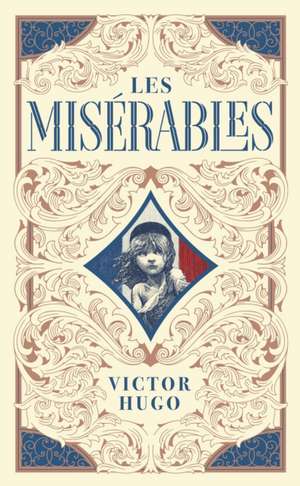
Les Miserables
Autor Victor Hugoen Limba Engleză Hardback – 30 mar 2017
Credem că introducerea copiilor în universul marilor clasici necesită o poartă de acces prietenoasă, iar această ediție din seria Classics Illustrated reușește să transforme complexitatea lui Victor Hugo într-o experiență vizuală captivantă. Valoarea educativă a volumului rezidă în capacitatea sa de a dezvolta empatia și simțul dreptății, prezentând lupta personajului Jean Valjean pentru mântuire într-un format accesibil de 48 de pagini. Notăm cu interes modul în care ilustrațiile semnate de Gerald McCann și Norman Nodel dau viață Parisului din secolul al XIX-lea, oferind repere vizuale esențiale pentru înțelegerea contextului istoric al Rebeliunii din Iunie.
Spre deosebire de romanele sale monumentale precum The Hunchback of Notre-Dame, unde arhitectura și destinul tragic domină, Les Miserables se concentrează pe transformarea interioară și pe forța binelui. Merită menționat că această versiune nu este doar o simplă scurtare, ci o reinterpretare grafică ce păstrează esența dilemelor morale dintre Jean Valjean și inspectorul Javert. Pe același raft cu Oxford Bookworms Library: Level 1:: Les Misérables audio pack, această carte se adresează copiilor de peste 10 ani care caută o narațiune dinamică, fiind ideală pentru cei care preferă să descopere istoria prin intermediul benzilor desenate înainte de a aborda textul integral.
Preț: 248.66 lei
Preț vechi: 344.36 lei
-28%
Carte disponibilă
Livrare economică 06-20 noiembrie
Livrare express 23-29 octombrie pentru 186.25 lei
Specificații
ISBN-10: 1435163699
Pagini: 928
Dimensiuni: 160 x 238 x 54 mm
Greutate: 1.53 kg
Ediția:General, Bonded Leather
Editura: Little Brown
Colecția BookAnnex
Locul publicării:London, United Kingdom
V-ar putea interesa
-
 Lady Chatterley's LoverD. H. LawrencePreț: 28.01 lei
 -
 The IliadHomerPreț: 81.29 lei
 -
 Giovanni's RoomJames Baldwin-36%Preț: 44.93 lei69.97 lei
 -
 Vanity FairWilliam Makepeace Thackeray-43%Preț: 114.26 lei199.11 lei
 -
 Anna KareninaLeo TolstoyPreț: 199.11 lei
 -
 The Jungle BooksRudyard Kipling-17%Preț: 103.98 lei124.95 lei
 -
 CranfordElizabeth Gaskell-18%Preț: 101.07 lei123.25 lei
 -
 American Supernatural TalesS T Joshi-23%Preț: 170.96 lei223.39 lei
 -
 Crime and Punishment: (OWC Hardback)Fyodor Dostoevsky-16%Preț: 118.28 lei140.89 lei
 -
 Anna KareninaLeo Tolstoy-16%Preț: 125.74 lei149.05 lei
 -
 Frankenstein: or `The Modern Prometheus': The 1818 TextMary Wollstonecraft Shelley-18%Preț: 101.04 lei123.20 lei
 -
 Oliver TwistCharles Dickens-15%Preț: 51.23 lei60.15 lei
 -
 Daisy Miller and Other StoriesHenry JamesPreț: 45.93 lei
 -
 War and PeaceLeo Tolstoy-28%Preț: 145.95 lei201.92 lei
 -
 Narrative of the Life of Frederick DouglassFrederick Douglass-19%Preț: 23.42 lei28.76 lei
 -
 DraculaBram Stoker-15%Preț: 38.13 lei44.92 lei
 -
 The Scarlet PimpernelEmmuska OrczyPreț: 36.11 lei
 -
 Fairy TalesHans Christian Andersen-22%Preț: 151.19 lei193.83 lei
 -
 Witchfinder Omnibus Volume 1Mike MignolaPreț: 280.56 lei
 -
 EmmaJane AustenPreț: 93.32 lei
 -
 A Tale of Two CitiesCharles DickensPreț: 83.14 lei
 -
 Doris Lessing StoriesDoris Lessing Trust-31%Preț: 100.38 lei145.93 lei
 -
 The Sea, The Sea & A Severed HeadIris Murdoch-24%Preț: 97.09 lei127.33 lei
 -
 The MoonstoneWilkie CollinsPreț: 32.30 lei
 -
 Jane EyreCharlotte BrontëPreț: 126.40 lei
 -
 The Tenant of Wildfell HallAnne BrontePreț: 149.63 lei
De ce să citești această carte
Recomandăm această adaptare grafică părinților care doresc să le cultive copiilor gustul pentru literatura clasică fără a-i copleși. Cititorul câștigă o înțelegere clară a valorilor morale și a istoriei franceze, totul prin intermediul unui ritm narativ alert și al unor ilustrații sugestive. Este un instrument excelent pentru a discuta despre iertare, onestitate și diferența dintre litera legii și spiritul dreptății.
Despre autor
Victor-Marie Hugo (1802–1885) a fost o figură centrală a mișcării romantice franceze, fiind un scriitor prolific a cărui carieră a cuprins peste șase decenii. Cunoscut la nivel mondial pentru romanele sale iconice Les Miserables și The Hunchback of Notre-Dame, Hugo a fost nu doar un maestru al prozei și poeziei, ci și un activist social dedicat, militând constant pentru abolirea pedepsei cu moartea și pentru dreptate socială. Opera sa reflectă profundele schimbări politice ale Franței, trecând de la regalism la un republicanism pasionat, teme care se regăsesc în structura morală a tuturor lucrărilor sale.
Descriere
One of the most widely read novels of all time, Les Miserables was the crowning literary achievement of Victor Hugo's career. An enormous melodrama set against the background of political upheaval in France following the rule of Napoleon I, the novel tells the story of the peasant Jean Valjean - unjustly imprisoned and hounded by his nemesis, the magnificently realized police detective, Javert. A monumental classic dedicated to the oppressed, Les Miserables captures the entirety of life in 19th-century France.
Descriere scurtă
Notă biografică
Julie Rose’s acclaimed translations include Alexandre Dumas’s The Knight of Maison-Rouge and Racine’s Phèdre, as well as works by Paul Virilio, Jacques Rancière, Chantal Thomas, and many others. She is a recipient of the PEN medallion for translation and the New South Wales Premier’s Translation Prize.
Adam Gopnik is the author of Paris to the Moon and Through the Children’s Gate, and editor of the Library of America anthology Americans in Paris. He writes on various subjects for The New Yorker and has recently written introductions to works by Maupassant, Balzac, Proust, and Alain-Fournier.
Recenzii
"It was Tolstoy who vindicated [Hugo's] early ambition by judging Les Misérables one of the world's great novels, if not the greatest… [His] ability to present the extremes of experience 'as they are' is, in the end, Hugo's great gift." —From the Introduction by Peter Washington
Extras
by Peter Washington
-
Victor Hugo might be regarded as the Mr Toad of French literature: vain, arrogrant, pompous, selfish, cold and stingy; a windbag, a humbug and a fraud, absurdly puffed up with the immensity of his own greatness. But unlike Mr Toad, he was also an astute and energetic promoter of hisown image as a Great Man. The process began early. Writing in Hugo's lifetime, Virginie Ancelot recalls the reception the young poet received in literary drawing-rooms when he arrived to read his latest ode.
"...There was a few moments' silence; then someone rose and approached him with visible emotion, took his hand and raised their eyes to heaven.
The multitude listened.
A single word was heard, to the great surprise of the uninitiated. And this word, which echoed in every corner of the salon, was:
'Cathedral!'
Then the orator returned to his place; another rose and cried out:
'Ogive!'
A third looked round him and ventured:
'Egyptian Pyramid!'
The assembly applauded, and then it was lost in profound reflection."
To the Anglo-Saxon mind - and, it should be said, to many Frenchmen - this is Parisian literary life at its worst: the posturing, the pretension, the self-regard, masquerading under the name of art. Yet Hugo is the man who wrote a handful of the most exquisite lyrics - 'Victor Hugo, helas!'said Gide when someone asked him to name the finest French poet - and at least one novel judged to be supreme. In his person, he sums up all that is most monsterous in writerly vanity; in his best work he transcended his failings. How did he do it? How did a monster come to write the masterpiece that is Les Miserables?
*
In an early essay on Scott, Hugo prophesies that
"After the picturesque but prosaic novel of Walter Scott, there will still be another novel to create ... It is the novel which is at once drama and epic, picturesque and poetic, real and ieal, true and great, the novel which will enshrine Walter Scott in Homer."
These words were written in 1823, just after the publication of his own first novel, Han d'Islande, and there is no doubt that Hugo had himself in mind as the man who could 'enshrine Walter Scott as Homer'. Anyone who can still get through this book may take a rather different view. Set in seventeeth-century Norway and dripping with gore on every page, Han d'Islande is nearer to the Gothic horror tradition than to Scott. For the man who really succeeded in reconciling the genres of epic and historic fiction we have to look further afield, to Hugo's own admirerer, Tolstoy. Yet it was Tolstoy who vindicated the French novelist's early ambition by judging Les Miserables one of the world's great novels, if not the greates, and acknowledged its effect on his own work.
Les Miserables was completed in 1862, shortly before the Russian novelist began War and Peace. The two novels are set in the same period. It cannot be said that Hugo had much to teach his junior about structure or characterization; like all his attempts at epic, in prose and verse, Les Miserables rambles, there are huge digressions and absurdities of plot, the characters are often thin, the action melodramatic. But in spacious, vigorous story-telling, in the use of an historical framework, in the relating of human events to a larger philosophical and spiritual context, in the deployment of fiction as a social and political weapon, in the exalatation of 'the people' as a supreme authority, in the treatment of suffering as a dominant theme - in all these matters, Hugo exerted a profound influence on Tolstoy. Without his example, War and Peace might have been a very different novel.
Perhaps the most extraordinary point of contact between them concerns Napoleon. One might expect the emperor to intrigue European writers in the early nineteenth century, as he intrigues Byron, Balzac and Stendhal, among others, but by the 1860s almost half a century had passed since Waterloo, yet Hugo and Tolstoy are still trying to unravel the mystery of one whose shadow falls across the entire century.
For Tolstoy, Napoleon is pre-eminently a human being - an extraordinary man, certainly, the instrument of destiny, but still a man. For Hugo he is more like a superman, a mysterious brooding presence with almost divine powers. The point is made by an ironic comparison between Napoleon and Wellington. Hugo's argument seems to be that Napoleon ought to have won Waterloo by sheer force of genius - indeed, that he did win it, when judged according to the rules of natural justice - but that Wellington achieved a victory on points by taking more care to spy out the lay of the battlefield and to estimate the balance of forces. Calculation is everything to the mundane Englishman, imagination nothing. When lightning flashes round the emperor's head, the duke looks like a very ordinary man. While Napoleon surveys the heavens, Wellington consults his watch.
Clearly, the image of general as genius was vital to Hugo's own project of himself as a literary Napoleon, but there is more to it than that. Commentators have often lamented the digression on Waterloo which is quite unnecessary to the plot and, coming early in the book, throws it decisively out of its narrative stride. But Hugo, though careless of structural refinement, does have a more serious purpose here - a purpose from which Tolstoy must have learnt much, and not only in his description of Borodino. For Hugo, who in turn learnt so much from Scott, grasped the fact that by imprinting the significance of a decisive historical moment on the minds of his readers he could hugely enlarge the scope of his novel. Precisely because Les Miserables is about little people, the history of a great man is one means of linking their petty lives with the Infinite. (The link is made touchingly explicit in the chapter called 'In Which Little Gavroche Takes Advantage of Napoleon the Great'.) Even events as great as Waterloo, we are told, can hinge on details: the location of a ditch, the arrival of a platoon. Conversely, the most trivial life may exemplify a great truth - and in that sense, all lives are equally significant, for every existence embodies these truths.
At the same time, Hugo's treatment of Waterloo makes it clear that realities and appearances diverge as much in everyday life as they do in historical interpretation - and that the two divergences are linked. What a post-Waterloo Frenchman thinks of Napoleon helps to shape what he thinks of himself. Sometimes we try to envision history in our own image; sometimes we use it to understand ourselves; at all times we are formed by it without our knowledge. One function of fiction is to help us achieve that knowledge. Les Miserables is, among other things, an attempt to explain the people of the mid-nineteenth century to themselves. Jean Valjean finds himself in a certain situation because he is a poor Frenchman at a particular time. This is one version of Fate - the sociological and political explanation of things. But Valjean is like Waterloo: his life also has a deeper purpose, a hidden meaning. Hugo has a number of names for this meaning - Fate, Destiny, God, the Infinite. But whatever he calls it, we observe a complex dialogue throughout the book between the surface causes of Valjean's predicament - poverty and ignorance - and their deeper meaning, to which he penetrates through suffering.