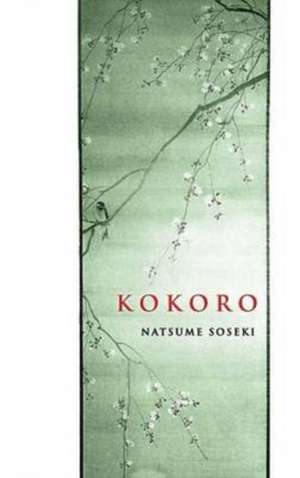
Kokoro
Autor Natsume Soseki Traducere de Edwin Mcclellanen Limba Engleză Paperback – 11 aug 2006
What is love, and what is friendship? What is the extent of our responsibility to ourselves and to others? "Kokoro, " signifying "the heart of things," examines these age-old questions in terms of the modern world.
A trilogy of stories that explores the very essence of loneliness, "Kokoro" opens with "Sensei and I," in which the narrator recounts his relationship with an intellectual who dwells in isolation but maintains a sophisticated worldview. "My Parents and I" brings the reader into the narrator's family circle, and "Sensei and His Testament" features the eponymous character's explanation of how he came to live a life of solitude.
Natsume Soseki (18671916), perhaps the greatest novelist of the Meiji period, remains one of Japan's most widely read authors. He wrote this novel in 1914, at the peak of his career, and it remains an excellent introduction to modern Japanese literature."
Preț: 83.71 lei
Puncte Express: 126
Carte disponibilă
Livrare economică 31 octombrie-14 noiembrie
Livrare prin curier în România Termenul estimat este afișat lângă disponibilitate.
Transport gratuit de la 400.00 lei Plată online sau ramburs, în funcție de opțiunile comenzii.
Retur gratuit în 14 zile Comandă securizată și suport în română.
Specificații
ISBN-13: 9780486451398
ISBN-10: 0486451399
Pagini: 208
Dimensiuni: 136 x 215 x 12 mm
Greutate: 0.22 kg
Editura: Dover Publications
ISBN-10: 0486451399
Pagini: 208
Dimensiuni: 136 x 215 x 12 mm
Greutate: 0.22 kg
Editura: Dover Publications
V-ar putea interesa
-
 And Then There Were NoneAgatha ChristiePreț: 103.05 lei
 -
 OutNatsuo Kirino-17%Preț: 65.80 lei79.60 lei
 -
 SanshiroNatsume Soseki-26%Preț: 58.75 lei79.02 lei
 -
 Thousand CranesYasunari KawabataPreț: 69.28 lei
 -
 BotchanNatsume Soseki-34%Preț: 51.04 lei77.76 lei
 -
 I Have the Right to Destroy MyselfYoung-Ha KimPreț: 71.77 lei
 -
 The Devotion Of Suspect X: A DETECTIVE GALILEO NOVELKeigo Higashino-24%Preț: 61.24 lei80.82 lei
 -
 Japanese TalesRoyall TylerPreț: 147.54 lei
 -
 Accessory to WarAvis LangPreț: 204.99 lei
 -
 The Metamorphosis and Other StoriesFranz Kafka-19%Preț: 23.12 lei28.58 lei
 -
 KitchenBanana Yoshimoto-21%Preț: 55.53 lei69.95 lei
 -
 The Goal: A Business Graphic NovelEliyahu GoldrattPreț: 217.66 lei
 -
 solaninInio Asano-17%Preț: 115.66 lei139.37 lei
 -
 Preț: 94.29 lei
 -
 Breasts and EggsMieko Kawakami-32%Preț: 49.98 lei73.29 lei
 -
 The Decagon House MurdersYukito AyatsujiPreț: 79.65 lei
 -
 Call Me By Your NameAndre Aciman-18%Preț: 59.10 lei72.28 lei
 -
 Convenience Store WomanSayaka Murata-20%Preț: 57.02 lei71.05 lei
 -
 SchoolgirlOsamu Dazai-25%Preț: 47.31 lei63.08 lei
 -
 Spy x Family, Vol. 2Tatsuya Endo-19%Preț: 52.67 lei64.76 lei
 -
 -18%Preț: 71.02 lei86.90 lei
 -
 Preț: 71.01 lei
 -
 Botchan: A Novel by Soseki NatsumeSoseki NatsumePreț: 72.22 lei
 -
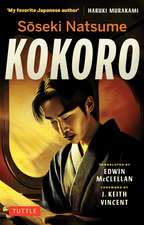 Soseki Natsume Kokoro: A Classic Novel of JapanSoseki NatsumePreț: 92.20 lei
Cuprins
Part One: Sensei and I Part Two: My Parents and I Part Three: Sensei and His Testament
Notă biografică
Natsume Soseki (1867-1916), one of Japan's most influential modern writers, is widely considered the foremost novelist of the Meiji era (1868-1914). Born Natsume Kinnosuke in Tokyo, he graduated from Tokyo University in 1893 and then taught high school English. He went to England on a Japanese government scholarship, and when he returned to Japan he lectured on English literature at Tokyo University and began his writing career with the novel Botchan. Numerous nervous disorders forced him to give up teaching in 1908, and he became a full-time writer. He wrote fourteen novels, including I Am A Cat and Kusamakura, as well as haiku, poems in the Chinese style, academic papers on literary theory, essays, autobiographical sketches, and fairy tales. His work enjoyed wide popularity in his lifetime and secured him a permanent place in Japanese literature.
Meredith McKinney holds a PhD in medieval Japanese literature from the University in Canberra, where she teaches in the Japan Centre. She lived and taught in Japan for twenty years and now lives near Braidwood, New South Wales. Her other translations include Ravine and Other Stories, The Tale of Saigyo, and for Penguin Classics, The Pillow Book of Sei Shonagon and Kusamakura.
Meredith McKinney holds a PhD in medieval Japanese literature from the University in Canberra, where she teaches in the Japan Centre. She lived and taught in Japan for twenty years and now lives near Braidwood, New South Wales. Her other translations include Ravine and Other Stories, The Tale of Saigyo, and for Penguin Classics, The Pillow Book of Sei Shonagon and Kusamakura.
Descriere
Descriere de la o altă ediție sau format:
"The subject of 'Kokoro,' which can be translated as 'the heart of things' or as 'feeling,' is the delicate matter of the contrast between the meanings the various parties of a relationship attach to it. In the course of this exploration, Soseki brilliantly describes different levels of friendship, family relationships, and the devices by which men attempt to escape from their fundamental loneliness. The novel sustains throughout its length something approaching poetry, and it is rich in understanding and insight. The translation, by Edwin McClellan, is extremely good."
—Anthony West, The New Yorker