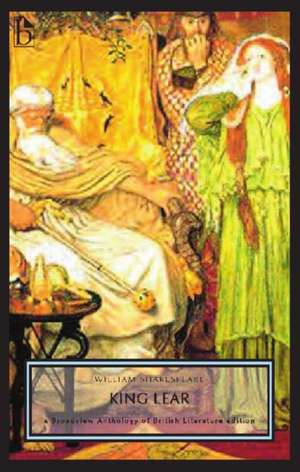
King Lear
Autor William Shakespeare Editat de Craig Walker Joseph Black, Leonard Conolly, Kate Flint, Isobel Grundy, Don LePan, Roy Liuzza, Jerome J. McGann, Anne Lake Prescott, Barry V. Qualls, Claire Watersen Limba Engleză Paperback – 10 iul 2010
Also included in this edition are excerpts from a variety of literary source materials (including Geoffrey on Monmouth’s Historia Regum Britanniae, the anonymous True Chronicle Historie of King Leir, and Samuel Harsnett’s A Declaration of Egregious Popish Impostures); material on the historical Annesley case that raised many of the same issues as does Shakespeare’s play; and the happy ending from Nahum Tate’s version of the play, which held the stage for 150 years after its first performance in 1681.
Preț: 122.04 lei
Preț vechi: 141.04 lei
-13%
Puncte Express: 183
Preț estimativ în valută:
21.58€ • 25.10$ • 18.67£
21.58€ • 25.10$ • 18.67£
Carte disponibilă
Livrare economică 02-16 aprilie
Specificații
ISBN-13: 9781551119670
ISBN-10: 1551119676
Pagini: 240
Dimensiuni: 140 x 216 x 12 mm
Greutate: 0.33 kg
Editura: BROADVIEW PR
Colecția Broadview Press
Locul publicării:Peterborough, Canada
ISBN-10: 1551119676
Pagini: 240
Dimensiuni: 140 x 216 x 12 mm
Greutate: 0.33 kg
Editura: BROADVIEW PR
Colecția Broadview Press
Locul publicării:Peterborough, Canada
V-ar putea interesa
-
 Jane EyreCharlotte BrontePreț: 24.60 lei
 -
 Invisible CitiesItalo Calvino-21%Preț: 53.24 lei67.61 lei
 -
 A Farewell to ArmsErnest Hemingway-20%Preț: 48.94 lei61.46 lei
 -
 On the Shoulders of GiantsStephen Hawking-18%Preț: 128.19 lei155.80 lei
 -
 -17%Preț: 112.48 lei135.30 lei
 -
 The FountainheadAyn Rand-16%Preț: 61.12 lei72.38 lei
 -
 From Bauhaus to Our HouseTom WolfePreț: 84.42 lei
 -
 The Tipping Point: How Little Things Can Make a Big DifferenceMalcolm Gladwell-28%Preț: 64.10 lei88.81 lei
 -
 MacbethWilliam ShakespearePreț: 26.27 lei
 -
 Pride and PrejudiceJane Austen-18%Preț: 34.42 lei42.16 lei
 -
 Theories of Modern Art – A Source Book By Artists & CriticsHerschel B. ChippPreț: 249.53 lei
 -
 Alice's Adventures in WonderlandLewis CarrollPreț: 35.06 lei
 -
 Great ExpectationsCharles DickensPreț: 36.61 lei
 -
 Tess of the d'UrbervillesThomas HardyPreț: 35.85 lei
 -
 A Portrait of the Artist as a Young ManJames JoycePreț: 34.92 lei
 -
 HamletWilliam ShakespearePreț: 34.63 lei
 -
 OthelloWilliam ShakespearePreț: 34.25 lei
 -
 MacbethCedric WattsPreț: 33.89 lei
 -
 The Great GatsbyF. Scott FitzgeraldPreț: 34.45 lei
Recenzii
The text of the play included here, prepared by Craig Walker for The Broadview Anthology of British Literature, has been acclaimed for its outstanding introductory material and annotations, and for its inclusion of parellel text versions of key scenes for which the texts of the Quarto and the Folio versions of the play are substantially different.
Also included in this edition are excerpts from a variety of literary source materials (including Geoffrey on Monmouth’s Historia Regum Britanniae, the anonymous True Chronicle Historie of King Leir, and Samuel Harsnett’s A Declaration of Egregious Popish Impostures); material on the historical Annesley case that raised many of the same issues as does Shakespeare’s play; and the happy ending from Nahum Tate’s version of the play, which held the stage for 150 years after its first performance in 1681.
“The Broadview chooses the Folio as the basic text, but, significantly, adds notes throughout that point out the differences appearing in the Quarto version. In addition, in the case of the three scenes in which differences are most pronounced, the anthology prints both Folio and Quarto versions side by side. This method opens up illuminating and exciting possibilities in the classroom.... I regard the unhesitating confrontation with the difficulties of King Lear that is shown by the Broadview editors as a microcosmic illustration of the toughness, determination, and conscientiousness of the editors throughout this entire British literature anthology.” — Robert H. Ray, Baylor University (author of Approaches to Teaching Shakespeare’s King Lear)
“... an exciting achievement ... It sets a new standard by which all other anthologies of British Literature will now have to be measured.” — Graham Hammill, SUNY—Buffalo
“The Broadview Anthology of British Literature is no mere pretender to the throne long held by Norton; it is the new standard.” — Richard Nordquist, Armstrong Atlantic State University
Also included in this edition are excerpts from a variety of literary source materials (including Geoffrey on Monmouth’s Historia Regum Britanniae, the anonymous True Chronicle Historie of King Leir, and Samuel Harsnett’s A Declaration of Egregious Popish Impostures); material on the historical Annesley case that raised many of the same issues as does Shakespeare’s play; and the happy ending from Nahum Tate’s version of the play, which held the stage for 150 years after its first performance in 1681.
“The Broadview chooses the Folio as the basic text, but, significantly, adds notes throughout that point out the differences appearing in the Quarto version. In addition, in the case of the three scenes in which differences are most pronounced, the anthology prints both Folio and Quarto versions side by side. This method opens up illuminating and exciting possibilities in the classroom.... I regard the unhesitating confrontation with the difficulties of King Lear that is shown by the Broadview editors as a microcosmic illustration of the toughness, determination, and conscientiousness of the editors throughout this entire British literature anthology.” — Robert H. Ray, Baylor University (author of Approaches to Teaching Shakespeare’s King Lear)
“... an exciting achievement ... It sets a new standard by which all other anthologies of British Literature will now have to be measured.” — Graham Hammill, SUNY—Buffalo
“The Broadview Anthology of British Literature is no mere pretender to the throne long held by Norton; it is the new standard.” — Richard Nordquist, Armstrong Atlantic State University
Cuprins
Introduction
In Context
- William Shakespeare 1564–1616
King Lear
In Context
- The Shakespearean Theater
- The Swan Theatre
Titus Andronicus in Performance
The Plot of an Elizabethan Play - Early Editions of King Lear
Source Material - from Geoffrey of Monmouth, The History of the Kings of Britain (12th century)
Cap o’ Rushes
from Anonymous, The True Chronicle History of King Leir and his Three Daughters (1605)
from Raphael Holinshed, The Chronicles of England, Scotland, and Ireland (1577, 1587)
from Edmund Spenser, The Faerie Queene (1590)
The Annesley Case
from Samuel Harsnett, A Declaration of Egregious Popish Impostures (1603) - King Lear on Stage in the Seventeenth Century
- from Richard Johnson, “The Ballad of King Lear and his Three Daughters” (1620)
from Nahum Tate, The History of King Lear (1681)
Textul de pe ultima copertă
The general editors of the new series of forty-two volumes -- renowned Shakespeareans Stephen Orgel of Stanford University and A. R. Braunmuller of UCLA -- have assembled a team of six eminent scholars who have, along with the general editors themselves, prepared new introductions and notes to all of Shakespeare's plays and poems. Redesigned in an easy-to-read format that preserves the favorite features of the original -- and including an essay on the theatrical world of Shakespeare, an introduction to the individual play, and a note on the text used -- the new Pelican Shakespeare will be an excellent resource for students, teachers, and theater professionals well into the twenty-first century.
Notă biografică
William Shakespeare was born in Stratford-upon-Avon in April 1564, and his birth is traditionally celebrated on April 23. The facts of his life, known from surviving documents, are sparse. He was one of eight children born to John Shakespeare, a merchant of some standing in his community. William probably went to the King’s New School in Stratford, but he had no university education. In November 1582, at the age of eighteen, he married Anne Hathaway, eight years his senior, who was pregnant with their first child, Susanna. She was born on May 26, 1583. Twins, a boy, Hamnet ( who would die at age eleven), and a girl, Judith, were born in 1585. By 1592 Shakespeare had gone to London working as an actor and already known as a playwright. A rival dramatist, Robert Greene, referred to him as “an upstart crow, beautified with our feathers.” Shakespeare became a principal shareholder and playwright of the successful acting troupe, the Lord Chamberlain’s Men (later under James I, called the King’s Men). In 1599 the Lord Chamberlain’s Men built and occupied the Globe Theater in Southwark near the Thames River. Here many of Shakespeare’s plays were performed by the most famous actors of his time, including Richard Burbage, Will Kempe, and Robert Armin. In addition to his 37 plays, Shakespeare had a hand in others, including Sir Thomas More and The Two Noble Kinsmen, and he wrote poems, including Venus and Adonis and The Rape of Lucrece. His 154 sonnets were published, probably without his authorization, in 1609. In 1611 or 1612 he gave up his lodgings in London and devoted more and more time to retirement in Stratford, though he continued writing such plays as The Tempest and Henry VII until about 1613. He died on April 23 1616, and was buried in Holy Trinity Church, Stratford. No collected edition of his plays was published during his life-time, but in 1623 two members of his acting company, John Heminges and Henry Condell, put together the great collection now called the First Folio.