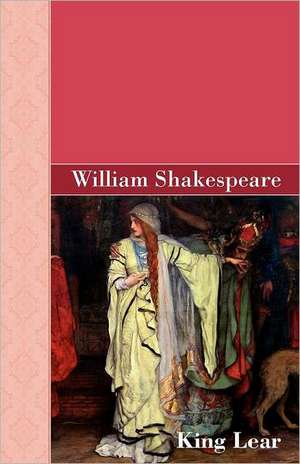
King Lear
Autor William Shakespeareen Limba Engleză Paperback – 11 feb 2010 – vârsta de la 12 până la 15 ani
Preț: 104.01 lei
Puncte Express: 156
Carte tipărită la comandă
Livrare economică 27 mai-10 iunie
Specificații
ISBN-13: 9781605126142
ISBN-10: 1605126144
Pagini: 184
Dimensiuni: 140 x 216 x 11 mm
Greutate: 0.24 kg
Editura: Akasha Classics
ISBN-10: 1605126144
Pagini: 184
Dimensiuni: 140 x 216 x 11 mm
Greutate: 0.24 kg
Editura: Akasha Classics
V-ar putea interesa
-
 Jane EyreCharlotte BrontePreț: 24.60 lei
 -
 Invisible CitiesItalo Calvino-21%Preț: 53.24 lei67.63 lei
 -
 A Farewell to ArmsErnest Hemingway-20%Preț: 48.94 lei61.49 lei
 -
 On the Shoulders of GiantsStephen Hawking-17%Preț: 128.96 lei156.01 lei
 -
 God Created the IntegersStephen Hawking-17%Preț: 112.48 lei135.34 lei
 -
 The FountainheadAyn Rand-16%Preț: 61.12 lei72.39 lei
 -
 From Bauhaus to Our HouseTom WolfePreț: 85.38 lei
 -
 The Tipping Point: How Little Things Can Make a Big DifferenceMalcolm Gladwell-28%Preț: 63.91 lei88.71 lei
 -
 MacbethWilliam ShakespearePreț: 26.55 lei
 -
 Pride and PrejudiceJane Austen-18%Preț: 34.83 lei42.31 lei
 -
 Theories of Modern ArtHerschel B. ChippPreț: 249.57 lei
 -
 Alice's Adventures in WonderlandLewis CarrollPreț: 35.22 lei
 -
 Great ExpectationsCharles DickensPreț: 36.61 lei
 -
 Tess of the d'UrbervillesThomas HardyPreț: 35.91 lei
 -
 A Portrait of the Artist as a Young ManJames JoycePreț: 35.15 lei
 -
 HamletWilliam ShakespearePreț: 34.75 lei
 -
 OthelloWilliam ShakespearePreț: 34.61 lei
 -
 MacbethCedric WattsPreț: 33.89 lei
 -
 The Great GatsbyF. Scott FitzgeraldPreț: 34.45 lei
Notă biografică
William Shakespeare (1564 - 1616) was an English poet, playwright, and actor, widely regarded as the greatest writer in the English language and the world's greatest dramatist. He is often called England's national poet and the "Bard of Avon". His extant works, including collaborations, consist of some 39 plays, 154 sonnets, and two long narrative poems. His plays have been translated into every major living language and are performed more often than those of any other playwright.
Shakespeare was born and raised in Stratford-upon-Avon, Warwickshire. At the age of 18, he married Anne Hathaway, with whom he had three children: Susanna and twins Hamnet and Judith. Sometime between 1585 and 1592, he began a successful career in London as an actor, writer, and part-owner of a playing company called the Lord Chamberlain's Men, later known as the King's Men. At age 49 (around 1613), he appears to have retired to Stratford, where he died three years later.
Shakespeare produced most of his known works between 1589 and 1613. His early plays were primarily comedies and histories and are regarded as some of the best work produced in these genres. Until about 1608, he wrote mainly tragedies, among them Hamlet, Othello, King Lear, and Macbeth, all considered to be among the finest works in the English language.
Descriere
Descriere de la o altă ediție sau format:
King Lear has ruled for many years. As age overtakes him, he divides his kingdom amongst his children. Misjudging their loyalty, he soon finds himself stripped of all the trappings of state, wealth and power that had defined him.
Arden Performance Editions are ideal for anyone engaging with a Shakespeare play in performance. With clear facing-page notes giving definitions of words, easily accessible information about key textual variants, lineation, metrical ambiguities and pronunciation, each edition has been developed to open the play's possibilities and meanings to actors and students.
Designed to be used and to be useful, each edition has plenty of space for personal annotations and the well-spaced text is easy to read and to navigate.
Each edition offers:
- Short, clear definitions of words
- Information about key textual variants
- Notes on pronunciation of difficult names and unfamiliar words
- An easy to read layout with space to write your own notes
- A short introduction to the play
King Lear has ruled for many years. As age overtakes him, he divides his kingdom amongst his children. Misjudging their loyalty, he soon finds himself stripped of all the trappings of state, wealth and power that had defined him.
Arden Performance Editions are ideal for anyone engaging with a Shakespeare play in performance. With clear facing-page notes giving definitions of words, easily accessible information about key textual variants, lineation, metrical ambiguities and pronunciation, each edition has been developed to open the play's possibilities and meanings to actors and students.
Designed to be used and to be useful, each edition has plenty of space for personal annotations and the well-spaced text is easy to read and to navigate.
Each edition offers:
- Short, clear definitions of words
- Information about key textual variants
- Notes on pronunciation of difficult names and unfamiliar words
- An easy to read layout with space to write your own notes
- A short introduction to the play
Textul de pe ultima copertă
The general editors of the new series of forty-two volumes -- renowned Shakespeareans Stephen Orgel of Stanford University and A. R. Braunmuller of UCLA -- have assembled a team of six eminent scholars who have, along with the general editors themselves, prepared new introductions and notes to all of Shakespeare's plays and poems. Redesigned in an easy-to-read format that preserves the favorite features of the original -- and including an essay on the theatrical world of Shakespeare, an introduction to the individual play, and a note on the text used -- the new Pelican Shakespeare will be an excellent resource for students, teachers, and theater professionals well into the twenty-first century.
Cuprins
Introduction
In Context
- William Shakespeare 1564–1616
King Lear
In Context
- The Shakespearean Theater
- The Swan Theatre
Titus Andronicus in Performance
The Plot of an Elizabethan Play - Early Editions of King Lear
Source Material - from Geoffrey of Monmouth, The History of the Kings of Britain (12th century)
Cap o’ Rushes
from Anonymous, The True Chronicle History of King Leir and his Three Daughters (1605)
from Raphael Holinshed, The Chronicles of England, Scotland, and Ireland (1577, 1587)
from Edmund Spenser, The Faerie Queene (1590)
The Annesley Case
from Samuel Harsnett, A Declaration of Egregious Popish Impostures (1603) - King Lear on Stage in the Seventeenth Century
- from Richard Johnson, “The Ballad of King Lear and his Three Daughters” (1620)
from Nahum Tate, The History of King Lear (1681)
Recenzii
The text of the play included here, prepared by Craig Walker for The Broadview Anthology of British Literature, has been acclaimed for its outstanding introductory material and annotations, and for its inclusion of parellel text versions of key scenes for which the texts of the Quarto and the Folio versions of the play are substantially different.
Also included in this edition are excerpts from a variety of literary source materials (including Geoffrey on Monmouth’s Historia Regum Britanniae, the anonymous True Chronicle Historie of King Leir, and Samuel Harsnett’s A Declaration of Egregious Popish Impostures); material on the historical Annesley case that raised many of the same issues as does Shakespeare’s play; and the happy ending from Nahum Tate’s version of the play, which held the stage for 150 years after its first performance in 1681.
“The Broadview chooses the Folio as the basic text, but, significantly, adds notes throughout that point out the differences appearing in the Quarto version. In addition, in the case of the three scenes in which differences are most pronounced, the anthology prints both Folio and Quarto versions side by side. This method opens up illuminating and exciting possibilities in the classroom.... I regard the unhesitating confrontation with the difficulties of King Lear that is shown by the Broadview editors as a microcosmic illustration of the toughness, determination, and conscientiousness of the editors throughout this entire British literature anthology.” — Robert H. Ray, Baylor University (author of Approaches to Teaching Shakespeare’s King Lear)
“... an exciting achievement ... It sets a new standard by which all other anthologies of British Literature will now have to be measured.” — Graham Hammill, SUNY—Buffalo
“The Broadview Anthology of British Literature is no mere pretender to the throne long held by Norton; it is the new standard.” — Richard Nordquist, Armstrong Atlantic State University
Also included in this edition are excerpts from a variety of literary source materials (including Geoffrey on Monmouth’s Historia Regum Britanniae, the anonymous True Chronicle Historie of King Leir, and Samuel Harsnett’s A Declaration of Egregious Popish Impostures); material on the historical Annesley case that raised many of the same issues as does Shakespeare’s play; and the happy ending from Nahum Tate’s version of the play, which held the stage for 150 years after its first performance in 1681.
“The Broadview chooses the Folio as the basic text, but, significantly, adds notes throughout that point out the differences appearing in the Quarto version. In addition, in the case of the three scenes in which differences are most pronounced, the anthology prints both Folio and Quarto versions side by side. This method opens up illuminating and exciting possibilities in the classroom.... I regard the unhesitating confrontation with the difficulties of King Lear that is shown by the Broadview editors as a microcosmic illustration of the toughness, determination, and conscientiousness of the editors throughout this entire British literature anthology.” — Robert H. Ray, Baylor University (author of Approaches to Teaching Shakespeare’s King Lear)
“... an exciting achievement ... It sets a new standard by which all other anthologies of British Literature will now have to be measured.” — Graham Hammill, SUNY—Buffalo
“The Broadview Anthology of British Literature is no mere pretender to the throne long held by Norton; it is the new standard.” — Richard Nordquist, Armstrong Atlantic State University