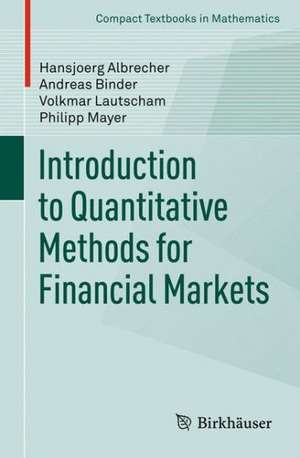
Introduction to Quantitative Methods for Financial Markets: Compact Textbooks in Mathematics
Autor Hansjoerg Albrecher, Andreas Binder, Volkmar Lautscham, Philipp Mayeren Limba Engleză Paperback – 24 iul 2013
Subliniem că acest volum se adresează în mod direct studenților la programele de Master sau MBA și practicienilor care urmăresc să își consolideze fundamentul cantitativ în analiza piețelor financiare. Spre deosebire de lucrările pur teoretice, Introduction to Quantitative Methods for Financial Markets reușește să pună în echilibru rigoarea matematică și aplicabilitatea imediată în tranzacționare. Notăm cu interes structura modulară organizată în 15 capitole independente, care permite o parcurgere selectivă în funcție de nevoile specifice: de la evaluarea opțiunilor europene și americane prin modelul Binomial sau Black-Scholes, până la calibrarea modelelor prin probleme inverse și optimizarea portofoliului. Meritǎ menționat că autorii integrează algoritmi concreți folosind Mathematica și pachetul specializat UnRisk, oferind astfel o dimensiune computațională rară în manualele introductive. Dacă Introduction to Financial Mathematics de Donald R. Chambers v-a oferit cadrul teoretic și intuiția necesară, lucrarea de față furnizează instrumentele de calcul și implementarea numerică indispensabilă în mediul corporate. Această abordare continuă viziunea autorilor expusă în lucrarea lor anterioară în limba germană, Einführung in die Finanzmathematik, rafinând conceptele despre swap-uri și produse structurate pentru un public internațional. În procesul de învățare, cititorul va progresa logic de la înțelegerea ratelor dobânzii spre metode complexe de simulare și managementul riscului de credit, beneficiind de studii de caz aplicate pe derivate exotice.
Din seria Compact Textbooks in Mathematics
-
 Preț: 355.17 lei
 -
 Preț: 389.74 lei
 -
 Preț: 361.70 lei
 -
 Preț: 332.28 lei
 -
 Preț: 421.00 lei
 -
 Preț: 389.10 lei
 - 15%
 Preț: 467.00 lei
 -
 Preț: 449.86 lei
 -
 Preț: 356.67 lei
 -
 Preț: 484.36 lei
 -
 Preț: 388.77 lei
 -
 Preț: 416.33 lei
 -
 Preț: 454.93 lei
 -
 Preț: 384.04 lei
 -
 Preț: 412.59 lei
 - 20%
 Preț: 367.83 lei
 -
 Preț: 357.66 lei
 -
 Preț: 350.49 lei
 -
 Preț: 411.38 lei
 - 15%
 Preț: 468.56 lei
 -
 Preț: 430.75 lei
 -
 Preț: 395.75 lei
 -
 Preț: 351.47 lei
 -
 Preț: 383.92 lei
 -
 Preț: 317.18 lei
 -
 Preț: 418.96 lei
 -
 Preț: 465.48 lei
 -
 Preț: 394.49 lei
 -
 Preț: 380.04 lei
 -
 Preț: 382.76 lei
 -
 Preț: 423.55 lei
 -
 Preț: 336.15 lei
 -
 Preț: 345.14 lei
 -
 Preț: 347.40 lei
 -
 Preț: 353.21 lei
 -
 Preț: 392.58 lei
 -
 Preț: 420.83 lei
 -
 Preț: 351.37 lei
 -
 Preț: 395.96 lei
 -
 Preț: 349.73 lei
 -
 Preț: 315.35 lei
 -
 Preț: 416.11 lei
 -
 Preț: 366.52 lei
 -
 Preț: 428.38 lei
 -
 Preț: 300.13 lei
 - 21%
 Preț: 284.77 lei
 -
 Preț: 353.97 lei
 -
 Preț: 475.71 lei
 -
 Preț: 420.27 lei
Preț: 497.21 lei
Preț vechi: 584.96 lei
-15%
Carte tipărită la comandă
Livrare economică 19 noiembrie-03 decembrie
Specificații
ISBN-10: 3034805187
Pagini: 204
Ilustrații: IX, 191 p. 48 illus., 10 illus. in color.
Dimensiuni: 155 x 235 x 12 mm
Greutate: 0.32 kg
Ediția:2013
Editura: birkhäuser
Colecția Compact Textbooks in Mathematics
Seria Compact Textbooks in Mathematics
Locul publicării:Basel, Switzerland
V-ar putea interesa
-
 The Complete Guide to Option Pricing FormulasEspen Gaarder Haug-15%Preț: 329.06 lei385.30 lei
 -
 An Introduction to Quantitative FinanceStephen Blyth-12%Preț: 364.59 lei414.55 lei
 -
 Mastering Derivatives MarketsFrancesca Taylor-19%Preț: 443.13 lei547.07 lei
 -
 Mastering Financial CalculationsBob Steiner-15%Preț: 433.04 lei509.47 lei
 -
 Intermediate Financial TheoryJean-Pierre Danthine-33%Preț: 444.06 lei666.40 lei
 -
 Paul Wilmott on Quantitative Finance 2e +CD 3V SetPaul Wilmott-23%Preț: 1382.43 lei1795.36 lei
 -
 Paul Wilmott Introduces Quantitative FinancePaul Wilmott-19%Preț: 450.62 lei556.31 lei
 -
 Market Risk Analysis, Quantitative Methods in FinanceCarol AlexanderPreț: 441.25 lei
 -
 Numerical Methods in Finance with C++Maciej J. Capi¿skiPreț: 329.19 lei
 -
 Quantitative Methods for FinanJohn L TeallPreț: 532.83 lei
 -
 Financial Mathematics: A Comprehensive Treatment in Discrete TimeGiuseppe Campolieti-8%Preț: 482.52 lei524.48 lei
 -
 Introduction to Stochastic Calculus Applied to FinanceDamien LambertonPreț: 448.87 lei
 -
 Mathematics of Financial ModelRavindran-8%Preț: 474.59 lei515.86 lei
 -
 Foundations of the Pricing of Financial DerivativesRobert E Brooks-8%Preț: 512.83 lei557.43 lei
 -
 An Introduction to Mathematical Finance with ApplicationsArlie O. Petters-15%Preț: 483.63 lei568.97 lei
 -
 Financial Mathematics: From Discrete to Continuous TimeKevin J. Hastings-14%Preț: 814.66 lei947.29 lei
 -
 Computation and Simulation for FinanceCónall Kelly-17%Preț: 408.65 lei492.34 lei
 -
 Mathematical Finance: Theory Review and ExercisesEmanuela Rosazza GianinPreț: 357.66 lei
 -
 Financial MathematicsAndrea PascucciPreț: 458.33 lei
Public țintă
Upper undergraduateDe ce să citești această carte
Recomandăm această carte consultanților și analiștilor financiari care doresc să treacă de la teorie la execuție. Veți câștiga o înțelegere profundă a modului în care produsele derivate sunt evaluate și gestionate în practică, având acces la implementări algoritmice gata de utilizat. Este resursa ideală pentru a stăpâni metodele numerice și calibrarea modelelor financiare într-un format compact și riguros.
Despre autor
Hansjoerg Albrecher, Andreas Binder, Volkmar Lautscham și Philipp Mayer formează o echipă de experți cu un profil solid atât în mediul academic, cât și în cel aplicat. Hansjoerg Albrecher este un reputat specialist în matematici financiare și de asigurări, contribuind cu o perspectivă teoretică vastă. Andreas Binder aduce expertiza din zona software-ului financiar, fiind implicat în dezvoltarea soluțiilor de calcul pentru managementul riscului. Colaborarea lor reflectă misiunea seriei Compact Textbooks in Mathematics de a oferi resurse educaționale precise, adaptate cerințelor actuale ale piețelor de capital și nevoilor studenților de la facultățile de profil economic și matematic.
Descriere scurtă
In particular, the exposition is tailored for classroom use in a Bachelor or Master program course, as well as for practitioners who wish to further strengthen their quantitative background.
Cuprins
Recenzii
“The aim of this book is twofold. Firstly to equip the reader with the fundamental mathematical skills associated with modern finance and secondly to relate these skills to practical outcomes. … It is written as an introductory text for senior undergraduates or early graduate students with a reasonable background in mathematics. … For the interested reader references are provided if they wish to further enrich their knowledge. Also, at the end of each chapter a number of beneficial exercises are provided.” (John O’Hara, zbMATH, Vol. 1273, 2013)
Notă biografică
Andreas Binder is CEO of MathConsult GmbH and head of MathConsult's computational finance group, who have been developing the UnRisk® software suite for valuation and risk management of financial instruments. He is an experienced adviser of banks, auditors, regulators and capital management firms.
Volkmar Lautscham has graduated in Technical Mathematics and Financial/Industrial Management from Graz University of Technology and Karl-Franzens University, respectively, with longer academic stays abroad in Sheffield, London and Stockholm. From 2006 to 2009, he was working for a major investment bank in London focusing on credit underwriting/structuring and real estate. The author currently holds a position at the University of Lausanne, where he pursues a PhD degree and teaches within the MSc Actuarial Science programme.
Philipp Mayer obtained his PhD in financial mathematics from Graz University of Technology. He then held amongst others a post-doc position at the Radon Institute of the Austrian Academy of Sciences in Linz, before returning to Graz as an assistant professor, where he carried out research in financial mathematics and taught both bachelor and master level courses. In 2010 he joined the Financial Markets department of a major financial institution in Brussels, where he is responsible for modeling equity, commodity and hybridinstruments.