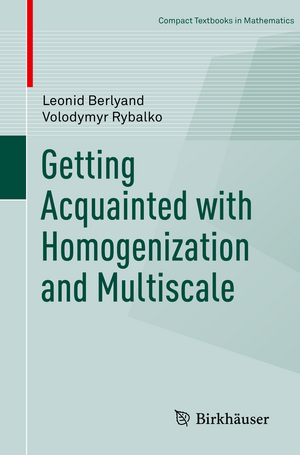
Getting Acquainted with Homogenization and Multiscale: Compact Textbooks in Mathematics
Autor Leonid Berlyand, Volodymyr Rybalkoen Limba Engleză Paperback – 29 noi 2018
Recomandăm acest volum ca o resursă de nivel masterat și doctorat, concepută special pentru a ghida studenții de la matematică și inginerie prin domeniul matur al teoriei omogenizării. Lucrarea Getting Acquainted with Homogenization and Multiscale reușește să sintetizeze un spectru larg de tehnici multiscală, oferind un echilibru între rigoarea matematică și intuiția fizică necesară în știința materialelor. Apreciem în mod deosebit efortul autorilor Leonid Berlyand și Volodymyr Rybalko de a include explicații vizuale și figuri care susțin demonstrațiile teoretice complexe.
Structura cărții urmărește o progresie logică, pornind de la preliminarii și contextul istoric al domeniului în primele trei capitole, trecând apoi la metodele clasice de expansiune asimptotică și convergență pe două scale. Capitolele finale extind analiza către frontierele actuale ale cercetării, precum omogenizarea stocastică (Capitolul 8) și problemele neliniare legate de plasticitate (Capitolul 10). Comparabil cu An Introduction to Homogenization de Doina Cioranescu în ceea ce privește rigoarea cadrului variațional, acest titlu se distinge prin abordarea mai modernă a convergenței Gamma și prin includerea limitelor de continuu pentru probleme discrete.
În contextul operei lui Leonid Berlyand, acest volum completează viziunea sa asupra mecanicii mediilor continue expusă în Introduction to the Network Approximation Method for Materials Modeling. Dacă lucrarea anterioară se concentra pe metode de aproximare pentru rețele, textul de față oferă fundamentul teoretic pentru înțelegerea modului în care microstructurile fine determină proprietățile macroscopice ale materialelor compozite. Formatul compact și limbajul accesibil îl fac un punct de plecare ideal pentru cercetătorii aflați la început de drum.
Din seria Compact Textbooks in Mathematics
-
 Preț: 389.74 lei
 -
 Preț: 325.91 lei
 -
 Preț: 389.10 lei
 -
 Preț: 332.89 lei
 -
 Preț: 421.00 lei
 -
 Preț: 361.70 lei
 -
 Preț: 483.93 lei
 -
 Preț: 384.04 lei
 -
 Preț: 357.66 lei
 - 20%
 Preț: 367.83 lei
 -
 Preț: 411.38 lei
 -
 Preț: 449.86 lei
 -
 Preț: 464.29 lei
 - 15%
 Preț: 453.70 lei
 -
 Preț: 388.77 lei
 -
 Preț: 396.49 lei
 -
 Preț: 350.49 lei
 -
 Preț: 422.90 lei
 -
 Preț: 349.42 lei
 -
 Preț: 317.18 lei
 -
 Preț: 342.21 lei
 -
 Preț: 300.13 lei
 -
 Preț: 351.37 lei
 -
 Preț: 391.74 lei
 -
 Preț: 392.58 lei
 - 15%
 Preț: 497.21 lei
 -
 Preț: 353.97 lei
 -
 Preț: 395.96 lei
 -
 Preț: 322.89 lei
 -
 Preț: 345.14 lei
 -
 Preț: 412.59 lei
 -
 Preț: 416.11 lei
 -
 Preț: 394.49 lei
 -
 Preț: 475.71 lei
 -
 Preț: 404.98 lei
 -
 Preț: 315.35 lei
 -
 Preț: 349.73 lei
 -
 Preț: 383.92 lei
 -
 Preț: 350.49 lei
 - 21%
 Preț: 284.77 lei
 -
 Preț: 465.48 lei
 -
 Preț: 386.76 lei
 -
 Preț: 380.04 lei
 -
 Preț: 336.15 lei
 -
 Preț: 454.93 lei
 -
 Preț: 416.33 lei
 - nou
 Preț: 416.74 lei
 - nou
 Preț: 331.93 lei
Preț: 342.68 lei
Carte tipărită la comandă
Livrare economică 09-15 septembrie
Specificații
ISBN-10: 3030017761
Pagini: 164
Ilustrații: XVIII, 178 p. 42 illus., 14 illus. in color.
Dimensiuni: 155 x 235 mm
Greutate: 0.27 kg
Ediția:1st ed. 2018
Editura: Springer International Publishing
Colecția Birkhäuser
Seria Compact Textbooks in Mathematics
Locul publicării:Cham, Switzerland
De ce să citești această carte
Este o introducere esențială pentru studenții de la inginerie și matematică care doresc să stăpânească metodele asimptotice moderne. Cititorul câștigă o înțelegere clară a modului în care fenomenele la scară mică influențează comportamentul global al sistemelor, trecând de la exemple clasice de rețele 2D la provocările actuale ale omogenizării stocastice.
Despre autor
Leonid Berlyand este un matematician recunoscut pentru contribuțiile sale în analiza aplicată și știința materialelor, fiind co-autor al unor lucrări de referință precum Introduction to the Network Approximation Method for Materials Modeling. Expertiza sa se concentrează pe intersecția dintre mecanica mediilor continue și tehnicile matematice riguroase. Alături de Volodymyr Rybalko, acesta propune în seria Compact Textbooks in Mathematics de la Birkhäuser o abordare pedagogică a problemelor multiscală, menită să pună bazele teoretice pentru o nouă generație de cercetători în domeniul sistemelor complexe.
Descriere scurtă
Cuprins
Recenzii
Notă biografică
Volodymyr Rybalko works as a senior research fellow in Mathematical Division, B.Verkin Institute for Low Temperature Physics and Engineering of National Academy of Sciences of Ukraine. He is an expert in the area of PDEs, he is known, in particular, for his contributions in homogenization theory.