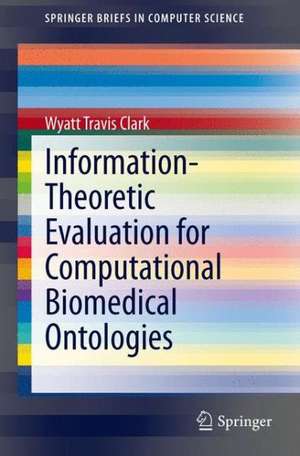
Information-Theoretic Evaluation for Computational Biomedical Ontologies: SpringerBriefs in Computer Science
Autor Wyatt Travis Clarken Limba Engleză Paperback – 23 ian 2014
Din seria SpringerBriefs in Computer Science
- 20%
 Preț: 312.38 lei
 - 20%
 Preț: 324.81 lei
 - 20%
 Preț: 318.06 lei
 -
 Preț: 448.42 lei
 - 20%
 Preț: 315.57 lei
 -
 Preț: 404.69 lei
 - 20%
 Preț: 175.41 lei
 - 20%
 Preț: 282.99 lei
 -
 Preț: 477.41 lei
 - 20%
 Preț: 353.26 lei
 - 20%
 Preț: 364.93 lei
 -
 Preț: 379.07 lei
 - 20%
 Preț: 311.84 lei
 - 20%
 Preț: 323.75 lei
 - 20%
 Preț: 329.53 lei
 - 20%
 Preț: 311.04 lei
 - 20%
 Preț: 309.78 lei
 - 20%
 Preț: 321.60 lei
 - 20%
 Preț: 310.23 lei
 - 20%
 Preț: 325.87 lei
 - 47%
 Preț: 251.63 lei
 - 20%
 Preț: 309.30 lei
 - 20%
 Preț: 311.50 lei
 -
 Preț: 392.17 lei
 -
 Preț: 359.92 lei
 - 20%
 Preț: 309.93 lei
 - 20%
 Preț: 310.73 lei
 - 20%
 Preț: 310.73 lei
 -
 Preț: 361.22 lei
 - 20%
 Preț: 311.84 lei
 - 20%
 Preț: 310.56 lei
 - 20%
 Preț: 310.73 lei
 - 20%
 Preț: 311.84 lei
 - 20%
 Preț: 311.04 lei
 - 20%
 Preț: 309.93 lei
 - 20%
 Preț: 311.18 lei
 - 20%
 Preț: 310.23 lei
 - 20%
 Preț: 311.04 lei
 - 20%
 Preț: 323.94 lei
 - 20%
 Preț: 311.18 lei
 - 20%
 Preț: 309.78 lei
 - 20%
 Preț: 321.39 lei
 - 20%
 Preț: 325.21 lei
 - 20%
 Preț: 310.73 lei
 - 20%
 Preț: 311.50 lei
 - 20%
 Preț: 333.12 lei
 - 20%
 Preț: 312.17 lei
 -
 Preț: 362.51 lei
 - 20%
 Preț: 312.17 lei
 - 20%
 Preț: 235.15 lei
Preț: 361.01 lei
Puncte Express: 542
Carte tipărită la comandă
Livrare economică 18 noiembrie-02 decembrie
Livrare prin curier în România Termenul estimat este afișat lângă disponibilitate.
Transport gratuit de la 400.00 lei Plată online sau ramburs, în funcție de opțiunile comenzii.
Retur gratuit în 14 zile Comandă securizată și suport în română.
Specificații
ISBN-13: 9783319041377
ISBN-10: 3319041371
Pagini: 56
Ilustrații: VII, 46 p. 12 illus., 6 illus. in color.
Dimensiuni: 155 x 235 x 3 mm
Greutate: 0.11 kg
Ediția:2014
Editura: Springer International Publishing
Colecția Springer
Seria SpringerBriefs in Computer Science
Locul publicării:Cham, Switzerland
ISBN-10: 3319041371
Pagini: 56
Ilustrații: VII, 46 p. 12 illus., 6 illus. in color.
Dimensiuni: 155 x 235 x 3 mm
Greutate: 0.11 kg
Ediția:2014
Editura: Springer International Publishing
Colecția Springer
Seria SpringerBriefs in Computer Science
Locul publicării:Cham, Switzerland
V-ar putea interesa
-
 Understanding BeliefsNils J Nilsson-19%Preț: 76.71 lei94.54 lei
 -
 Pattern Recognition and Machine LearningChristopher M Bishop-20%Preț: 642.81 lei803.52 lei
 -
 Type-2 Fuzzy Logic ControlMendel-20%Preț: 768.63 lei960.78 lei
 -
 DATA BonanzaAtkinson-20%Preț: 693.56 lei866.95 lei
 -
 Activity LearningDiane J Cook-9%Preț: 717.08 lei788.00 lei
 -
 Dragon Professional Individual for DummiesStephanie Diamond-20%Preț: 180.15 lei225.19 lei
 -
 Practical OpenCVSamarth Brahmbhatt-20%Preț: 306.69 lei383.37 lei
 -
 Computational IntelligenceAlexandru Floares-35%Preț: 1012.79 lei1567.33 lei
 -
 Artificial Intelligence for Building Energy AnalysisFr'd'ric Magoul's-20%Preț: 923.76 lei1154.70 lei
 -
 -20%Preț: 924.08 lei1155.10 lei
Public țintă
ResearchCuprins
Introduction.- Methods.- Experiments and Results.- Discussion.
Textul de pe ultima copertă
The development of effective methods for the prediction of ontological annotations is an important goal in computational biology, yet evaluating their performance is difficult due to problems caused by the structure of biomedical ontologies and incomplete annotations of genes. This work proposes an information-theoretic framework to evaluate the performance of computational protein function prediction. A Bayesian network is used, structured according to the underlying ontology, to model the prior probability of a protein's function. The concepts of misinformation and remaining uncertainty are then defined, that can be seen as analogs of precision and recall. Finally, semantic distance is proposed as a single statistic for ranking classification models. The approach is evaluated by analyzing three protein function predictors of gene ontology terms. The work addresses several weaknesses of current metrics, and provides valuable insights into the performance of protein function prediction tools.
Caracteristici
Provides a concise overview of a proven method for evaluating the performance of computational protein-function prediction Proposes a solution that is critical in disease-gene prioritisation, an increasingly hot topic Defines important concepts for scientists using information-theoretic approaches in their algorithms development Includes supplementary material: sn.pub/extras