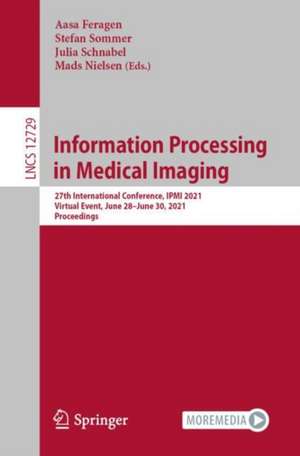
Information Processing in Medical Imaging: Lecture Notes in Computer Science, cartea 12729
Editat de Aasa Feragen, Stefan Sommer, Julia Schnabel, Mads Nielsenen Limba Engleză Paperback – 21 iun 2021
The 59 full papers presented in this volume were carefully reviewed and selected from 200 submissions. They were organized in topical sections as follows: registration; causal models and interpretability; generative modelling; shape; brain connectivity; representation learning; segmentation; sequential modelling; learning with few or low quality labels; uncertainty quantification and generative modelling; and deep learning.
Din seria Lecture Notes in Computer Science
- 20%
 Preț: 558.53 lei
 - 20%
 Preț: 571.88 lei
 - 20%
 Preț: 675.83 lei
 - 20%
 Preț: 1020.28 lei
 - 20%
 Preț: 620.33 lei
 - 20%
 Preț: 560.93 lei
 - 20%
 Preț: 633.70 lei
 - 20%
 Preț: 731.82 lei
 - 20%
 Preț: 1359.66 lei
 - 20%
 Preț: 560.93 lei
 - 20%
 Preț: 733.68 lei
 - 20%
 Preț: 828.44 lei
 - 15%
 Preț: 558.12 lei
 - 20%
 Preț: 793.92 lei
 - 20%
 Preț: 560.93 lei
 - 20%
 Preț: 748.63 lei
 - 20%
 Preț: 562.49 lei
 - 20%
 Preț: 1246.46 lei
 - 20%
 Preț: 449.81 lei
 - 20%
 Preț: 556.96 lei
 - 20%
 Preț: 562.49 lei
 - 20%
 Preț: 851.78 lei
 - 20%
 Preț: 313.10 lei
 - 18%
 Preț: 945.44 lei
 - 20%
 Preț: 314.86 lei
 - 20%
 Preț: 560.93 lei
 - 20%
 Preț: 606.22 lei
 - 20%
 Preț: 1033.45 lei
 - 20%
 Preț: 563.29 lei
 - 20%
 Preț: 733.68 lei
 - 20%
 Preț: 1137.10 lei
 - 20%
 Preț: 735.28 lei
 - 20%
 Preț: 1079.23 lei
 - 20%
 Preț: 584.42 lei
 - 20%
 Preț: 854.16 lei
 - 15%
 Preț: 672.87 lei
 - 20%
 Preț: 1032.47 lei
 - 20%
 Preț: 617.17 lei
 - 20%
 Preț: 1022.15 lei
 - 20%
 Preț: 984.64 lei
 - 20%
 Preț: 620.33 lei
 - 20%
 Preț: 402.28 lei
 - 20%
 Preț: 316.28 lei
 - 20%
 Preț: 663.69 lei
 - 20%
 Preț: 320.24 lei
 - 20%
 Preț: 343.12 lei
 - 20%
 Preț: 313.87 lei
Preț: 741.36 lei
Preț vechi: 926.69 lei
-20%
Puncte Express: 1112
Carte tipărită la comandă
Livrare economică 02-16 decembrie
Livrare prin curier în România Termenul estimat este afișat lângă disponibilitate.
Transport gratuit pentru acest produs Plată online sau ramburs, în funcție de opțiunile comenzii.
Retur gratuit în 14 zile Comandă securizată și suport în română.
Specificații
ISBN-13: 9783030781903
ISBN-10: 3030781909
Pagini: 804
Ilustrații: XIX, 782 p. 283 illus., 261 illus. in color.
Dimensiuni: 155 x 235 x 43 mm
Greutate: 1.19 kg
Ediția:1st edition 2021
Editura: Springer
Colecția Lecture Notes in Computer Science
Seria Lecture Notes in Computer Science
Locul publicării:Cham, Switzerland
ISBN-10: 3030781909
Pagini: 804
Ilustrații: XIX, 782 p. 283 illus., 261 illus. in color.
Dimensiuni: 155 x 235 x 43 mm
Greutate: 1.19 kg
Ediția:1st edition 2021
Editura: Springer
Colecția Lecture Notes in Computer Science
Seria Lecture Notes in Computer Science
Locul publicării:Cham, Switzerland
Cuprins
Registration.- Hypermorph: Amortized Hyperparameter Learning for Image Registration.- Deep learning based geometric registration for medical images: How accurate can we get without visual features.- Diffeomorphic registration with density changes for the analysis of imbalanced shapes.- Estimation of Causal Effects in the Presence of Unobserved Confounding in the Alzheimer's Continuum.- Multiple-shooting adjoint method for whole-brain dynamic causal modeling.- Going Beyond Saliency Maps: Training Deep Models to Interpret Deep Models.- Enabling Data Diversity: Efficient Automatic Augmentation via Regularized Adversarial Training.- Blind stain separation using model-aware generative learning and its applications on fluorescence microscopy images.- MR Slice Profile Estimation by Learning to Match Internal Patch Distributions.- Partial Matching in the Space of Varifolds.- Nested Grassmanns for Dimensionality Reduction with Applications to Shape Analysis.- Hierarchical Morphology-Guided Tooth Instance Segmentation from CBCT Images.- Cortical Morphometry Analysis based on Worst Transportation Theory.- Geodesic B-Score for Improved Assessment of Knee Osteoarthritis.- Cytoarchitecture Measurements in Brain Gray Matter using Likelihood-Free Inference.- Non-isomorphic Inter-modality Graph Alignment and Synthesis for Holistic Brain Mapping.- Knowledge Transfer for Few-shot Segmentation of Novel White Matter Tracts.- Discovering Spreading Pathways of Neuropathological Events in Alzheimer’s Disease Using Harmonic Wavelets.- A Multi-Scale Spatial and Temporal Attention Network on Dynamic Connectivity to Localize The Eloquent Cortex in Brain Tumor Patients.- Learning Multi-resolution Graph Edge Embedding for Discovering Brain Network Dysfunction in Neurological Disorders.- Equivariant Spherical Deconvolution: Learning Sparse Orientation Distribution Functions from Spherical Data.- Geodesic Tubes for Uncertainty Quantification in Diffusion MRI.- Structural Connectome Atlas Construction in the Space of Riemannian Metrics.- A Higher Order Manifold-valued Convolutional Neural Network with Applications in Diffusion MRI Processing.- Representation Disentanglement for Multi-modal Brain MR Analysis.- Variational Knowledge Distillation for Disease Classification in Chest X-Rays.- Information-based Disentangled Representation Learning for Unsupervised MR Harmonization.- A 3D SegNet: Anatomy-aware artifact disentanglement and segmentation network for unpaired segmentation, artifact reduction, and modality translation.- Unsupervised Learning of Local Discriminative Representation for Medical Images.- TopoTxR: A Topological Biomarker for Predicting Treatment Response in Breast Cancer.- Segmenting two-dimensional structures with strided tensor networks.- Distributional Gaussian Process Layers for Outlier Detection in Image Segmentation.- Deep Label Fusion: A 3D End-to-End Hybrid Multi-Atlas Segmentation and Deep Learning Pipeline.- Feature Library: A Benchmark for Cervical Lesion Segmentation.- Generalized Organ Segmentation by Imitating One-shot Reasoning using Anatomical Correlation.-EnMcGAN: Adversarial Ensemble Learning for 3D Complete Renal Structures Segmentation.- Segmentation with Multiple Acceptable Annotations: A Case Study of Myocardial Segmentation in Contrast Echocardiography.- A New Bidirectional Unsupervised Domain Adaptation Segmentation Framework.- 3D Nucleus Instance Segmentation for Whole-Brain Microscopy Images.- Teach me to segment with mixed-supervision: confident students become masters.- Sequential modelling.- Future Frame Prediction for Robot-assisted Surgery.- Velocity-To-Pressure (V2P) - Net: Inferring Relative Pressures from Time-Varying 3D Fluid Flow Velocities.- Lighting Enhancement Aids Reconstruction of Colonoscopic Surfaces.- Mixture modeling for identifying subtypes in disease course mapping.- Learning transition times in event sequences: the temporal event-based model of disease progression.- Learning with few or low quality labels.- Knowledge Distillation with Adaptive Asymmetric Label Sharpening for Semi-supervised Fracture Detection in Chest X-rays.- Semi-Supervised Screening of COVID-19 from Positive and Unlabeled Data with Constraint Non-Negative Risk Estimator.- Deep MCEM for Weakly-Supervised Learning to Jointly Segment and Recognize Objects using Very Few Expert Segmentations.- Weakly Supervised Deep Learning for Aortic Valve Finite Element Mesh Generation from 3D CT Images.- Continual Active Learning for Efficient Adaptation of Machine Learning Models to Changing Image Acquisition.- Multimodal Self-Supervised Learning for Medical Image Analysis.- Uncertainty Quantification and Generative Modelling.- Spatially Varying Label Smoothing: Capturing Uncertainty from Expert Annotations.- Quantile Regression for Uncertainty Estimation in VAEs with Applications to Brain Lesion Detection.- A Probabilistic Framework for Modeling the Variability Across Federated Datasets of Heterogeneous Multi-View Observations.- Is segmentation uncertainty useful?.- Principled Ultrasound Data Augmentation for Classification of Standard Planes.- Adversarial Regression Learning for Bone Age Estimation.- Learning image quality assessment by reinforcing task amenable data selection.- Collaborative Multi-Agent Reinforcement Learning for Landmark Localization Using Continuous Action Space.