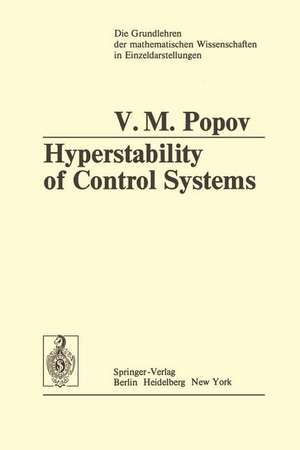
Hyperstability of Control Systems: Grundlehren der mathematischen Wissenschaften, cartea 204
Autor Vasile M. Popov Traducere de Radu Georgescuen Limba Engleză Paperback – 21 noi 2011
Din seria Grundlehren der mathematischen Wissenschaften
- 15%
 Preț: 573.68 lei
 - 15%
 Preț: 718.41 lei
 - 24%
 Preț: 873.89 lei
 - 20%
 Preț: 636.09 lei
 - 24%
 Preț: 1249.43 lei
 - 24%
 Preț: 845.82 lei
 - 15%
 Preț: 476.18 lei
 - 18%
 Preț: 971.92 lei
 - 24%
 Preț: 802.79 lei
 -
 Preț: 345.92 lei
 - 15%
 Preț: 435.43 lei
 -
 Preț: 442.48 lei
 -
 Preț: 410.22 lei
 - 15%
 Preț: 430.28 lei
 - 15%
 Preț: 530.87 lei
 - 15%
 Preț: 569.36 lei
 -
 Preț: 340.03 lei
 - 18%
 Preț: 731.19 lei
 -
 Preț: 372.46 lei
 - 15%
 Preț: 441.13 lei
 - 15%
 Preț: 484.61 lei
 -
 Preț: 450.83 lei
 -
 Preț: 334.62 lei
 -
 Preț: 351.65 lei
 -
 Preț: 472.84 lei
 - 15%
 Preț: 450.65 lei
 -
 Preț: 406.62 lei
 - 18%
 Preț: 742.38 lei
 -
 Preț: 373.19 lei
 -
 Preț: 406.16 lei
 - 15%
 Preț: 558.62 lei
 -
 Preț: 482.86 lei
 -
 Preț: 350.02 lei
 -
 Preț: 389.10 lei
 -
 Preț: 406.62 lei
 - 18%
 Preț: 729.13 lei
 -
 Preț: 456.84 lei
 -
 Preț: 389.02 lei
 -
 Preț: 349.03 lei
 -
 Preț: 507.53 lei
 -
 Preț: 416.94 lei
 - 18%
 Preț: 772.35 lei
 -
 Preț: 393.95 lei
 -
 Preț: 398.46 lei
 - 15%
 Preț: 595.95 lei
 - 15%
 Preț: 457.19 lei
 - 15%
 Preț: 447.24 lei
Preț: 378.01 lei
Puncte Express: 567
Carte tipărită la comandă
Livrare economică 18 noiembrie-02 decembrie
Livrare prin curier în România Termenul estimat este afișat lângă disponibilitate.
Transport gratuit de la 400.00 lei Plată online sau ramburs, în funcție de opțiunile comenzii.
Retur gratuit în 14 zile Comandă securizată și suport în română.
Specificații
ISBN-13: 9783642656569
ISBN-10: 3642656560
Pagini: 404
Ilustrații: 400 p.
Dimensiuni: 152 x 229 x 22 mm
Greutate: 0.58 kg
Ediția:Softcover reprint of the original 1st edition 1973
Editura: Springer
Colecția Grundlehren der mathematischen Wissenschaften
Seria Grundlehren der mathematischen Wissenschaften
Locul publicării:Berlin, Heidelberg, Germany
ISBN-10: 3642656560
Pagini: 404
Ilustrații: 400 p.
Dimensiuni: 152 x 229 x 22 mm
Greutate: 0.58 kg
Ediția:Softcover reprint of the original 1st edition 1973
Editura: Springer
Colecția Grundlehren der mathematischen Wissenschaften
Seria Grundlehren der mathematischen Wissenschaften
Locul publicării:Berlin, Heidelberg, Germany
V-ar putea interesa
-
 Calculus Made EasySilvanus P Thompson-11%Preț: 368.01 lei413.50 lei
 -
 An Introduction to Ordinary Differential EquationsRavi P. Agarwal-15%Preț: 531.96 lei625.83 lei
 -
 Hyperbolic Partial Differential EquationsSerge AlinhacPreț: 461.98 lei
 -
 Applied Functional AnalysisEberhard Zeidler-15%Preț: 736.44 lei866.40 lei
 -
 Critical Point Theory and Hamiltonian SystemsJean Mawhin-18%Preț: 1008.06 lei1229.34 lei
 -
 -15%Preț: 528.83 lei622.14 lei
 -
 Elements of IntegrationBartle-9%Preț: 996.25 lei1094.78 lei
 -
 The FormulaLuke DormehlPreț: 115.42 lei
 -
 Simulation and the Monte Carlo Method 3eR. Rubinstein-27%Preț: 759.57 lei1040.51 lei
 -
 Fundamentals of CalculusCarla C. Morris-27%Preț: 825.48 lei1130.80 lei
 -
 Calculus: Early TranscendentalsWilliam Briggs-15%Preț: 576.28 lei679.82 lei
 -
 Elementary AnalysisKenneth A. RossPreț: 431.95 lei
 -
 Integral and MeasureVigirdas Mackevicius-9%Preț: 987.57 lei1085.24 lei
 -
 Numerical Methods For Simulationde Saporta-9%Preț: 987.44 lei1085.10 lei
 -
 Dynamics and Control of Trajectory TubesAlexander B. KurzhanskiPreț: 392.85 lei
 -
 Ordinary Differential EquationsVladimir I. Arnold-17%Preț: 525.45 lei633.08 lei
 -
 -18%Preț: 1400.04 lei1707.37 lei
Public țintă
ResearchCuprins
1. Introduction.- 1. Stability as a property of a family of systems.- 2. The families of systems considered in the problem of absolute stability.- 3. Selecting the most natural families of systems.- 4. Introducing new families of systems.- 5. The concept of hyperstability.- 6. Indications on the use of the monograph.- 2. Classes of Equivalent Systems.- § 1. Equivalence classes for quadratic forms with relations between the variables.- § 2. Classes of single-input systems.- § 3. The characteristic polynomial of single-input systems.- § 4. Conditions under which all systems with the same characteristic polynomial belong to the same class.- § 5. Equivalence classes for multi-input systems.- § 6. Equivalence classes for discrete systems.- § 7. Equivalence classes for systems with time dependent coefficients.- 3. Positive Systems.- § 8. Single-input positive systems.- § 9. Multi-input positive systems.- § 10. Discrete positive systems.- § 11. Positive systems with time-dependent coefficients.- § 12. Nonlinear positive systems.- 4. Hyperstable Systems and Blocks.- § 13. General properties of the hyperstable systems.- § 14. Single-input hyperstable systems.- § 15. Simple hyperstable blocks.- § 16. Multi-input hyperstable systems.- § 17. Multi-input hyperstable blocks.- § 18. Discrete hyperstable systems and blocks.- § 19. Hyperstability of more general systems.- § 20. Integral hyperstable blocks.- § 21. Lemma of I. Barb?lat and its use in the study of asymptotic stability.- § 22. Other methods for studying asymptotic stability.- § 23. Conditions of asymptotic stability of single-input and multi-input systems with constant coefficients.- § 24. Characterization of the hyperstability property by the stability of systems with negative feedback.- 5.Applications.- § 25. Inclusion of the problem of absolute stability in a problem of hyperstability.- § 26. Determination of some Liapunov functions.- § 27. Stability in finite domains of the state space.- § 28. Stability of systems containing nuclear reactors.- § 29. Stability of some systems with non-linearities of a particular form.- § 30. Optimization of control systems for integral performance indices.- Appendix A. Controllability; Observability; Nondegeneration.- § 31. Controllability of single-input systems.- 1. Definition of the complete controllability of single-input systems.- 2. Theorem of complete controllability of single-input systems.- 3. Discussion.- 4. Proof of the theorem.- 5. Relations between single-input completely controllable systems.- § 32. Single-output completely observable systems.- § 33. Nondegenerate systems.- 1. Definition of the property of non degeneration and statement of the theorem of non degeneration.- 2. Remarks on the theorem of nondegeneration.- 3. Proof of the theorem of non degeneration.- 4. Bringing nondegenerate systems into the Jordan-Lur’e-Lefschetz form.- § 34. Controllability of multi-input systems.- 1. Definition and theorem of the complete controllability of multi-input systems.- 2. Proof of Theorem 1.- 3. Other properties of completely controllable multi-input systems.- § 35. Completely observable multi-output systems.- § 36. Special forms for multi-input blocks.- Appendix B. Factorization of Polynomial Matrices.- § 37. Auxiliary proposition.- § 38. Theorem of factorization on the unit circle.- 1. Statement of the theorem.- 2. Preliminary remarks.- 3. Some additional assumptions.- 5. A family of factorization relations.- 6. A special way of writing polynomial matrices.- 7. A nonsingular factorization.- 8.Properties of the nonsingular factorizations.- 9. Bringing the nonsingular factorization to the form required in Theorem 1.- 10. More about Assumption (e).- 11. Eliminating restrictions (C) and (e).- § 39. The theorem of factorization on the imaginary axis.- 1. Statement of the theorem.- 2. Definition of a matrix factorizable on the unit circle.- 3. Relations between ?(?) and ?(?).- 4. Factorization of the imaginary axis.- Appendix C. Positive Real Functions.- Appendix D. The Principal Hyperstable Blocks.- Appendix E. Notations.- Appendix F. Bibliography.