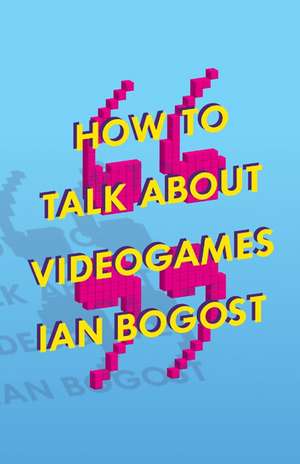
How to Talk about Videogames: Electronic Mediations, cartea 47
Autor Ian Bogosten Limba Engleză Paperback – 15 noi 2015
Destinată studenților în studii media, cercetătorilor culturii digitale și criticilor de specialitate, această lucrare semnată de Ian Bogost oferă un cadru teoretic riguros pentru a înțelege natura hibridă a jocurilor video. Suntem de părere că volumul reușește să depășească dihotomia sterilă dintre „artă înaltă” și „divertisment facil”, propunând o perspectivă surprinzătoare: jocurile sunt, în egală măsură, tablouri și prăjitoare de pâine. Această abordare ne ajută să înțelegem că jocurile nu sunt doar citite sau privite, ci operate ca niște dispozitive, o distincție esențială pentru metodologia criticii contemporane.
Recomandăm How to Talk about Videogames ca o alternativă pragmatică la Exploring Videogames with Deleuze and Guattari de Ciara Cremin pentru cursurile de analiză media, având avantajul unei ancorări directe în experiența cotidiană a utilizatorului și a unei diversități tematice impresionante. Structura cărții urmărește o progresie de la micro-fenomene precum „grația sordidă” a Flappy Bird, până la analize complexe ale simulatoarelor de zbor și ale jocurilor sportive precum FIFA sau Madden NFL.
Descoperim aici o critică ce refuză auto-izolarea academică. Ian Bogost avertizează împotriva transformării criticilor de jocuri în entități rupte de contextul cultural larg. Față de lucrările sale anterioare, precum Unit Operations, unde se concentra pe structurile computaționale, acest volum din seria Electronic Mediations adoptă un ton mai eseistic și mai conectat la realitatea socială, transformând funcționarea internă a jocului într-un argument despre modul în care dăm sens lumii moderne.
Din seria Electronic Mediations
-
 Preț: 174.04 lei
 - 20%
 Preț: 680.56 lei
 -
 Preț: 144.30 lei
 -
 Preț: 182.33 lei
 - 20%
 Preț: 112.89 lei
 -
 Preț: 209.36 lei
 -
 Preț: 129.97 lei
 -
 Preț: 108.68 lei
 -
 Preț: 150.57 lei
 -
 Preț: 173.29 lei
 -
 Preț: 186.14 lei
 -
 Preț: 183.29 lei
 -
 Preț: 273.25 lei
 - 20%
 Preț: 157.30 lei
 -
 Preț: 176.16 lei
 -
 Preț: 181.78 lei
 -
 Preț: 218.56 lei
 -
 Preț: 212.58 lei
 -
 Preț: 181.44 lei
 -
 Preț: 147.30 lei
 -
 Preț: 191.87 lei
 -
 Preț: 175.38 lei
 -
 Preț: 184.68 lei
 - 20%
 Preț: 195.48 lei
 -
 Preț: 190.58 lei
 - 20%
 Preț: 173.85 lei
 - 20%
 Preț: 182.73 lei
 -
 Preț: 228.16 lei
 -
 Preț: 218.10 lei
 -
 Preț: 219.41 lei
 -
 Preț: 171.16 lei
 -
 Preț: 205.83 lei
 -
 Preț: 159.11 lei
 -
 Preț: 181.80 lei
 - 26%
 Preț: 130.54 lei
 -
 Preț: 165.50 lei
 - 18%
 Preț: 96.36 lei
 - 5%
 Preț: 125.99 lei
 - 36%
 Preț: 117.30 lei
 - 26%
 Preț: 118.94 lei
 - 12%
 Preț: 165.76 lei
 - 19%
 Preț: 140.15 lei
 - 19%
 Preț: 142.55 lei
 -
 Preț: 217.92 lei
 - 18%
 Preț: 145.77 lei
 - 34%
 Preț: 136.99 lei
 - 34%
 Preț: 512.69 lei
 - nou
 Preț: 135.02 lei
Preț: 130.40 lei
Carte disponibilă
Livrare economică 09-23 noiembrie
Livrare express 24-30 octombrie pentru 21.48 lei
Specificații
ISBN-10: 0816699127
Pagini: 208
Dimensiuni: 140 x 216 x 15 mm
Greutate: 0.25 kg
Ediția:1
Editura: University of Minnesota Press
Colecția Univ Of Minnesota Press
Seria Electronic Mediations
V-ar putea interesa
-
 Persuasive GamesIan BogostPreț: 359.47 lei
 -
 Unit OperationsIan BogostPreț: 320.55 lei
 -
 The Future Was HereJimmy Maher-20%Preț: 279.41 lei349.26 lei
 -
 Racing the BeamNick MontfortPreț: 138.05 lei
 -
 -13%Preț: 240.76 lei275.24 lei
 -
 OurSpace: Resisting the Corporate Control of CultureChristine HaroldPreț: 175.80 lei
 -
 Preț: 186.14 lei
 -
 Code and Clay, Data and Dirt: Five Thousand Years of Urban MediaShannon MatternPreț: 178.37 lei
 -
 Constructing Artistic IntegrityKim BarbourPreț: 311.58 lei
 -
 Preț: 309.55 lei
 -
 Political Communication in EgyptSaad Hamza-8%Preț: 464.22 lei504.59 lei
 -
 Preț: 311.42 lei
De ce să citești această carte
Recomandăm această carte oricărui profesionist din industria jocurilor sau cercetător care dorește să articuleze critic valoarea acestui mediu fără a cădea în clișee. Cititorul câștigă un vocabular nou și o perspectivă critică ce integrează jocurile video în marea cultură. Este un instrument esențial pentru a înțelege de ce jocurile funcționează așa cum o fac și ce spune acest lucru despre societatea noastră, dincolo de simpla interactivitate.
Despre autor
Ian Bogost este o figură centrală în studiile media contemporane, deținând catedra Ivan Allen College în Media Studies la Georgia Institute of Technology. Autor prolific, el a explorat intersecția dintre computație și cultură în lucrări de referință precum Persuasive Games și Alien Phenomenology. Expertiza sa este dublată de practică, fiind co-fondator al Persuasive Games LLC, unde dezvoltă jocuri ce abordează teme sociale complexe. Această dublă ipostază, de teoretician și creator, îi conferă autoritatea de a deconstrui mecanismele jocurilor video dintr-o perspectivă tehnică și filozofică unică.
Descriere scurtă
Delving into popular, familiar games like Flappy Bird, Mirror’s Edge, Mario Kart, Scribblenauts, Ms. Pac-Man, FarmVille, Candy Crush Saga, Bully, Medal of Honor, Madden NFL, and more, Bogost posits that videogames are as much like appliances as they are like art and media. We don’t watch or read games like we do films and novels and paintings, nor do we perform them like we might dance or play football or Frisbee. Rather, we do something in-between with games. Games are devices we operate, so game critique is both serious cultural currency and self-parody. It is about figuring out what it means that a game works the way it does and then treating the way it works as if it were reasonable, when we know it isn’t.
Noting that the term games criticism once struck him as preposterous, Bogost observes that the idea, taken too seriously, risks balkanizing games writing from the rest of culture, severing it from the “rivers and fields” that sustain it. As essential as it is, he calls for its pursuit to unfold in this spirit: “God save us from a future of games critics, gnawing on scraps like the zombies that fester in our objects of study.”
Notă biografică
Cuprins
Introduction. Nobody Asked for a Toaster Critic: Doing Videogame Criticism
1. The Squalid Grace of Flappy Bird
2. A Portrait of the Artist as a Game Studio: Flow, Flower, Journey
3. A Way of Looking: Mirror's Edge
4. The Blue Shell is Everything that’s Wrong with America: Mario Kart
5. Little Black Sambo, I’m Going to Eat You Up!: Scribblenauts
6. Can a Gobbler Have it All?: Ms. Pac-Man
7. Racketeer Sports: Farmville, Candy Crush Saga, and Free to Play
8. The Haute Couture of Videogames: Hundreds
9. Can the Other Come Out and Play?: Between and Way
10. Free Speech is not a Marketing Plan: Bully and Medal of Honor
11. Shaking the Holocaust Train: Manhunt, Train, and Gestural Control
12. The Long Shot: Heavy Rain
13. Puzzling the Sublime: Orbital & Drop7
14. Work is the Best Place to Goof Off: Flight Simulator, Euro Truck Simulator, and the New Simulation
15. A Trio of Artisanal Reviews: Proteus
16. What is a Sports Videogame?: FIFA, Madden, and More
17. The Agony of Mastery: Swing Copters
18. The Abyss Between the Human and the Alpine: Mountain
19. Word Games Last Forever: Words with Friends
20. Perpetual Adolescence: Gone Home
Conclusion. Anything But Games: Not Doing Game Criticism
Notes
Recenzii
"No one else is as wide-ranging, funny, or inspiringly immune to cant or groupthink as Ian Bogost. How to Talk about Videogames is his most accessible and entertaining book yet."—Tom Bissell, author of Extra Lives and Apostle*
"Ian Bogost can take apart a game’s design and tell you exactly what makes it work and what it means to us personally and to our game-playing society. How to Talk about Videogames has deep insights into a range of current topics we are dealing with or experiencing today. There’s a lot here to learn."—John Romero, veteran game creator
"Whether Bogost is examining old favorites like Ms. Pac-Man or scrutinizing a flash-in-the-pan app like Flappy Bird, his outlook is thoughtful, inquisitive, and amused."—Game On
"Bogost embraces the preposterousness and paradox of games as both consumer products and art, and in running with that tension he offers a compelling method of understanding and writing about them."—Gamechurch.com
"[How to Talk about Videogames] has already proven indispensable to those of us interested in how video games have become such a vital artistic medium."—Electronic Literature
"Ian Bogost’s How to Talk About Videogames isn’t just a book about games—it’s a book about criticism, and where it fits in our wider culture. Bogost is the rare academic writer whose work is as clear and exciting as the best of the mainstream, and whose critical exercises backfire by becoming enormous commercial/popular successes."—Boing Boing