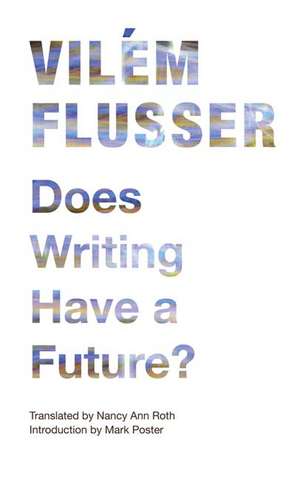
Does Writing Have a Future?: Electronic Mediations
Autor Vilém Flusser Traducere de Nancy Ann Roth Introducere de Mark Posteren Limba Engleză Paperback – 24 feb 2011
În cadrul programelor de studii media și filosofie a tehnologiei, Does Writing Have a Future? ocupă un loc central, fiind o analiză vizionară a modului în care digitalizarea reconfigurează fundamentul civilizației noastre: cuvântul scris. Remarcăm în această lucrare, publicată inițial în 1987, o capacitate de anticipare surprinzătoare a modului în care mediile electronice vor absorbi și transforma funcțiile textului tradițional. Putem afirma că Flusser nu prezice pur și simplu dispariția scrisului, ci investighează o mutație ontologică a gândirii umane.
Structura volumului este riguros organizată pentru a ghida cititorul printr-o genealogie a mediilor. Pornind de la capitole despre „Inscripții” și „Alfabet”, autorul trece prin analiza „Tiparului” și a „Cărților”, culminând cu secțiuni dedicate „Digitalului” și „Recodificării”. Această progresie indică o tranziție de la liniaritatea paginii scrise la multidimensionalitatea codului informatic. Cititorii familiarizați cu Into the Universe of Technical Images vor aprecia modul în care acest volum completează viziunea lui Flusser asupra imaginilor tehnice, oferind contraponderea necesară prin analiza textului ca suport al conștiinței istorice.
Descoperim aici o perspectivă distinctă față de lucrările sale anterioare, precum Communicology – Mutations in Human Relations?; dacă acolo punea bazele teoretice ale comunicării, în Does Writing Have a Future? se concentrează pe tensiunea dintre gestul fizic al scrierii și abstractizarea digitală. Tonul este unul precis, academic dar provocator, evitând nostalgiile inutile și propunând în schimb o înțelegere a modului în care noile medii vor genera noi forme de interogare critică.
Din seria Electronic Mediations
-
 Preț: 174.04 lei
 - 20%
 Preț: 680.56 lei
 -
 Preț: 144.30 lei
 -
 Preț: 182.33 lei
 - 20%
 Preț: 112.89 lei
 -
 Preț: 209.36 lei
 -
 Preț: 129.97 lei
 -
 Preț: 108.68 lei
 -
 Preț: 150.57 lei
 -
 Preț: 173.29 lei
 -
 Preț: 130.40 lei
 -
 Preț: 186.14 lei
 -
 Preț: 183.29 lei
 -
 Preț: 273.25 lei
 - 20%
 Preț: 157.30 lei
 -
 Preț: 176.16 lei
 -
 Preț: 181.78 lei
 -
 Preț: 218.56 lei
 -
 Preț: 250.55 lei
 -
 Preț: 181.44 lei
 -
 Preț: 191.87 lei
 -
 Preț: 175.38 lei
 -
 Preț: 184.68 lei
 - 20%
 Preț: 195.48 lei
 -
 Preț: 190.58 lei
 - 20%
 Preț: 173.85 lei
 - 20%
 Preț: 182.73 lei
 -
 Preț: 228.16 lei
 -
 Preț: 218.10 lei
 -
 Preț: 219.41 lei
 -
 Preț: 171.16 lei
 -
 Preț: 205.83 lei
 -
 Preț: 159.11 lei
 -
 Preț: 181.80 lei
 - 26%
 Preț: 130.54 lei
 -
 Preț: 165.50 lei
 - 18%
 Preț: 96.36 lei
 - 5%
 Preț: 125.99 lei
 - 36%
 Preț: 117.30 lei
 - 26%
 Preț: 118.94 lei
 - 12%
 Preț: 165.76 lei
 - 19%
 Preț: 140.15 lei
 - 19%
 Preț: 142.55 lei
 -
 Preț: 217.92 lei
 - 18%
 Preț: 145.77 lei
 - 34%
 Preț: 136.99 lei
 - 34%
 Preț: 512.69 lei
 - nou
 Preț: 135.02 lei
Preț: 147.30 lei
Carte disponibilă
Livrare economică 06-20 noiembrie
Livrare express 22-28 octombrie pentru 23.14 lei
Specificații
ISBN-10: 0816670234
Pagini: 208
Dimensiuni: 127 x 203 x 23 mm
Greutate: 0.27 kg
Ediția:1
Editura: University of Minnesota Press
Colecția Univ Of Minnesota Press
Seria Electronic Mediations
V-ar putea interesa
-
 Politics Theory and Contemporary CultureMark PosterPreț: 272.79 lei
 -
 Preț: 235.36 lei
 -
 Deleuze and New TechnologyDavid Savat-17%Preț: 229.97 lei277.06 lei
 -
 Ruthless Criticism: New Perspectives in U.S. Communication HistoryWilliams SolomonPreț: 452.90 lei
 -
 Computers, Surveillance, and PrivacyDavid LyonPreț: 380.08 lei
 -
 GesturesVilém FlusserPreț: 149.49 lei
 -
 Preț: 257.53 lei
 -
 Preț: 176.16 lei
 -
 Voice Depiction in Uganda's Media Coverage of Political 2003-2005Abdulhamid MpozaPreț: 375.24 lei
 -
 Mobile Number PortabilityMuralidhara B. RameshPreț: 310.84 lei
 -
 The Role Of Information Technology In Media IndustryAbdul Waseem KhattakPreț: 312.32 lei
 -
 The Impact of Spatial Ability Training and Its TransferKhairulanuar Samsudin-8%Preț: 471.28 lei512.27 lei
De ce să citești această carte
Această carte este esențială pentru cercetătorii în științele comunicării și studii culturale care doresc să înțeleagă rădăcinile teoretice ale erei digitale. Cititorul câștigă o perspectivă profundă asupra modului în care tehnologia schimbă nu doar felul în care scriem, ci și modul în care gândim istoria și progresul. Este un argument convingător despre supraviețuirea actului creativ într-o lume dominată de coduri binare.
Despre autor
Vilém Flusser (1920–1991) a fost un filosof și teoretician al comunicării născut în Praga, stabilit ulterior în Brazilia și Franța. Opera sa este marcată de o abordare fenomenologică a culturii și tehnologiei, fiind considerat unul dintre cei mai importanți gânditori ai media din secolul XX, adesea comparat cu Marshall McLuhan. Lucrările sale explorează tranziția de la cultura textuală la cea vizual-tehnică, anticipând impactul internetului și al digitalizării asupra relațiilor umane. Prin serii precum Electronic Mediations, contribuțiile sale continuă să influențeze fundamental teoria media contemporană.
Descriere scurtă
Confirming Flusser’s status as a theorist of new media in the same rank as Marshall McLuhan, Jean Baudrillard, Paul Virilio, and Friedrich Kittler, the balance of this book teases out the nuances of these developments. To find a common denominator among texts and practices that span millennia, Flusser looks back to the earliest forms of writing and forward to the digitization of texts now under way. For Flusser, writing—despite its limitations when compared to digital media—underpins historical consciousness, the concept of progress, and the nature of critical inquiry. While the text as a cultural form may ultimately become superfluous, he argues, the art of writing will not so much disappear but rather evolve into new kinds of thought and expression.
Notă biografică
Cuprins
Mark Poster
Does Writing Have a Future?
Introduction
Superscript
Inscriptions
Notation
Letters of the Alphabet
Texts
Instructions
Spoken Languages
Poetry
Ways of Reading
Deciphering
Books
Letters
Newspapers
Stationeries
Desks
Scripts
The Digital
Recoding
Subscript
Afterword to the Second Edition
Translator’s Afterword and Acknowledgments
Nancy Roth
Translator’s Notes
Index