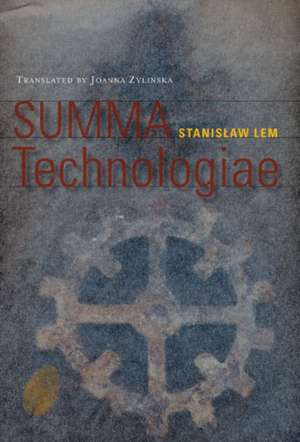
Summa Technologiae: Electronic Mediations, cartea 40
Autor Stanislaw Lem Traducere de Joanna Zylinskaen Limba Engleză Paperback – 2014
Putem afirma că apariția volumului Summa Technologiae în cadrul seriei Electronic Mediations de la University of Minnesota Press marchează un moment istoric pentru cititorii de limbă engleză: este prima traducere completă a celei mai importante opere de non-ficțiune a lui Stanislaw Lem. Deși publicat original în 1964, tratatul își păstrează o actualitate frapantă, fiind mai degrabă un exercițiu de logică aplicată asupra viitorului decât o simplă speculație. Ediția de față, tradusă de Joanna Zylinska, deschide dialogul cu o introducere critică ce analizează relevanța lui Lem în contextul noilor medii și al științelor vieții.
Structura cărții este una progresivă, pornind de la „Dilemele” fundamentale ale civilizației și avansând spre „Intelectronică”, unde Lem analizează pericolele „electrocrației” și moralitatea homeostaților. Merită menționat că autorul nu se limitează la predicții tehnologice — deși anticipează cu precizie uimitoare realitatea virtuală și nanotehnologia — ci investighează în profunzime paralela dintre evoluția biologică și cea tehnică. El concluzionează, într-un ton caustic și riguros, că tehnologia va supraviețui umanității, definind evoluția ca fiind oportunistă și extravagantă. Această perspectivă completează viziunea oferită de Between an Animal and a Machine de Pawel Majewski, adăugând fundamentul teoretic original pe care Majewski îl analizează ulterior prin prisma antropologiei cibernetice.
În contextul operei sale, dacă în The Cyberiad sau The Invincible Lem folosea satira și narativul pentru a explora relația om-mașină, în Summa Technologiae el renunță la masca ficțiunii pentru un discurs filozofic dens. Este o lectură de o complexitate academică, unde ritmul este impus de rigoarea argumentației, nu de acțiune, oferind o bază solidă pentru înțelegerea rădăcinilor gândirii postumaniste contemporane.
Din seria Electronic Mediations
-
 Preț: 174.04 lei
 - 20%
 Preț: 680.56 lei
 -
 Preț: 144.30 lei
 -
 Preț: 182.33 lei
 - 20%
 Preț: 112.89 lei
 -
 Preț: 209.36 lei
 -
 Preț: 132.28 lei
 -
 Preț: 108.68 lei
 -
 Preț: 173.29 lei
 -
 Preț: 130.40 lei
 -
 Preț: 186.14 lei
 -
 Preț: 183.29 lei
 -
 Preț: 273.25 lei
 - 20%
 Preț: 157.30 lei
 -
 Preț: 176.16 lei
 -
 Preț: 181.78 lei
 -
 Preț: 218.56 lei
 -
 Preț: 212.58 lei
 -
 Preț: 181.44 lei
 -
 Preț: 147.30 lei
 -
 Preț: 191.87 lei
 -
 Preț: 175.38 lei
 -
 Preț: 184.68 lei
 - 20%
 Preț: 195.48 lei
 -
 Preț: 190.58 lei
 - 20%
 Preț: 173.85 lei
 - 20%
 Preț: 182.73 lei
 -
 Preț: 228.16 lei
 -
 Preț: 218.10 lei
 -
 Preț: 219.41 lei
 -
 Preț: 171.16 lei
 -
 Preț: 205.83 lei
 -
 Preț: 159.11 lei
 -
 Preț: 181.80 lei
 - 26%
 Preț: 130.54 lei
 -
 Preț: 165.50 lei
 - 18%
 Preț: 96.36 lei
 - 5%
 Preț: 125.99 lei
 - 36%
 Preț: 117.30 lei
 - 26%
 Preț: 118.94 lei
 - 12%
 Preț: 165.76 lei
 - 19%
 Preț: 140.15 lei
 - 19%
 Preț: 142.55 lei
 -
 Preț: 217.92 lei
 - 18%
 Preț: 145.77 lei
 - 34%
 Preț: 136.99 lei
 - 34%
 Preț: 512.69 lei
 - nou
 Preț: 135.02 lei
Preț: 150.57 lei
Carte disponibilă
Livrare economică 13-27 noiembrie
Livrare express 30 octombrie-05 noiembrie pentru 83.87 lei
Specificații
ISBN-10: 0816675775
Pagini: 440
Ilustrații: 1
Dimensiuni: 152 x 229 x 33 mm
Greutate: 0.59 kg
Ediția:1
Editura: University of Minnesota Press
Colecția Univ Of Minnesota Press
Seria Electronic Mediations
V-ar putea interesa
-
 A Supposedly Fun Thing I'll Never Do AgainDavid Foster Wallace-26%Preț: 70.03 lei94.01 lei
 -
 -21%Preț: 114.25 lei144.60 lei
 -
 My Work Is Not Yet DoneThomas Ligotti-20%Preț: 84.23 lei105.83 lei
 -
 Art and Artifice: And Other Essays of IllusionJim SteinmeyerPreț: 108.85 lei
 -
 Preț: 215.86 lei
 -
 Pieces of Sound: German Experimental RadioDaniel GilfillanPreț: 226.76 lei
 -
 Calling All Cars: Radio Dragnets and the Technology of PolicingKathleen BattlesPreț: 195.74 lei
 -
 Preț: 147.69 lei
 -
 The End of Man: A Feminist CounterapocalypseJoanna ZylinskaPreț: 77.53 lei
 -
 In Heaven, Everything Is FineThomas LigottiPreț: 145.60 lei
 -
 PhotomediationsKamila KucPreț: 138.22 lei
 -
 In the Blink of An Eye: New EditionWalter MurchPreț: 79.33 lei
 -
 Social Media Enter the StadiumLeanne RitchiePreț: 310.84 lei
 -
 Preț: 309.55 lei
 -
 The Coverage of Development Issues in Nepalese MediaBishal Kumar BhandariPreț: 313.25 lei
De ce să citești această carte
Această lucrare este esențială pentru cercetătorii în studii media și filozofia tehnologiei, oferind o perspectivă vizionară asupra modului în care inteligența artificială și bionica redefinesc condiția umană. Cititorul câștigă acces la sistemul de gândire care a stat la baza marilor romane ale lui Lem, înțelegând de ce autorul polonez este considerat un „filozof al viitorului” ale cărui avertismente despre supraîncărcarea informațională sunt astăzi mai relevante ca oricând.
Despre autor
Stanislaw Lem a fost cel mai tradus și influent autor de literatură de anticipație din afara spațiului anglo-saxon. Laureat al Premiului Kafka și colaborator al unor publicații prestigioase precum New Yorker, Lem a depășit granițele genului beletristic prin lucrări de o profundă rigoare filozofică. Deși este cunoscut publicului larg pentru romanul Solaris, opera sa vastă include eseuri, critică literară și tratate de cibernetică. Gândirea sa, marcată de un materialism sobru și o ironie fină, a explorat constant limitele cunoașterii umane și impactul tehnologiei asupra societății, poziționându-l ca un reper intelectual al secolului XX.
Descriere scurtă
The Polish writer Stanislaw Lem is best known to English-speaking readers as the author of the 1961 science fiction novel Solaris, adapted into a meditative film by Andrei Tarkovsky in 1972 and remade in 2002 by Steven Soderbergh. Throughout his writings, comprising dozens of science fiction novels and short stories, Lem offered deeply philosophical and bitingly satirical reflections on the limitations of both science and humanity.
In Summa Technologiae—his major work of nonfiction, first published in 1964 and now available in English for the first time—Lem produced an engaging and caustically logical philosophical treatise about human and nonhuman life in its past, present, and future forms. After five decades Summa Technologiae has lost none of its intellectual or critical significance. Indeed, many of Lem’s conjectures about future technologies have now come true: from artificial intelligence, bionics, and nanotechnology to the dangers of information overload, the concept underlying Internet search engines, and the idea of virtual reality. More important for its continued relevance, however, is Lem’s rigorous investigation into the parallel development of biological and technical evolution and his conclusion that technology will outlive humanity.
Preceding Richard Dawkins’s understanding of evolution as a blind watchmaker by more than two decades, Lem posits evolution as opportunistic, shortsighted, extravagant, and illogical. Strikingly original and still timely, Summa Technologiae resonates with a wide range of contemporary debates about information and new media, the life sciences, and the emerging relationship between technology and humanity.
Notă biografică
Stanislaw Lem (1921–2006) was the best-known science fiction author writing outside the English language. His books have been translated into more than forty languages and have sold more than 27 million copies worldwide.
Joanna Zylinska is professor of new media and communications at Goldsmiths, University of London. She is the author of Bioethics in the Age of New Media and The Ethics of Cultural Studies.
Cuprins
Contents
Translator’s Introduction. Evolution May Be Greater Than the Sum of Its Parts, but It’s Not All That Great: On Lem’s Summa Technnologiae
Joanna Zylinska
Summa Technologie
1. Dilemmas
2. Two Evolutions
Similarities
Differences
The First Cause
Several Naïve Questions
3. Civilizations in the Universe
The Formulation of the Problem
The Formulation of the Method
The Statistics of Civilizations in the Universe
A Catastrophic Theory of the Universe
A Metatheory of Miracles
Man’s Uniqueness
Intelligence: An Cccident or a Necessity?
Hypotheses
Votum Separatum
Future Prospects
4. Intelectronics
Return to Earth
A Megabyte Bomb
The Big Game
Scientific Myths
The Intelligence Amplifier
The Black Box
The Morality of Homeostats
The Dangers of Electrocracy
Cybernetics and Sociology
Belief and Information
Experimental Metaphysics
The Beliefs of Electric Brains
The Ghost in the Machine
The Trouble with Information
Doubts and Antinomies
5. Prolegomena to Omnipotence
Before Chaos
Chaos and Order
Scylla and Charybdis: On Restraint
The Silence of the Designer
Methodological Madness
A New Linnaeus: About Systematics
Models and Reality
Plagiarism and Creation
On Imitology
6. Phantomology
The Fundamentals of Phantomatics
The Phantomatic Machine
Peripheral and Central Phantomatics
The Limits of Phantomatics
Cerebromatics
Teletaxy and Phantoplication
Personality and Information
7. The Creation of Worlds
Information Farming
Linguistic Engineering
The Engineering of Transcendence
Cosmogonic Engineering
8. A Lampoon of Evolution
The Reconstruction of the Species
Constructing Life
Constructing Death
Constructing Consciousness
Error-based Constructs
Bionics and Biocybernetics
In the Eyes of the Designer
Reconstructing Man
Cyborgization
The Autoevolutionary Machine
Extrasensory Phenomena
Conclusion
Notes
Bibliography
Index
Recenzii
"With Summa Technologiae, his masterwork of non-fiction which has been translated into English for the first time, Lem has taken Western civilisation for a spin—with spectacular consequences. " —New Scientist