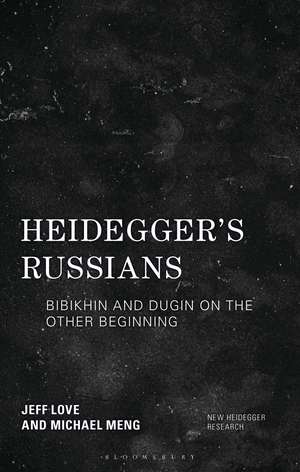
Heidegger's Russians: New Heidegger Research
Autor Michael Meng, Jeff Loveen Limba Engleză Hardback – 13 noi 2025
The book focuses on Heidegger's thought as revolutionary and in search of bringing about an other beginning in philosophy and politics. Dugin and Bibikhin are examples of Russian thinkers inspired by Heidegger to consider revolutionary alternatives in the creation of a new beginning for Russia in the wake of the collapse of the Soviet Union in 1991. Dugin represents an attempt to assert the sovereign identity and destiny of Russia and Russian thought as against modern liberal thinking, inspired by the Enlightenment and embodied in the hegemony of the United States, the "unipolar tyrant" threatening to impose its domination on the world. Bibikhin envisages a different assertion of Russian identity that does not seek direct confrontation with other nations but a transformation in how we may think the political and the destiny of humanity in the modern technological age. If Dugin advocates struggle and a philosophy of chaos that is distinctively Russian in his view, Bibikhin advocates a coming to terms with our brief existence by taking on the burden of mortality, in his words, the "burden of the cross." If Dugin advocates recognition of the negative and nothingness, Bibikhin advocates plenitude, a fullness that cannot be exhausted. These Russian thinkers take up major aspects of Heidegger's philosophical work; they adapt them in intriguing ways to an extreme existential and political situation whose consequences are still very relevant to the present day, both in terms of Russia's influence on the world stage and on the growing turn to the political right that is an international phenomenon of considerable importance.
Din seria New Heidegger Research
- 21%
 Preț: 289.64 lei
 - 23%
 Preț: 259.47 lei
 - 27%
 Preț: 284.87 lei
 - 33%
 Preț: 794.27 lei
 - 19%
 Preț: 331.02 lei
 - 29%
 Preț: 347.76 lei
 - 27%
 Preț: 283.29 lei
 - 28%
 Preț: 223.43 lei
 - 23%
 Preț: 328.48 lei
 - 19%
 Preț: 331.43 lei
 - 19%
 Preț: 326.92 lei
 - 29%
 Preț: 346.24 lei
 - 24%
 Preț: 269.14 lei
 - 19%
 Preț: 332.57 lei
 - 16%
 Preț: 334.63 lei
 - 26%
 Preț: 286.94 lei
 - 26%
 Preț: 259.28 lei
 - 28%
 Preț: 219.46 lei
 - 28%
 Preț: 220.15 lei
 - 26%
 Preț: 280.84 lei
 - 22%
 Preț: 319.95 lei
 - 27%
 Preț: 252.91 lei
 - 27%
 Preț: 282.40 lei
 - 34%
 Preț: 948.77 lei
 - 32%
 Preț: 552.38 lei
 - 22%
 Preț: 316.87 lei
 - 34%
 Preț: 598.59 lei
Preț: 503.78 lei
Preț vechi: 910.34 lei
-45%
Puncte Express: 756
Carte tipărită la comandă
Livrare economică 18 noiembrie-02 decembrie
Livrare prin curier în România Termenul estimat este afișat lângă disponibilitate.
Transport gratuit pentru acest produs Plată online sau ramburs, în funcție de opțiunile comenzii.
Retur gratuit în 14 zile Comandă securizată și suport în română.
Specificații
ISBN-13: 9781538146279
ISBN-10: 1538146274
Pagini: 190
Dimensiuni: 154 x 232 x 16 mm
Greutate: 0.43 kg
Editura: BLOOMSBURY ACADEMIC
Colecția New Heidegger Research
Seria New Heidegger Research
Locul publicării:New York, United States
ISBN-10: 1538146274
Pagini: 190
Dimensiuni: 154 x 232 x 16 mm
Greutate: 0.43 kg
Editura: BLOOMSBURY ACADEMIC
Colecția New Heidegger Research
Seria New Heidegger Research
Locul publicării:New York, United States
V-ar putea interesa
-
 GeometricsBabs WardPreț: 97.11 lei
 -
 -33%Preț: 773.40 lei1150.02 lei
 -
 -36%Preț: 534.49 lei829.59 lei
 -
 -33%Preț: 550.43 lei815.91 lei
 -
 Remembering with Things: Material Memory, Culture, and TechnologyRonald Durán Allimant-33%Preț: 549.31 lei815.22 lei
 -
 -32%Preț: 649.84 lei960.75 lei
 -
 Shifting ScenesChris MorashPreț: 129.54 lei
Cuprins
Introduction
1. The Violence-Doer
2. Political Detours?
3. In Search of Russian Philosophy
4. The Last God
5. An Other Way
6. Is Transition Still Possible?
Bibliography
Index
1. The Violence-Doer
2. Political Detours?
3. In Search of Russian Philosophy
4. The Last God
5. An Other Way
6. Is Transition Still Possible?
Bibliography
Index
Recenzii
This is a bold and astonishing book. It pulls together two very different Russian philosophers, the humanist Vladimir Bibikhin and the Putin apologist Alexander Dugin, serious Heideggerians who apply the master's legacy on mortality, politics, and metaphysics to reboot a new Russia. A wake-up call for the Western ear too prone to hear only our own fading triumphalist debates.
This book offers a provocative and unsettling meditation on what a "new beginning" in thought might mean today. Drawing on Heidegger's later vision of a thinking released from metaphysical closure, it brings into stark relief two radically different Russian appropriations of that legacy: Vladimir Bibikhin's gentle reverence for Being and transformative openness, and Alexander Dugin's volatile defense of cultural singularity through what he terms a "philosophy of chaos." The dialogue-at times implicit, at times confrontational-between plenitude and void, nonviolence and aggression, resonates far beyond Russia's borders. What emerges is a deeply consequential challenge to the intellectual complacency of the West: that our assumptions about universality, reason, and order may themselves be historical accidents rather than philosophical necessities. One may recoil from Dugin's polemics or find solace in Bibikhin's calm, but neither can be dismissed. This book forces us to confront a world where thought itself should begin again-from nothing, or from everything.
Love and Meng brilliantly take the reader through their original and compelling interpretation of Heidegger's revolutionary notion of openness, the violence and criminality against conventional thinking required to attend to it, and the diametrically opposed directions that two Russian thinkers take Heidegger's destruction of metaphysics on behalf of the other beginning: the philosophy of chaos of Aleksandr Dugin, Putin's philosopher, and Vladimir Bibikhin's emancipatory amekhania as joyful exuberance at life. In unfolding the reception of Heidegger by these recent and influential Russian thinkers, the authors place the reader at their crossroads, and ours.
This book offers a provocative and unsettling meditation on what a "new beginning" in thought might mean today. Drawing on Heidegger's later vision of a thinking released from metaphysical closure, it brings into stark relief two radically different Russian appropriations of that legacy: Vladimir Bibikhin's gentle reverence for Being and transformative openness, and Alexander Dugin's volatile defense of cultural singularity through what he terms a "philosophy of chaos." The dialogue-at times implicit, at times confrontational-between plenitude and void, nonviolence and aggression, resonates far beyond Russia's borders. What emerges is a deeply consequential challenge to the intellectual complacency of the West: that our assumptions about universality, reason, and order may themselves be historical accidents rather than philosophical necessities. One may recoil from Dugin's polemics or find solace in Bibikhin's calm, but neither can be dismissed. This book forces us to confront a world where thought itself should begin again-from nothing, or from everything.
Love and Meng brilliantly take the reader through their original and compelling interpretation of Heidegger's revolutionary notion of openness, the violence and criminality against conventional thinking required to attend to it, and the diametrically opposed directions that two Russian thinkers take Heidegger's destruction of metaphysics on behalf of the other beginning: the philosophy of chaos of Aleksandr Dugin, Putin's philosopher, and Vladimir Bibikhin's emancipatory amekhania as joyful exuberance at life. In unfolding the reception of Heidegger by these recent and influential Russian thinkers, the authors place the reader at their crossroads, and ours.
Notă biografică
Michael Meng is Associate Professor of History at Clemson University, USA. He is the author of Shattered Spaces: Encountering Jewish Ruins in Postwar Germany and Poland (2011) and co-editor of several volumes including Jewish Space in Contemporary Poland (2015) and Rebuilding Jewish Life in Germany (2020). With Jeff Love, he has co-written Revolutionary Bio-Politics from Fedorov to Mao (2023).