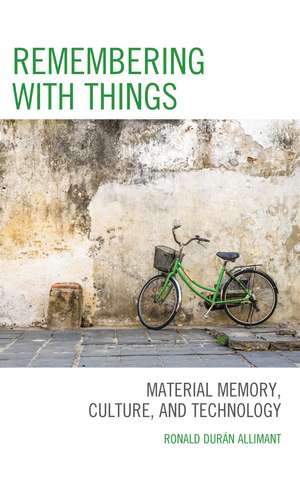
Remembering with Things: Material Memory, Culture, and Technology
Autor Ronald Durán Allimanten Limba Engleză Hardback – 5 sep 2023
Preț: 549.31 lei
Preț vechi: 815.22 lei
-33%
Puncte Express: 824
Carte tipărită la comandă
Livrare economică 17 noiembrie-01 decembrie
Livrare prin curier în România Termenul estimat este afișat lângă disponibilitate.
Transport gratuit pentru acest produs Plată online sau ramburs, în funcție de opțiunile comenzii.
Retur gratuit în 14 zile Comandă securizată și suport în română.
Specificații
ISBN-13: 9781786613189
ISBN-10: 1786613182
Pagini: 170
Dimensiuni: 160 x 232 x 18 mm
Greutate: 0.42 kg
Editura: Bloomsbury Publishing
Colecția Rowman & Littlefield
Locul publicării:New York, United States
ISBN-10: 1786613182
Pagini: 170
Dimensiuni: 160 x 232 x 18 mm
Greutate: 0.42 kg
Editura: Bloomsbury Publishing
Colecția Rowman & Littlefield
Locul publicării:New York, United States
Cuprins
Introduction
Chapter 1. The Dynamic View of Memory, Culture, and Technology
Chapter 2. Material Memory, Technology, and Cultural Heritage
Chapter 3. Material Memory and Technical Images
Chapter 4. Memory and Oblivion 1: Technological Somnambulism and the Material Memory of Things
Chapter 5. Memory and Oblivion 2: The Technical Production of Nature
Glossary
Acknowledgements
References
About the Author
Chapter 1. The Dynamic View of Memory, Culture, and Technology
Chapter 2. Material Memory, Technology, and Cultural Heritage
Chapter 3. Material Memory and Technical Images
Chapter 4. Memory and Oblivion 1: Technological Somnambulism and the Material Memory of Things
Chapter 5. Memory and Oblivion 2: The Technical Production of Nature
Glossary
Acknowledgements
References
About the Author
Recenzii
In Remembering with Things, Dura´n Allimant offers a fresh take on approaches to material culture and technological artifacts. He specifically challenges what he calls an "artisanal paradigm of process and production," which sees immaterial spirit implant upon unformed physical objects, thus separating the material and immaterial in a way that "ignores the active and constitute role that material things and technical artifacts play in the shaping of forms of life" (p. x). The author does this by incorporating memory-a "disciplinary cross-fertilizer" that links academic knowledge with everyday life (p. xi)-into his phenomenological approach to material culture and technical artifacts. However, while Dura´n Allimant proposes that his text would be accessible to non-specialists across disciplines, especially in science and technology studies, it sits more comfortably within the realm of philosophy, especially philosophy of technology, rather than in a broader science and technology field. That said, for students of memory studies and of philosophy of technology, this book expands the scope of memory, culture, and technology. Recommended. Advanced undergraduates through faculty.
Ronald Durán Allimant makes a first-rate contribution to the phenomenology of artifacts and material culture. His conception of memory as a dynamic process in interaction with things brings a fresh perspective to both the philosophy of technology and practical notions of cultural heritage.
Allimant challenges us to consider memory in its material dimension. Analyzing how technical artifacts and images are imbued with memories and history, he offers a rousing conclusion as to how we might mobilize the memory of things to reconsider both the relation between mind and matter, and between nature and culture.
Ronald Durán Allimant makes a first-rate contribution to the phenomenology of artifacts and material culture. His conception of memory as a dynamic process in interaction with things brings a fresh perspective to both the philosophy of technology and practical notions of cultural heritage.
Allimant challenges us to consider memory in its material dimension. Analyzing how technical artifacts and images are imbued with memories and history, he offers a rousing conclusion as to how we might mobilize the memory of things to reconsider both the relation between mind and matter, and between nature and culture.