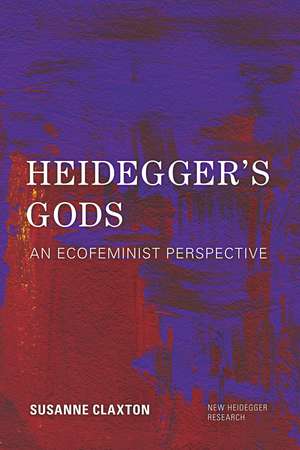
Heidegger's Gods: An Ecofeminist Perspective: New Heidegger Research
Autor Susanne Claxtonen Limba Engleză Paperback – 16 sep 2018
Susanne Claxton defends the thesis that a proper return to myth and art as a means by which the transcendental realities that constitute the phenomenology of our embodied existence may be better understood is also the means by which we may come to truly dwell in the Heideggerian sense and thus find solutions to the myriad global and personal crises that plague us. By examining key concepts in Heidegger's thinking and their role in ancient philosophy, Claxton establishes an alternative conception of truth and explores what that concept reveals. Employing the ecofeminist critique, Claxton highlights the relevant intersections with Heidegger, and lays out criticisms raised by Nietzsche, comparing the differences in thought between Nietzsche and Heidegger in order to demonstrate the supremacy of the ecophenomenological approach and show the ways in which Nietzsche falls short. The book also explores the mythological figure of Lilith and how the thought of Giorgio Agamben, especially in regard to his concept of the state of exception, provides further insight and an undeniable co-incidence of relevant concepts which further solidify the common goals and projects of both Heidegger and Ecofeminism.
Din seria New Heidegger Research
- 21%
 Preț: 289.64 lei
 - 23%
 Preț: 259.47 lei
 - 27%
 Preț: 284.87 lei
 - 33%
 Preț: 794.27 lei
 - 19%
 Preț: 331.02 lei
 - 29%
 Preț: 347.76 lei
 - 45%
 Preț: 503.78 lei
 - 28%
 Preț: 223.43 lei
 - 23%
 Preț: 328.48 lei
 - 19%
 Preț: 331.43 lei
 - 19%
 Preț: 326.92 lei
 - 29%
 Preț: 346.24 lei
 - 24%
 Preț: 269.14 lei
 - 19%
 Preț: 332.57 lei
 - 16%
 Preț: 334.63 lei
 - 26%
 Preț: 286.94 lei
 - 26%
 Preț: 259.28 lei
 - 28%
 Preț: 219.46 lei
 - 28%
 Preț: 225.70 lei
 - 26%
 Preț: 280.84 lei
 - 22%
 Preț: 319.95 lei
 - 27%
 Preț: 252.91 lei
 - 27%
 Preț: 282.40 lei
 - 34%
 Preț: 948.77 lei
 - 32%
 Preț: 552.38 lei
 - 22%
 Preț: 316.87 lei
 - 34%
 Preț: 598.59 lei
Preț: 283.29 lei
Preț vechi: 387.43 lei
-27%
Puncte Express: 425
Carte tipărită la comandă
Livrare economică 27 noiembrie-11 decembrie
Livrare prin curier în România Termenul estimat este afișat lângă disponibilitate.
Transport gratuit de la 400.00 lei Plată online sau ramburs, în funcție de opțiunile comenzii.
Retur gratuit în 14 zile Comandă securizată și suport în română.
Specificații
ISBN-13: 9781786602435
ISBN-10: 1786602431
Pagini: 176
Dimensiuni: 153 x 220 x 13 mm
Greutate: 0.27 kg
Editura: Bloomsbury Publishing
Colecția Rowman & Littlefield
Seria New Heidegger Research
Locul publicării:New York, United States
ISBN-10: 1786602431
Pagini: 176
Dimensiuni: 153 x 220 x 13 mm
Greutate: 0.27 kg
Editura: Bloomsbury Publishing
Colecția Rowman & Littlefield
Seria New Heidegger Research
Locul publicării:New York, United States
Cuprins
1. Introduction / 2. Heidegger and the Greeks / 3. Poetry and the Gods / 4. Our Loss of Dwelling / 5. Lilith and Agamben / 6. Beyond the Binary / 7. Dwelling in a New World / Bibliography / Index
Recenzii
The book's audacity is its unabashed claim to prescribe a solution for global crises. The thing is, this book brings together the Heideggerian and ecofeminist critiques of modernity in a clear, convincing, straightforward way that grounds and provides much-needed conceptual support for what I am regularly and consistently hearing from policy-makers, environmental economists, nongovernmental and civil society organizations, indigenous groups, women of the global South, trade unions, even scientists, at the annual Conference of Parties of the United Nations Framework Convention on Climate Change. This book should certainly be read by ecofeminists, Heidegger scholars, and other intellectuals, but it is not a book just for academics. It's far too true, blunt, and courageous. This book should be read by anyone concerned about the planet, exploitation of any kind, and the future of human experience.. This book . is needed as the first full-length monograph bringing Heidegger together with ecofeminism in an inspired, original articulation of his gods to remind its readers that current practices of ecodestruction and exploitation can be otherwise.
Taking on nothing less than the metaphysics of modernity, Claxton's creativity and skill knows no bounds. Here she places environmental ethics and ecological feminism in conversation with Heidegger's Dasein and Agamben's state of exception to surprising effect. The book is a significant contribution to phenomenological analysis and a joy to read.
"While it may seem unwholesome to some to discuss Martin Heidegger´s philosophy today, believing that his whole philosophy is incriminated by his adherence to Nazism, the German philosopher nonetheless takes us closer to that which is most alive, as is shown by Susanne D. Claxton´s book. Our responsibility is to transfigure the taboo into totem, and we do this by choosing that which is productive and healthy in Heidegger's thinking. If you are in any way concerned to rethink the techno-industrial paradigms through the artistic creation of new myths and thus to transform man beyond his anthropocentrism, it is recommended to read Heidegger's Gods".
Hölderlin asked: "What are poets for in dark times?" Heidegger answered: "In the darkness of the world's night, the poets bring mortals the trace of the Gods who have fled." In Heidegger's Gods: An Ecofeminist Perspective, Dr. Susanne Claxton unfolds the healing depths of that mysterious answer with eloquence and insight. Today, as we seek pathways through and beyond our own dark times, we need Claxton's wise and loving philosophical guidance more than ever.
If only a god can save us, Claxton shows this god must be female. Her original and exciting reading of Heidegger is a real page-turner in its innovative connection of Heidegger with both Agamben and ecofeminism to displace the either/or of ecocentrism and anthropocentrism with refreshing insights into Dasein's possibilities for dwelling.
Guided principally by Heidegger's rich and poetic philosophical reflections, and gathering together the insights of many other thinkers and poets as well, Susanne Claxton offers a strikingly beautiful and original meditation on the possibilities for us humans of a renewed and refreshed sojourn on this earth, under the sky, in the company of all other beings. She challenges us to think with the spirit and from the heart in order to reset our relation with all things. There is much wisdom in this book-much needed for our times.
As a profound meditation on what it would look like to dwell meaningfully in our contemporary epoch, with its unprecedented challenges, Claxton's book is an outstanding contribution to Heidegger scholarship and ecofeminist thought.
Claxton is an excellent, competent, and lucid reader of the later Heidegger. The work is also notable for the way it brings together ecofeminist theory, later Heidegger and eco-phenomenology in a comprehensive philosophical vision which gives the book its overall coherence. It will be an important work for anyone working at the intersection of phenomenology, feminism and environmental ethics. Students of Heidegger will undoubtedly delight in her innovative application of his work, as well as her deft analysis of the most pressing problems facing humanity in late modernity.
Susanne Claxton has provided an engaging and fresh contribution to the literature of both ecofeminism and ecophenomenology. [.] Heidegger's Gods: An Ecofeminist Perspective should be widely read and also makes an excellent text to assign in courses for both ecofeminism and ecophenomenology. Highly recommended.
Taking on nothing less than the metaphysics of modernity, Claxton's creativity and skill knows no bounds. Here she places environmental ethics and ecological feminism in conversation with Heidegger's Dasein and Agamben's state of exception to surprising effect. The book is a significant contribution to phenomenological analysis and a joy to read.
"While it may seem unwholesome to some to discuss Martin Heidegger´s philosophy today, believing that his whole philosophy is incriminated by his adherence to Nazism, the German philosopher nonetheless takes us closer to that which is most alive, as is shown by Susanne D. Claxton´s book. Our responsibility is to transfigure the taboo into totem, and we do this by choosing that which is productive and healthy in Heidegger's thinking. If you are in any way concerned to rethink the techno-industrial paradigms through the artistic creation of new myths and thus to transform man beyond his anthropocentrism, it is recommended to read Heidegger's Gods".
Hölderlin asked: "What are poets for in dark times?" Heidegger answered: "In the darkness of the world's night, the poets bring mortals the trace of the Gods who have fled." In Heidegger's Gods: An Ecofeminist Perspective, Dr. Susanne Claxton unfolds the healing depths of that mysterious answer with eloquence and insight. Today, as we seek pathways through and beyond our own dark times, we need Claxton's wise and loving philosophical guidance more than ever.
If only a god can save us, Claxton shows this god must be female. Her original and exciting reading of Heidegger is a real page-turner in its innovative connection of Heidegger with both Agamben and ecofeminism to displace the either/or of ecocentrism and anthropocentrism with refreshing insights into Dasein's possibilities for dwelling.
Guided principally by Heidegger's rich and poetic philosophical reflections, and gathering together the insights of many other thinkers and poets as well, Susanne Claxton offers a strikingly beautiful and original meditation on the possibilities for us humans of a renewed and refreshed sojourn on this earth, under the sky, in the company of all other beings. She challenges us to think with the spirit and from the heart in order to reset our relation with all things. There is much wisdom in this book-much needed for our times.
As a profound meditation on what it would look like to dwell meaningfully in our contemporary epoch, with its unprecedented challenges, Claxton's book is an outstanding contribution to Heidegger scholarship and ecofeminist thought.
Claxton is an excellent, competent, and lucid reader of the later Heidegger. The work is also notable for the way it brings together ecofeminist theory, later Heidegger and eco-phenomenology in a comprehensive philosophical vision which gives the book its overall coherence. It will be an important work for anyone working at the intersection of phenomenology, feminism and environmental ethics. Students of Heidegger will undoubtedly delight in her innovative application of his work, as well as her deft analysis of the most pressing problems facing humanity in late modernity.
Susanne Claxton has provided an engaging and fresh contribution to the literature of both ecofeminism and ecophenomenology. [.] Heidegger's Gods: An Ecofeminist Perspective should be widely read and also makes an excellent text to assign in courses for both ecofeminism and ecophenomenology. Highly recommended.