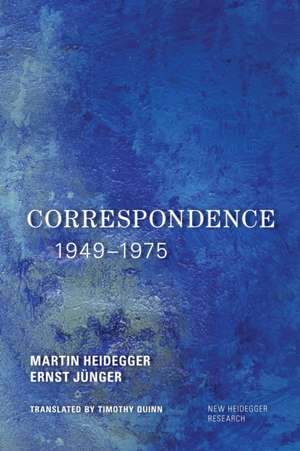
Correspondence 1949-1975: New Heidegger Research
Traducere de Timothy Sean Quinn Autor Martin Heidegger, Ernst Jüngeren Limba Engleză Paperback – 11 iul 2016
Observăm în ultimele decenii o reorientare a studiilor fenomenologice către analiza documentelor private, scrisorile devenind instrumente esențiale pentru înțelegerea evoluției gândirii filosofice în context istoric. Correspondence 1949-1975 reprezintă o piesă de arhivă fundamentală, oferind pentru prima dată publicului anglofon acces la dialogul epistolar integral dintre Martin Heidegger și Ernst Jünger. Această ediție, apărută sub egida Bloomsbury Publishing, nu este doar o simplă succesiune de mesaje personale, ci o cronică a modului în care acești doi gânditori centrali ai secolului XX și-au redefinit rolurile culturale în Europa postbelică.
Structura volumului este riguros organizată în două părți: prima cuprinde corespondența propriu-zisă, îmbogățită cu intervenții ale membrilor familiei Heidegger, iar a doua prezintă eseul „Across the Line”. Această juxtapunere permite cititorului să urmărească cum conceptele teoretice despre tehnologie și nihilism circulau între eseurile lui Jünger și cursurile lui Heidegger. Comparabil cu The Correspondence of Hannah Arendt and Gershom Scholem în ceea ce privește rigoarea documentării tensiunilor intelectuale dintr-o Germanie aflată în reconstrucție, acest volum se distinge prin focalizarea pe „problema tehnologiei”, temă care a devenit definitorie pentru opera târzie a lui Heidegger.
Suntem de părere că această lucrare completează în mod necesar cercetările anterioare ale traducătorului Timothy Sean Quinn, care în Apiqoros a explorat marginaliile istoriei filosofiei. Dacă în lucrările sale despre Salomon Maimon, Quinn analiza critica rațiunii, aici el facilitează accesul la o prietenie filosofică ce a modelat pesimismul cultural contemporan. Ritmul lecturii este cel al unui dialog intelectual dens, unde tonul variază de la reflecții metafizice la momente de consolare personală, oferind o perspectivă umană asupra unor figuri adesea considerate abstracte.
Din seria New Heidegger Research
- 21%
 Preț: 289.64 lei
 - 23%
 Preț: 259.47 lei
 - 27%
 Preț: 284.87 lei
 - 33%
 Preț: 794.27 lei
 - 19%
 Preț: 331.02 lei
 - 29%
 Preț: 347.76 lei
 - 45%
 Preț: 503.78 lei
 - 27%
 Preț: 283.29 lei
 - 28%
 Preț: 223.43 lei
 - 23%
 Preț: 328.48 lei
 - 19%
 Preț: 331.43 lei
 - 19%
 Preț: 326.92 lei
 - 29%
 Preț: 346.24 lei
 - 24%
 Preț: 269.14 lei
 - 19%
 Preț: 332.57 lei
 - 16%
 Preț: 334.63 lei
 - 26%
 Preț: 286.94 lei
 - 26%
 Preț: 259.28 lei
 - 28%
 Preț: 219.46 lei
 - 28%
 Preț: 220.15 lei
 - 26%
 Preț: 280.84 lei
 - 22%
 Preț: 319.95 lei
 - 27%
 Preț: 282.40 lei
 - 34%
 Preț: 948.77 lei
 - 32%
 Preț: 552.38 lei
 - 22%
 Preț: 316.87 lei
 - 34%
 Preț: 598.59 lei
Preț: 252.91 lei
Preț vechi: 348.53 lei
-27%
Carte tipărită la comandă
Livrare economică 21 noiembrie-05 decembrie
Specificații
ISBN-10: 178348876X
Pagini: 144
Dimensiuni: 136 x 214 x 10 mm
Greutate: 0.18 kg
Editura: Bloomsbury Publishing
Colecția Rowman & Littlefield
Seria New Heidegger Research
Locul publicării:New York, United States
V-ar putea interesa
-
 Contributions to Philosophy (Of the Event)Martin HeideggerPreț: 391.12 lei
 -
 -14%Preț: 614.45 lei714.47 lei
 -
 Sustainable Urbanism and Direct Action: Case Studies in Dialectical ActivismBenjamin Heim ShepardPreț: 221.84 lei
 -
 -14%Preț: 878.27 lei1021.23 lei
 -
 -14%Preț: 763.72 lei888.06 lei
 -
 -24%Preț: 353.58 lei462.56 lei
 -
 The Uses of Imperial Citizenship: The British and French EmpiresJack Harrington-31%Preț: 692.98 lei1001.97 lei
 -
 Towards Gendering Institutionalism: Equality in EuropeHeather MacRae-23%Preț: 314.81 lei407.50 lei
 -
 Europeanised or European?Sandra KrogerPreț: 325.66 lei
 -
 Hegel, Husserl and the Phenomenology of Historical WorldsTanja Staehler-34%Preț: 816.89 lei1242.77 lei
De ce să citești această carte
Recomandăm acest volum cercetătorilor și studenților interesați de istoria ideilor și de fenomenologia germană. Cititorul câștigă o perspectivă unică asupra colaborării dintre un filosof și un romancier în fața crizei modernității tehnologice. Este o resursă esențială pentru a înțelege cum au fost formulate temele din opera târzie a lui Heidegger, oferind în același timp contextul istoric necesar pentru a descifra eseul „Across the Line” al lui Jünger.
Despre autor
Martin Heidegger (1889-1976) a fost unul dintre cei mai influenți filosofi ai secolului XX, a cărui lucrare „Ființă și timp” a redefinit ontologia modernă. Ernst Jünger (1895-1998), scriitor și eseist de renume, a explorat în opera sa impactul tehnologiei și al războiului asupra condiției umane. Traducătorul acestui volum, Timothy Sean Quinn, este profesor de filosofie la Universitatea Xavier și un specialist în istoria filosofiei politice și a gândirii germane, fiind cunoscut pentru eforturile sale de a recupera texte filosofice mai puțin accesibile publicului larg.
Descriere
Beginning in 1949, the German novelist and essayist Ernst Jnger began a correspondence with the philosopher Martin Heidegger that lasted until Heidegger's death in 1975. This volume contains the first English translation of their complete correspondence, as well as letters from Heidegger's wife and son and others referred to in their correspondence. It also contains a translation of Jnger's essay Across the Line (ber die Linie), his contribution to a Festschrift celebrating Heidegger's sixtieth birthday. Jnger's and Heidegger's correspondence is of enormous historical interest, revealing how both men came to understand their cultural roles in post-war Europe. It is valuable as well for showing the emergence of themes pervasive in Heidegger's post-war thought: his cultural and political pessimism and his concern with the problem of global technology. The correspondence also reveals the evolution of a philosophical friendship between two writers central to twentieth century European thought, and the mutual influence that friendship worked on their writing.
Cuprins
Recenzii
While each is a neglected figure in American academia, the correspondence of these two impressive thinkers makes for an impressive addition to understanding their oeuvres. There is a tendency to think of philosophers and writers as devoid of personal lives, and hopefully this volume
will contribute to rectifying that error.
With this elegant translation, Timothy Sean Quinn allows us to eavesdrop on a fascinating conversation: two prolific authors, moved by Nietzsche to confront nihilism, discuss their writings and share life's moments - Heidegger consoles Jünger for the loss of his spouse, and the final letter, sent by Heidegger's wife, is a collection of poems that had comforted him on his deathbed. The humanity of the thinker strikingly emerges in these beautifully rendered exchanges.