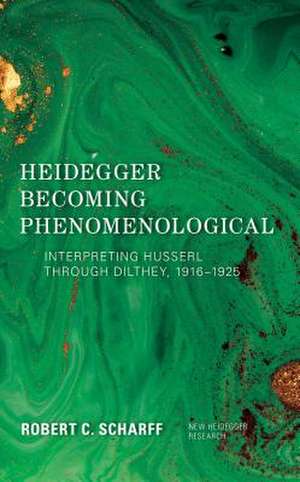
Heidegger Becoming Phenomenological: Interpreting Husserl through Dilthey, 1916–1925: New Heidegger Research
Autor Robert C. Scharffen Limba Engleză Paperback – 11 dec 2018
Din seria New Heidegger Research
- 21%
 Preț: 289.64 lei
 - 23%
 Preț: 259.47 lei
 - 33%
 Preț: 794.27 lei
 - 19%
 Preț: 331.02 lei
 - 29%
 Preț: 347.76 lei
 - 44%
 Preț: 517.97 lei
 - 27%
 Preț: 283.29 lei
 - 28%
 Preț: 223.43 lei
 - 23%
 Preț: 328.48 lei
 - 19%
 Preț: 331.43 lei
 - 19%
 Preț: 326.92 lei
 - 29%
 Preț: 346.24 lei
 - 24%
 Preț: 269.14 lei
 - 19%
 Preț: 332.57 lei
 - 16%
 Preț: 334.63 lei
 - 26%
 Preț: 286.94 lei
 - 26%
 Preț: 259.28 lei
 - 28%
 Preț: 219.46 lei
 - 28%
 Preț: 225.70 lei
 - 26%
 Preț: 280.84 lei
 - 22%
 Preț: 319.95 lei
 - 27%
 Preț: 252.91 lei
 - 27%
 Preț: 282.40 lei
 - 34%
 Preț: 948.77 lei
 - 32%
 Preț: 552.38 lei
 - 22%
 Preț: 316.87 lei
 - 34%
 Preț: 598.59 lei
Preț: 284.87 lei
Preț vechi: 388.29 lei
-27%
Puncte Express: 427
Carte tipărită la comandă
Livrare economică 05-19 decembrie
Livrare prin curier în România Termenul estimat este afișat lângă disponibilitate.
Transport gratuit de la 400.00 lei Plată online sau ramburs, în funcție de opțiunile comenzii.
Retur gratuit în 14 zile Comandă securizată și suport în română.
Specificații
ISBN-13: 9781786607737
ISBN-10: 1786607735
Pagini: 192
Dimensiuni: 150 x 226 x 14 mm
Greutate: 0.34 kg
Editura: Bloomsbury Publishing
Colecția Rowman & Littlefield
Seria New Heidegger Research
Locul publicării:New York, United States
ISBN-10: 1786607735
Pagini: 192
Dimensiuni: 150 x 226 x 14 mm
Greutate: 0.34 kg
Editura: Bloomsbury Publishing
Colecția Rowman & Littlefield
Seria New Heidegger Research
Locul publicării:New York, United States
Cuprins
Preface / Acknowledgments / Note on citations / Introduction / 1. Preparing to "Be" Phenomenological / Part I / 2. From Dilthey to Heidegger: Recasting the Erklären-Verstehen Debate / 3. Heidegger's Destructive Retrieval of Dilthey's "Standpoint of Life" / Part II / 4. From Dilthey to Husserl / 5. Heidegger's Diltheyian Retrieval of Husserl's "Two Sides" / Part III / 6. Continuously "Becoming" Phenomenological / References / Index
Recenzii
Robert Scharff's new book, Heidegger Becoming Phenomenological: Interpreting Husserl through Dilthey, 1916-1925 is a provocative account of Heidegger's early years that no one interested in Heidegger or phenomenology can afford to ignore.
As Scharff sees it, Heidegger's way of becoming phenomenological was not Husserl's, who regarded phenomenology as a theoretical-scientific attitude of a transcendental subject expositing its intentional objects, but rather Dilthey's, who situates it in the whole of life that is always already there as an articulated historical context that mutually correlates self and world into a meaningful whole.
No one knows the Heidegger-Dilthey connection better than Robert Scharff, and in this revolutionary new work he pushes the reset button on the origins of Being and Time. Through a meticulous reading of the earliest courses Scharff reveals how Heidegger's grappling with Dilthey turned him into a phenomenologist of life and eventually of Dasein, in contrast to the transcendental consciousness of Husserl. Written with clarity and verve, this book leaves the "Seinology" of later commentaries in the dust and restores to Heidegger's work the existential vitality that is its birthright.
The book is detailed, well-researched, and argued in a refreshingly direct style. It is important reading for anyone interested in Heidegger's early work, and should motivate many to give more consideration to Dilthey's influence on Heidegger. ... Heidegger Becoming Phenomenological does make an important contribution to Heidegger scholarship, but that is not its only goal. It also aims to retrieve from Heidegger the idea of doing philosophy that emerges from experience and responds to the concerns of the surrounding lifeworld.
Anyone interested in the history of continental philosophy, the interconnection of Husserl, Heidegger and Dilthey, or the history of phenomenology in general, will find much of worth in Scharff's text. It would be especially informative for those in the early stages in their acquaintance with these topics, but those with a familiarity will undoubtedly find something worthwhile here too. . . . The divide between analytic and continental philosophy is beginning to become more blurred, with analytic philosophers doing metaphysics, and there is more dialogue than ever between philosophers across the divide (Heidegger and Wittgenstein being a key example), Heidegger Becoming Phenomenological is also a powerful reminder of why this is a good thing, and how much continental and analytic philosophers have to learn from each other.
As Scharff sees it, Heidegger's way of becoming phenomenological was not Husserl's, who regarded phenomenology as a theoretical-scientific attitude of a transcendental subject expositing its intentional objects, but rather Dilthey's, who situates it in the whole of life that is always already there as an articulated historical context that mutually correlates self and world into a meaningful whole.
No one knows the Heidegger-Dilthey connection better than Robert Scharff, and in this revolutionary new work he pushes the reset button on the origins of Being and Time. Through a meticulous reading of the earliest courses Scharff reveals how Heidegger's grappling with Dilthey turned him into a phenomenologist of life and eventually of Dasein, in contrast to the transcendental consciousness of Husserl. Written with clarity and verve, this book leaves the "Seinology" of later commentaries in the dust and restores to Heidegger's work the existential vitality that is its birthright.
The book is detailed, well-researched, and argued in a refreshingly direct style. It is important reading for anyone interested in Heidegger's early work, and should motivate many to give more consideration to Dilthey's influence on Heidegger. ... Heidegger Becoming Phenomenological does make an important contribution to Heidegger scholarship, but that is not its only goal. It also aims to retrieve from Heidegger the idea of doing philosophy that emerges from experience and responds to the concerns of the surrounding lifeworld.
Anyone interested in the history of continental philosophy, the interconnection of Husserl, Heidegger and Dilthey, or the history of phenomenology in general, will find much of worth in Scharff's text. It would be especially informative for those in the early stages in their acquaintance with these topics, but those with a familiarity will undoubtedly find something worthwhile here too. . . . The divide between analytic and continental philosophy is beginning to become more blurred, with analytic philosophers doing metaphysics, and there is more dialogue than ever between philosophers across the divide (Heidegger and Wittgenstein being a key example), Heidegger Becoming Phenomenological is also a powerful reminder of why this is a good thing, and how much continental and analytic philosophers have to learn from each other.