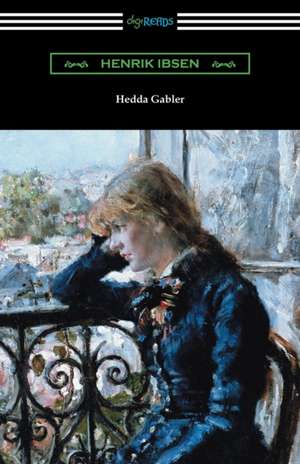
Hedda Gabler
Autor Henrik Ibsenen Limba Engleză Paperback – 5 feb 2019
Hedda Gabler
By Henrik Ibsen
Translated by Edmund Gosse and William Archer
Hedda, the daughter of an aristocratic and enigmatic general, has just returned to her villa in Kristiania (now Oslo) from her honeymoon. Her husband is George Tesman, a young, aspiring, and reliable (but not brilliant) academic who continued his research during their honeymoon. It becomes clear in the course of the play that she has never loved him but married him because she thinks her years of youthful abandon are over. It is also suggested that she may be pregnant.
The reappearance of George's academic rival, Eilert Lovborg, throws their lives into disarray. Eilert, a writer, is also a recovered alcoholic who has wasted his talent until now. Thanks to a relationship with Hedda's old schoolmate Thea Elvsted (who has left her husband for him), Eilert shows signs of rehabilitation and has just published a bestseller in the same field as George. When Hedda and Eilert talk privately together, it becomes apparent that they are former lovers.
From Munich, on June 29, 1890, Ibsen wrote to the Swedish poet, Count Carl Soilsky: "Our intention has all along been to spend the summer in the Tyrol again. But circumstances are against our doing so. I am at present engaged upon a new dramatic work, which for several reasons has made very slow progress, and I do not leave Munich until I can take with me the completed first draft. There is little or no prospect of my being able to complete it in July." Ibsen did not leave Munich at all that season. On October 30 he wrote: "At present I am utterly engrossed in a new play. Not one leisure hour have I had for several months." Three weeks later (November 20) he wrote to his French translator, Count Prozor: "My new play is finished; the manuscript went off to Copenhagen the day before yesterday.... It produces a curious feeling of emptiness to be thus suddenly separated from a work which has occupied one's time and thoughts for several months, to the exclusion of all else. But it is a good thing, too, to have done with it. The constant intercourse with the fictitious personages was beginning to make me quite nervous." To the same correspondent he wrote on December 4: "The title of the play is Hedda Gabler. My intention in giving it this name was to indicate that Hedda, as a personality, is to be regarded rather as her father's daughter than as her husband's wife. It was not my desire to deal in this play with so-called problems. What I principally wanted to do was to depict human beings, human emotions, and human destinies, upon a groundwork of certain of the social conditions and principles of the present day."
So far we read the history of the play in the official "Correspondence."(A) Some interesting glimpses into the poet's moods during the period between the completion of The Lady from the Sea and the publication of Hedda Gabler are to be found in the series of letters to Fraulein Emilie Bardach, of Vienna, published by Dr. George Brandes.(B) This young lady Ibsen met at Gossensass in the Tyrol in the autumn of 1889. The record of their brief friendship belongs to the history of The Master Builder rather than to that of Hedda Gabler, but the allusions to his work in his letters to her during the winter of 1889 demand some examination.
Preț: 49.92 lei
Carte tipărită la comandă
Livrare economică 09-23 iulie
Specificații
ISBN-10: 1420960970
Pagini: 82
Dimensiuni: 140 x 216 x 5 mm
Greutate: 0.11 kg
Editura: Digireads.com
V-ar putea interesa
-
 A Doll's House and Other PlaysHenrik IbsenPreț: 70.49 lei
 -
 Hedda Gabler and Other PlaysHenrik Ibsen-20%Preț: 74.67 lei92.87 lei
 -
 The Master Builder and Other PlaysHenrik IbsenPreț: 92.22 lei
 -
 A Doll's House, Men of Honour, When We Dead AwakenHenrik Ibsen-19%Preț: 51.90 lei64.42 lei
 -
 Preț: 57.84 lei
 -
 Four Major Plays Vol.1: Centennial EditionHenrik IbsenPreț: 44.74 lei
 -
 A Doll's HouseHenrik Ibsen-20%Preț: 19.66 lei24.70 lei
 -
 Rosencrantz and Guildenstern Are DeadTom StoppardPreț: 76.50 lei
 -
 The Substance of FireJon Robin BaitzPreț: 88.51 lei
 -
 Waverly GalleryKenneth LonerganPreț: 83.94 lei
 -
 Other Desert CitiesJon Robin BaitzPreț: 88.70 lei
 -
 A Doll’s HouseHenrik Ibsen-18%Preț: 77.39 lei94.77 lei
 -
 Guide to Producing a Fashion Show: Bundle Book + Studio Access CardJudith C. Everett-11%Preț: 500.85 lei562.76 lei
 -
 A Doll's HouseHenrik IbsenPreț: 31.45 lei
 -
 GhostsHenrik IbsenPreț: 26.64 lei
 -
 The Master BuilderHenrik IbsenPreț: 31.45 lei
 -
 PERFORMING PRESENCENick KayePreț: 168.12 lei
 -
 Unlimited ActionDominic JohnsonPreț: 168.66 lei
 -
 Medea and Other PlaysEuripidesPreț: 43.30 lei
 -
 HeddaLucy KirkwoodPreț: 97.56 lei
 -
 Nora : A Doll's HouseStef SmithPreț: 74.06 lei
 -
 The Lady from the SeaHenrik IbsenPreț: 28.59 lei
 -
 An Inspector Calls: Annotation-Friendly EditionJ. B. PriestleyPreț: 84.22 lei
 -
 The Importance of Being EarnestOscar WildePreț: 31.83 lei
 -
 Fashion Details: 4000 DrawingsElisabetta Kuky Drudi-16%Preț: 196.68 lei232.83 lei
Notă biografică
Descriere
Known as the father of modern drama, Henrik Ibsen is considered one of the world's greatest playwrights. His ability to turn revolutionary philosophical ideas into brilliant social dramas inspired the likes of George Bernard Shaw, while his drive to manifest the truths of the human heart is mirrored in the plays of Anton Chekhov. Ibsen's genius, revealed in these four selections, lies in his startling abiliy to define his characters and their struggles, whih epitomize the inner conflicts that beset all human beings. A chilling play of manipulation and obsession, "Hedda Gabler" features one of the stage's most unforgettable modern heroines. A delightful early work, "Peer Gynt" is both a satire on the nature of man and a masterpiece of folklore and fantasy that follows the adventures of an irrepressible youth. Mysterious, lyrical, and tragic, "The Master Builder" symbolically dramatizes the trajectory of Ibsen's own art as well as the impossible aspirations of the soul. This Bantam Classic edition also includes "Little Eyolf," a brilliantly consrtucted psychological study of paternal responsibility and the impact of a child's death on a man torn between two women.
Cuprins
COMMENTARY
Cultural and Theatrical Contexts
Theatrical Style
Themes
Characterisation
Setting
Translation
Performance History
Scholarly and Popular Debate
Further reading and viewing
HEDDA GABLER
Notes