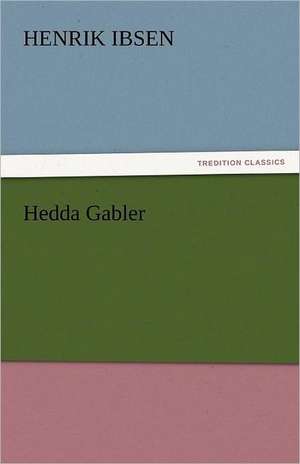
Hedda Gabler
Autor Henrik Ibsenen Limba Engleză Paperback – 17 noi 2011
Preț: 150.47 lei
Puncte Express: 226
Carte tipărită la comandă
Livrare economică 07-21 decembrie
Livrare prin curier în România Termenul estimat este afișat lângă disponibilitate.
Transport gratuit de la 400.00 lei Plată online sau ramburs, în funcție de opțiunile comenzii.
Retur gratuit în 14 zile Comandă securizată și suport în română.
Specificații
ISBN-13: 9783842454408
ISBN-10: 3842454406
Pagini: 180
Dimensiuni: 133 x 203 x 13 mm
Greutate: 0.23 kg
Editura: TREDITION CLASSICS
ISBN-10: 3842454406
Pagini: 180
Dimensiuni: 133 x 203 x 13 mm
Greutate: 0.23 kg
Editura: TREDITION CLASSICS
V-ar putea interesa
-
 A Doll's House and Other PlaysHenrik IbsenPreț: 74.04 lei
 -
 Hedda Gabler and Other PlaysHenrik Ibsen-18%Preț: 77.47 lei94.36 lei
 -
 The Master Builder and Other PlaysHenrik IbsenPreț: 95.86 lei
 -
 A Doll's House, Men of Honour, When We Dead AwakenHenrik Ibsen-17%Preț: 54.19 lei65.62 lei
 -
 Preț: 61.73 lei
 -
 Four Major Plays Vol.1: Centennial EditionHenrik IbsenPreț: 52.89 lei
 -
 A Doll's HouseHenrik IbsenPreț: 24.75 lei
 -
 Rosencrantz and Guildenstern Are DeadTom StoppardPreț: 77.73 lei
 -
 The Substance of FireJon Robin BaitzPreț: 112.92 lei
 -
 Waverly GalleryKenneth LonerganPreț: 90.75 lei
 -
 Other Desert CitiesJon Robin BaitzPreț: 93.89 lei
 -
 A Doll’s HouseHenrik Ibsen-10%Preț: 81.22 lei90.00 lei
 -
 Guide to Producing a Fashion Show: Bundle Book + Studio Access CardJudith C. Everett-11%Preț: 500.85 lei562.76 lei
 -
 A Doll's HouseHenrik IbsenPreț: 34.04 lei
 -
 GhostsHenrik IbsenPreț: 28.47 lei
 -
 The Master BuilderHenrik IbsenPreț: 33.83 lei
 -
 Performing PresenceGabriella GiannachiPreț: 256.63 lei
 -
 Unlimited actionDominic JohnsonPreț: 176.68 lei
 -
 Medea and Other PlaysEuripidesPreț: 43.30 lei
 -
 HeddaLucy KirkwoodPreț: 97.38 lei
 -
 Nora : A Doll's HouseStef SmithPreț: 77.73 lei
 -
 The Lady from the SeaHenrik IbsenPreț: 30.58 lei
 -
 An Inspector Calls: Annotation-Friendly EditionJ. B. PriestleyPreț: 86.45 lei
 -
 Preț: 34.20 lei
 -
 Fashion Details: 4000 DrawingsElisabetta Kuky Drudi-13%Preț: 208.90 lei239.67 lei
Descriere
Descriere de la o altă ediție sau format:
Known as the father of modern drama, Henrik Ibsen is considered one of the world's greatest playwrights. His ability to turn revolutionary philosophical ideas into brilliant social dramas inspired the likes of George Bernard Shaw, while his drive to manifest the truths of the human heart is mirrored in the plays of Anton Chekhov. Ibsen's genius, revealed in these four selections, lies in his startling abiliy to define his characters and their struggles, whih epitomize the inner conflicts that beset all human beings. A chilling play of manipulation and obsession, "Hedda Gabler" features one of the stage's most unforgettable modern heroines. A delightful early work, "Peer Gynt" is both a satire on the nature of man and a masterpiece of folklore and fantasy that follows the adventures of an irrepressible youth. Mysterious, lyrical, and tragic, "The Master Builder" symbolically dramatizes the trajectory of Ibsen's own art as well as the impossible aspirations of the soul. This Bantam Classic edition also includes "Little Eyolf," a brilliantly consrtucted psychological study of paternal responsibility and the impact of a child's death on a man torn between two women.
Known as the father of modern drama, Henrik Ibsen is considered one of the world's greatest playwrights. His ability to turn revolutionary philosophical ideas into brilliant social dramas inspired the likes of George Bernard Shaw, while his drive to manifest the truths of the human heart is mirrored in the plays of Anton Chekhov. Ibsen's genius, revealed in these four selections, lies in his startling abiliy to define his characters and their struggles, whih epitomize the inner conflicts that beset all human beings. A chilling play of manipulation and obsession, "Hedda Gabler" features one of the stage's most unforgettable modern heroines. A delightful early work, "Peer Gynt" is both a satire on the nature of man and a masterpiece of folklore and fantasy that follows the adventures of an irrepressible youth. Mysterious, lyrical, and tragic, "The Master Builder" symbolically dramatizes the trajectory of Ibsen's own art as well as the impossible aspirations of the soul. This Bantam Classic edition also includes "Little Eyolf," a brilliantly consrtucted psychological study of paternal responsibility and the impact of a child's death on a man torn between two women.
Notă biografică
Born in Norway in 1828, Henrik Ibsen began his writing career with romantic history plays influenced by Shakespeare and Schiller. In 1851 he was appointed writer-in-residence at the newly established Norwegian Theatre in Bergen with a contract to write a play a year for five years, following which he was made Artistic Director of the Norwegian Theatre in what is now Oslo. In the 1860s he moved abroad to concentrate wholly on writing. He began with two mighty verse dramas, Brand and Peer Gynt, and in the 1870s and 1880s wrote the sequence of realistic ‘problem’ plays for which he is best known, among them A Doll’s House, Ghosts, An Enemy of the People, Hedda Gabler and Rosmersholm. His last four plays, The Master Builder, Little Eyolf, John Gabriel Borkman and When We Dead Awaken, dating from his return to Norway in the 1890s, are increasingly overlaid with symbolism. Illness forced him to retire in 1900, and he died in 1906 after a series of crippling strokes.
Mark O'Rowe is an Irish playwright whose plays include Howie the Rookie (Bush Theatre, London, 1999), From Both Hips (Fishamble, 1997), Made in China (Abbey Theatre, Dublin, 2001), Crestfall (Gate Theatre, Dublin, 2003), Terminus (Abbey Theatre, 2007) and Our Few and Evil Days (Abbey Theatre, 2014). His screenplays include Broken (2012), based on the novel by Daniel Clay, Perrier’s Bounty (2009), Boy A (2007), based on the novel by Jonathan Trigell, and Intermission (2004).
Mark O'Rowe is an Irish playwright whose plays include Howie the Rookie (Bush Theatre, London, 1999), From Both Hips (Fishamble, 1997), Made in China (Abbey Theatre, Dublin, 2001), Crestfall (Gate Theatre, Dublin, 2003), Terminus (Abbey Theatre, 2007) and Our Few and Evil Days (Abbey Theatre, 2014). His screenplays include Broken (2012), based on the novel by Daniel Clay, Perrier’s Bounty (2009), Boy A (2007), based on the novel by Jonathan Trigell, and Intermission (2004).
Cuprins
Chronology
COMMENTARY
Cultural and Theatrical Contexts
Theatrical Style
Themes
Characterisation
Setting
Translation
Performance History
Scholarly and Popular Debate
Further reading and viewing
HEDDA GABLER
Notes
COMMENTARY
Cultural and Theatrical Contexts
Theatrical Style
Themes
Characterisation
Setting
Translation
Performance History
Scholarly and Popular Debate
Further reading and viewing
HEDDA GABLER
Notes
Recenzii
The production of an Ibsen play impels the inquiry, What is the province of art? If it be to elevate and refine, as we have hitherto humbly supposed, most certainly it cannot be said that the works of Ibsen have the faintest claim to be artistic. We see no ground on which his method is defensible...Things rank and gross in nature alone have place in the mean and sordid philosophy of Ibsen.