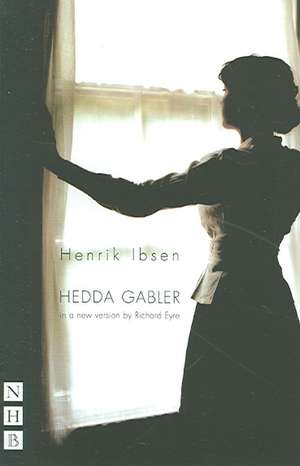
Hedda Gabler: NHB Classic Plays
Autor Henrik Ibsenen Limba Engleză Paperback – 10 mar 2005
Filled with a passion for life that cannot be confined by her marriage or “perfect home,” Hedda Gabler strives to find a way to fulfill her desires by manipulating those around her. Former artistic director of the National Theatre and top-flight director of both stage and screen, Richard Eyre helms his own new version of Ibsen’s classic at London’s Almeida Theatre in Spring 2005.
Din seria NHB Classic Plays
-
 Preț: 75.00 lei
-
 Preț: 68.20 lei
- 12%
 Preț: 80.67 lei
-
 Preț: 76.57 lei
-
 Preț: 77.82 lei
-
 Preț: 91.24 lei
- 14%
 Preț: 78.68 lei
-
 Preț: 66.63 lei
- 21%
 Preț: 70.46 lei
-
 Preț: 74.94 lei
-
 Preț: 60.64 lei
-
 Preț: 77.90 lei
-
 Preț: 84.46 lei
-
 Preț: 77.12 lei
-
 Preț: 77.46 lei
-
 Preț: 78.13 lei
-
 Preț: 77.96 lei
- 21%
 Preț: 74.41 lei
Preț: 77.87 lei
Puncte Express: 117
Carte disponibilă
Livrare economică 27 noiembrie-11 decembrie
Livrare express 13-19 noiembrie pentru 15.70 lei
Livrare prin curier în România Termenul estimat este afișat lângă disponibilitate.
Transport gratuit de la 400.00 lei Plată online sau ramburs, în funcție de opțiunile comenzii.
Retur gratuit în 14 zile Comandă securizată și suport în română.
Specificații
ISBN-13: 9781854598424
ISBN-10: 1854598422
Pagini: 96
Dimensiuni: 130 x 200 x 6 mm
Greutate: 0.12 kg
Ediția:Almeida Theatre version
Editura: NICK HERN BOOKS
Colecția NHB Classic Plays
Seria NHB Classic Plays
Locul publicării:United Kingdom
ISBN-10: 1854598422
Pagini: 96
Dimensiuni: 130 x 200 x 6 mm
Greutate: 0.12 kg
Ediția:Almeida Theatre version
Editura: NICK HERN BOOKS
Colecția NHB Classic Plays
Seria NHB Classic Plays
Locul publicării:United Kingdom
V-ar putea interesa
-
 A Doll's House and Other PlaysHenrik IbsenPreț: 74.47 lei
-
 Hedda Gabler and Other PlaysHenrik Ibsen-18%Preț: 77.47 lei94.36 lei
-
 The Master Builder and Other PlaysHenrik IbsenPreț: 95.86 lei
-
 A Doll's House, Men of Honour, When We Dead AwakenHenrik Ibsen-17%Preț: 54.72 lei65.62 lei
-
 Preț: 62.08 lei
-
 Four Major Plays Vol.1: Centennial EditionHenrik IbsenPreț: 52.89 lei
-
 A Doll's HouseHenrik IbsenPreț: 24.75 lei
-
 Rosencrantz and Guildenstern Are DeadTom StoppardPreț: 77.73 lei
-
 The Substance of FireJon Robin BaitzPreț: 112.92 lei
-
 Waverly GalleryKenneth LonerganPreț: 90.75 lei
-
 Other Desert CitiesJon Robin BaitzPreț: 94.43 lei
-
 A Doll’s HouseHenrik Ibsen-15%Preț: 81.43 lei96.30 lei
-
 Guide to Producing a Fashion Show: Bundle Book + Studio Access CardJudith C. Everett-11%Preț: 500.85 lei562.76 lei
-
 A Doll's HouseHenrik IbsenPreț: 34.04 lei
-
 GhostsHenrik IbsenPreț: 28.47 lei
-
 The Master BuilderHenrik IbsenPreț: 33.83 lei
-
 Performing PresenceGabriella GiannachiPreț: 256.63 lei
-
 Unlimited actionDominic JohnsonPreț: 176.68 lei
-
 Medea and Other PlaysEuripidesPreț: 43.30 lei
-
 HeddaLucy KirkwoodPreț: 97.38 lei
-
 Nora : A Doll's HouseStef SmithPreț: 77.73 lei
-
 The Lady from the SeaHenrik IbsenPreț: 30.58 lei
-
 An Inspector Calls: Annotation-Friendly EditionJ. B. PriestleyPreț: 86.45 lei
-
 Preț: 34.20 lei
-
 Fashion Details: 4000 DrawingsElisabetta Kuky Drudi-13%Preț: 208.90 lei239.67 lei
Descriere
New adaptation of Ibsen's classic by Richard Eyre, who ran England's National Theatre from 1988-97.
Notă biografică
Henrik Johan Ibsen (20 March 1828 - 23 May 1906) was a Norwegian playwright, theatre director, and poet. As one of the founders of modernism in theatre, Ibsen is often referred to as "the father of realism" and one of the most influential playwrights of his time.[2] His major works include Brand, Peer Gynt, An Enemy of the People, Emperor and Galilean, A Doll's House, Hedda Gabler, Ghosts, The Wild Duck, When We Dead Awaken, Pillars of Society, The Lady from the Sea, Rosmersholm, The Master Builder, and John Gabriel Borkman. He is the most frequently performed dramatist in the world after Shakespeare,and by the early 20th century A Doll's House became the world's most performed play. Several of his later dramas were considered scandalous to many of his era, when European theatre was expected to model strict morals of family life and propriety. Ibsen's later work examined the realities that lay behind the facades, revealing much that was disquieting to a number of his contemporaries. He had a critical eye and conducted a free inquiry into the conditions of life and issues of morality. His early poetic and cinematic play Peer Gynt, however, has also strong surreal elements.[6] Ibsen is often ranked as one of the most distinguished playwrights in the European tradition.[7] Richard Hornby describes him as "a profound poetic dramatist-the best since Shakespeare".[8] He is widely regarded as the foremost playwright of the nineteenth century.[7][9] He influenced other playwrights and novelists such as George Bernard Shaw, Oscar Wilde, Arthur Miller, James Joyce, Eugene O'Neill, and Miroslav Krle¿a. Ibsen was nominated for the Nobel Prize in Literature in 1902, 1903, and 1904.[10] Ibsen wrote his plays in Danish (the common written language of Denmark and Norway during his lifetime)[11] and they were published by the Danish publisher Gyldendal. Although most of his plays are set in Norway-often in places reminiscent of Skien, the port town where he grew up-Ibsen lived for 27 years in Italy and Germany, and rarely visited Norway during his most productive years. Born into a merchant family connected to the patriciate of Skien, Ibsen shaped his dramas according to his family background. He was the father of Prime Minister Sigurd Ibsen. Ibsen's dramas have a strong influence upon contemporary culture.
Cuprins
Chronology
COMMENTARY
Cultural and Theatrical Contexts
Theatrical Style
Themes
Characterisation
Setting
Translation
Performance History
Scholarly and Popular Debate
Further reading and viewing
HEDDA GABLER
Notes
COMMENTARY
Cultural and Theatrical Contexts
Theatrical Style
Themes
Characterisation
Setting
Translation
Performance History
Scholarly and Popular Debate
Further reading and viewing
HEDDA GABLER
Notes
Recenzii
The production of an Ibsen play impels the inquiry, What is the province of art? If it be to elevate and refine, as we have hitherto humbly supposed, most certainly it cannot be said that the works of Ibsen have the faintest claim to be artistic. We see no ground on which his method is defensible...Things rank and gross in nature alone have place in the mean and sordid philosophy of Ibsen.