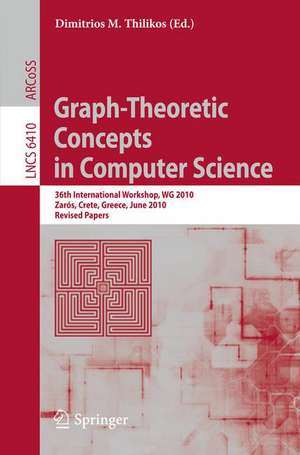
Graph-Theoretic Concepts in Computer Science: 36th International Workshop, WG 2010, Zarós, Crete, Greece, June 28-30, 2010, Revised Papers: Lecture Notes in Computer Science, cartea 6410
Editat de Dimitrios M. Thilikosen Limba Engleză Paperback – 29 oct 2010
Observăm în Graph-Theoretic Concepts in Computer Science o structură progresivă, specifică seriei Lecture Notes in Computer Science, care facilitează tranziția de la fundamentele teoretice la implementări algoritmice complexe. Volumul debutează cu secțiunea de prelegeri invitate, unde sunt explorate barierele algoritmice generate de tranzițiile de fază și conceptele de bidimensionalitate, oferind cadrul conceptual necesar pentru restul lucrărilor. Ulterior, cele 28 de articole selectate riguros sunt organizate în jurul unor probleme clasice de optimizare și complexitate, precum problema celui mai lung drum pe grafuri de cocomparabilitate sau calculul lățimii de tăiere (cutwidth) pentru grafuri de permutare bipartită.
Subliniem rigoarea procesului de selecție coordonat de Dimitrios M. Thilikos; fiecare lucrare a fost evaluată de o medie de 4.5 recenzori, rezultând un conținut de o densitate informațională ridicată. Această abordare practică a conceptelor abstracte amintește de stilul editorial aplicat de Dimitrios M. Thilikos și în Parameterized and Exact Computation, unde accentul cade pe eficiența algoritmilor și pe identificarea limitelor inferioare ale complexității. În volumul de față, regăsim o preocupare constantă pentru aplicabilitate, vizibilă în analizele dedicate grafurilor planare și tehnicilor de kernelizare pentru probleme de conectivitate.
Merită menționat că textul nu se limitează la prezentarea rezultatelor, ci investighează și structura grafurilor care admit desenări cu unghiuri drepte (RAC), integrând perspective de geometrie computațională. Progresia de la algoritmi liniari la perspective de complexitate parametrizată oferă o imagine de ansamblu asupra stadiului cercetării în domeniu la momentul conferinței din Creta.
Din seria Lecture Notes in Computer Science
- 20%
 Preț: 558.53 lei
 - 20%
 Preț: 571.88 lei
 - 20%
 Preț: 675.83 lei
 - 20%
 Preț: 1020.28 lei
 - 20%
 Preț: 851.78 lei
 - 20%
 Preț: 560.93 lei
 - 20%
 Preț: 633.70 lei
 - 20%
 Preț: 731.82 lei
 - 20%
 Preț: 1359.66 lei
 - 20%
 Preț: 620.33 lei
 - 20%
 Preț: 733.68 lei
 - 18%
 Preț: 945.44 lei
 - 15%
 Preț: 558.12 lei
 - 20%
 Preț: 793.92 lei
 - 20%
 Preț: 560.93 lei
 - 20%
 Preț: 748.63 lei
 - 20%
 Preț: 562.49 lei
 - 20%
 Preț: 1246.46 lei
 - 20%
 Preț: 449.81 lei
 - 20%
 Preț: 606.22 lei
 - 20%
 Preț: 620.33 lei
 - 20%
 Preț: 562.49 lei
 - 20%
 Preț: 560.93 lei
 - 20%
 Preț: 313.10 lei
 - 20%
 Preț: 828.44 lei
 - 20%
 Preț: 560.93 lei
 - 20%
 Preț: 314.86 lei
 - 20%
 Preț: 1033.45 lei
 - 20%
 Preț: 563.29 lei
 - 20%
 Preț: 733.68 lei
 - 20%
 Preț: 1137.10 lei
 - 20%
 Preț: 735.28 lei
 - 20%
 Preț: 1079.23 lei
 - 20%
 Preț: 584.42 lei
 - 20%
 Preț: 854.16 lei
 - 15%
 Preț: 672.87 lei
 - 20%
 Preț: 1032.47 lei
 - 20%
 Preț: 617.17 lei
 - 20%
 Preț: 1022.15 lei
 - 20%
 Preț: 984.64 lei
 - 20%
 Preț: 556.96 lei
 - 20%
 Preț: 402.28 lei
 - 20%
 Preț: 316.28 lei
 - 20%
 Preț: 663.69 lei
 - 20%
 Preț: 320.24 lei
 - 20%
 Preț: 343.12 lei
 - 20%
 Preț: 313.87 lei
Preț: 323.23 lei
Preț vechi: 404.04 lei
-20%
Carte disponibilă
Livrare economică 16-30 noiembrie
Specificații
ISBN-10: 3642169252
Pagini: 351
Ilustrații: XIII, 338 p. 62 illus.
Greutate: 0.52 kg
Ediția:2010
Editura: Springer Berlin, Heidelberg
Colecția Springer
Seriile Lecture Notes in Computer Science, Theoretical Computer Science and General Issues
Locul publicării:Berlin, Heidelberg, Germany
V-ar putea interesa
-
 Introduction to Graph TheoryRobin J. WilsonPreț: 372.11 lei
 -
 Combinatorial OptimizationChristos H. Papadimitriou-22%Preț: 150.07 lei193.35 lei
 -
 -24%Preț: 139.65 lei184.93 lei
 -
 -35%Preț: 300.13 lei465.31 lei
 -
 Preț: 397.01 lei
 -
 Modelling and Mining NetworksMegan Dewar-20%Preț: 728.28 lei910.36 lei
 -
 Algorithms and ComplexityIrene Finocchi-20%Preț: 502.85 lei628.57 lei
 -
 Graph TheoryRalucca GeraPreț: 536.31 lei
 -
 Approximation and Online AlgorithmsKlaus Jansen-20%Preț: 321.36 lei401.70 lei
 -
 -20%Preț: 662.02 lei827.52 lei
 -
 -20%Preț: 665.32 lei831.66 lei
 -
 -20%Preț: 342.50 lei428.13 lei
 -
 -20%Preț: 318.30 lei397.88 lei
 -
 -20%Preț: 330.23 lei412.79 lei
 -
 -20%Preț: 314.86 lei393.57 lei
 -
 -20%Preț: 328.16 lei410.20 lei
 -
 -20%Preț: 318.30 lei397.88 lei
 -
 -20%Preț: 313.10 lei391.37 lei
 -
 -20%Preț: 401.15 lei501.44 lei
 -
 Preț: 311.36 lei
Public țintă
ResearchDe ce să citești această carte
Pentru cercetătorii în informatică teoretică, acest volum reprezintă o resursă tehnică densă ce îmbină matematica discretă cu eficiența computațională. Cititorul câștigă acces la soluții optimizate pentru probleme de colorare, fluxuri și potriviri stabile, beneficiind de rigoarea unei selecții academice de prestigiu sub egida Springer. Este un instrument esențial pentru înțelegerea modului în care conceptele de grafuri pot fi aplicate în rezolvarea problemelor algoritmice dificile.