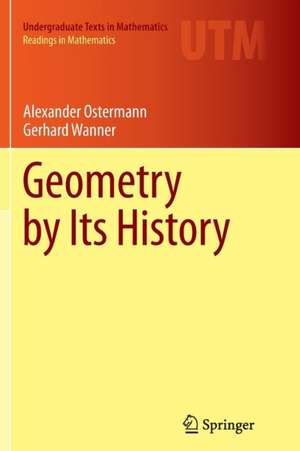
Geometry by Its History: Undergraduate Texts in Mathematics
Autor Alexander Ostermann, Gerhard Wanneren Limba Engleză Paperback – 9 mai 2014
Bazându-ne pe datele furnizate de editura Springer și pe recenziile academice de referință, descoperim în Geometry by Its History un manual care transformă rigoarea matematică într-o narațiune istorică coerentă. Această ediție din 2012, inclusă în prestigioasa serie Undergraduate Texts in Mathematics, propune o abordare cronologică a materiei, facilitând înțelegerea conceptelor complexe prin prisma contextului în care au fost descoperite. Structura este împărțită în două părți fundamentale. Prima parte, dedicată geometriei clasice, analizează contribuțiile fundamentale ale lui Thales, Pitagora și Elementele lui Euclid, extinzându-se până la secțiunile conice și trigonometrie. Apreciem modul în care autorii fac tranziția către a doua parte, unde revoluția algebrică inițiată de Descartes, Euler și Gauss redefinește disciplina. Această progresie ne conduce natural către geometria analitică, coordonatele carteziene și, ulterior, spre concepte moderne precum algebra vectorială și matricele. Ultimul capitol oferă o deschidere necesară către geometria proiectivă a secolului al XIX-lea. Geometry by Its History acoperă aceeași arie tematică precum Geometry Ancient and Modern de John R. Silvester, dar se diferențiază printr-o structură mai riguros didactică, axată pe parcursul istoric ca metodă de predare. Spre deosebire de alte titluri care evită metoda axiomatică, lucrarea semnată de Alexander Ostermann și Gerhard Wanner păstrează un echilibru între intuiția geometrică și formalismul matematic necesar la nivel universitar. În contextul operei autorilor, observăm o continuitate a stilului algoritmic și aplicat regăsit în Analysis for Computer Scientists, unde accentul cade pe modelare și claritate structurală.
Din seria Undergraduate Texts in Mathematics
-
 Preț: 445.70 lei
 -
 Preț: 405.09 lei
 - 15%
 Preț: 415.13 lei
 -
 Preț: 442.25 lei
 - 15%
 Preț: 414.11 lei
 - 15%
 Preț: 487.89 lei
 -
 Preț: 427.91 lei
 - 15%
 Preț: 469.14 lei
 -
 Preț: 548.54 lei
 -
 Preț: 405.42 lei
 - 15%
 Preț: 440.08 lei
 - 15%
 Preț: 463.77 lei
 - 12%
 Preț: 320.18 lei
 -
 Preț: 382.22 lei
 -
 Preț: 440.44 lei
 - 15%
 Preț: 507.99 lei
 -
 Preț: 377.12 lei
 - 24%
 Preț: 389.19 lei
 -
 Preț: 404.41 lei
 - 19%
 Preț: 509.25 lei
 -
 Preț: 320.86 lei
 - 20%
 Preț: 326.42 lei
 -
 Preț: 430.31 lei
 -
 Preț: 388.04 lei
 -
 Preț: 470.42 lei
 -
 Preț: 370.46 lei
 -
 Preț: 435.26 lei
 - 15%
 Preț: 470.34 lei
 - 20%
 Preț: 494.55 lei
 -
 Preț: 504.79 lei
 - 19%
 Preț: 390.93 lei
 -
 Preț: 440.55 lei
 - 15%
 Preț: 552.56 lei
 -
 Preț: 383.31 lei
 -
 Preț: 379.51 lei
 - 15%
 Preț: 461.97 lei
 -
 Preț: 449.07 lei
 -
 Preț: 367.33 lei
 -
 Preț: 394.72 lei
 - 17%
 Preț: 415.37 lei
 -
 Preț: 380.99 lei
 -
 Preț: 366.56 lei
 -
 Preț: 404.38 lei
 -
 Preț: 370.10 lei
 -
 Preț: 365.29 lei
Preț: 480.13 lei
Preț vechi: 564.86 lei
-15%
Carte tipărită la comandă
Livrare economică 07-21 decembrie
Livrare express 30 octombrie-05 noiembrie pentru 106.59 lei
Specificații
ISBN-10: 3642444695
Pagini: 452
Ilustrații: XII, 440 p.
Dimensiuni: 155 x 235 x 25 mm
Greutate: 0.68 kg
Ediția:2012
Editura: Springer
Colecția Undergraduate Texts in Mathematics
Seria Undergraduate Texts in Mathematics
Locul publicării:Berlin, Heidelberg, Germany
V-ar putea interesa
-
 An Introductory Course in Commutative AlgebraA. W. Chatters-20%Preț: 362.22 lei450.89 lei
 -
 Fractals: A User's Guide for the Natural SciencesHarold M. Hastings-29%Preț: 512.78 lei723.31 lei
 -
 Projective Geometry: An introductionRey Casse-28%Preț: 478.10 lei659.83 lei
 -
 Chaos and FractalsHeinz-Otto Peitgen-23%Preț: 724.70 lei941.16 lei
 -
 Fractals and Scaling in FinanceBenoit B. Mandelbrot-18%Preț: 1049.92 lei1280.39 lei
 -
 Geometry: Euclid and BeyondRobin HartshornePreț: 508.72 lei
 -
 -11%Preț: 496.78 lei558.19 lei
 -
 Topology from the Differentiable ViewpointJohn MilnorPreț: 375.92 lei
 -
 The Foundations of GeometryDavid HilbertPreț: 69.28 lei
 -
 A Short Course in Computational Geometry and TopologyHerbert Edelsbrunner-15%Preț: 521.16 lei613.12 lei
 -
 Geometric Numerical IntegrationErnst Hairer-18%Preț: 1448.72 lei1766.73 lei
 -
 Solving Ordinary Differential Equations IIErnst Hairer-18%Preț: 1447.04 lei1764.69 lei
 -
 Geometry and PhysicsJürgen Jost-15%Preț: 489.53 lei575.92 lei
 -
 -18%Preț: 1401.61 lei1709.28 lei
 -
 -18%Preț: 1400.04 lei1707.37 lei
 -
 Solving Ordinary Differential Equations IErnst Hairer-19%Preț: 470.63 lei581.02 lei
 -
 Computational GeometryMark de BergPreț: 441.16 lei
 -
 Gems of GeometryJohn Barnes-8%Preț: 420.17 lei456.71 lei
Public țintă
Upper undergraduateDe ce să citești această carte
Această carte se adresează studenților de la facultățile de matematică și profesorilor care doresc să predea geometria dintr-o perspectivă istorică și contextualizată. Cititorul câștigă o înțelegere profundă a modului în care algebra a transformat geometria, beneficiind de soluții incluse pentru exerciții și de un aparat grafic bogat. Este resursa ideală pentru cei care vor să vadă dincolo de formule, înțelegând geneza ideilor matematice.
Despre autor
Alexander Ostermann și Gerhard Wanner sunt cadre didactice și cercetători recunoscuți, specializați în analiză numerică și matematică aplicată. Gerhard Wanner este cunoscut la nivel internațional pentru contribuțiile sale în domeniul ecuațiilor diferențiale, fiind coautor al unor lucrări de referință în seria Springer. Alexander Ostermann a publicat anterior lucrări precum Analysis for Computer Scientists, unde a explorat fundamentele analizei dintr-o perspectivă algoritmică. Expertiza lor combinată în analiză și geometrie se reflectă în precizia și claritatea cu care tratează evoluția conceptelor matematice în Geometry by Its History.
Cuprins
Recenzii
Choice - Outstanding Academic Title in 2012
“This is an excellent, challenging textbook as well as a valuable resource for historical information, problems, and student projects. The historical content is broad based, comprehensive, and reliable. Each chapter has extensive exercises, many taken directly from or based on historical sources … . Hints and solutions for all problems are given in an appendix. Thorough bibliography. Summing Up: Highly recommended. Lower-division undergraduates and above.” (C. A. Gorini, Choice, Vol. 50 (3), November, 2012)
“The book under review is a treasure chest of interesting theorems and problems in geometry together with their illuminating histories. … This is the kind of book that one would enjoy browsing through and reading while sitting relaxedly in an armchair without any paper or pencil and starting at almost any page or paragraph. It should be on the shelf of every lover of geometry.” (Mowaffaq Hajja, zbMATH, Vol. 1288, 2014)
“This book belongs on the bookshelf of every geometer. … The authors have penned their book with students of geometry as well as science in mind. In fact, the book would serve well as a second year mathematics course in a classical liberal arts setting. … the book treats many interesting and beautiful problems, introducing powerful concepts along the way, and yet is written at a level suitable for an introductory course of geometry or even advanced mathematics.” (Alan S. McRae, Mathematical Reviews, February, 2013)
“There is a lot of interesting material in this book, supplemented by a lot of very nice artwork and many interesting exercises … . I would think that any other college instructor … with an interest in geometry would also want a copy on his or her shelf.” (Mark Hunacek, The Mathematical Association of America, June, 2012)
Notă biografică
Gerhard Wanner is the former President of Section VII of the Swiss Academy of Natural Sciences, former Head of Department of Mathematics at the University of Geneva, and former President of the Swiss Mathematical Society. He is the author of several books with Springer, including Analysis by its History, written together with Ernst Hairer.
Textul de pe ultima copertă
Complemented by numerous examples, exercises, figures and pictures, the book offers both motivation and insightful explanations, and provides stimulating and enjoyable reading for students and teachers alike.