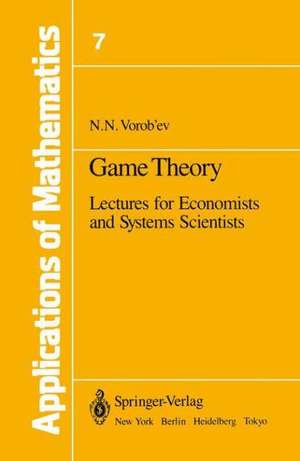
Game Theory: Lectures for Economists and Systems Scientists: Stochastic Modelling and Applied Probability, cartea 7
Autor Nikolai N. Vorob'ev Revizuit de S. Kotzen Limba Engleză Paperback – 14 oct 2011
Din seria Stochastic Modelling and Applied Probability
- 18%
 Preț: 910.58 lei
 - 15%
 Preț: 615.43 lei
 - 18%
 Preț: 955.59 lei
 - 15%
 Preț: 612.55 lei
 - 18%
 Preț: 760.59 lei
 -
 Preț: 375.79 lei
 - 15%
 Preț: 605.72 lei
 - 18%
 Preț: 737.30 lei
 - 18%
 Preț: 789.04 lei
 - 18%
 Preț: 809.66 lei
 - 18%
 Preț: 821.58 lei
 - 18%
 Preț: 1120.12 lei
 - 15%
 Preț: 616.22 lei
 - 15%
 Preț: 618.80 lei
 - 15%
 Preț: 645.13 lei
 - 18%
 Preț: 953.73 lei
 - 15%
 Preț: 618.23 lei
 - 18%
 Preț: 910.71 lei
 - 18%
 Preț: 830.41 lei
 - 15%
 Preț: 664.25 lei
 - 49%
 Preț: 456.98 lei
 - 35%
 Preț: 521.31 lei
 - 18%
 Preț: 1231.99 lei
 - 18%
 Preț: 752.78 lei
 - 32%
 Preț: 690.16 lei
 -
 Preț: 475.79 lei
 - 40%
 Preț: 410.77 lei
 -
 Preț: 373.40 lei
 - 20%
 Preț: 546.97 lei
 - 15%
 Preț: 644.51 lei
 - 18%
 Preț: 923.66 lei
 - 18%
 Preț: 1068.72 lei
Preț: 610.82 lei
Preț vechi: 718.61 lei
-15%
Puncte Express: 916
Carte tipărită la comandă
Livrare economică 20 noiembrie-04 decembrie
Livrare prin curier în România Termenul estimat este afișat lângă disponibilitate.
Transport gratuit pentru acest produs Plată online sau ramburs, în funcție de opțiunile comenzii.
Retur gratuit în 14 zile Comandă securizată și suport în română.
Specificații
ISBN-13: 9781461263432
ISBN-10: 1461263433
Pagini: 192
Ilustrații: XII, 179 p.
Dimensiuni: 155 x 235 x 10 mm
Greutate: 0.28 kg
Ediția:Softcover reprint of the original 1st ed. 1977
Editura: Springer
Colecția Springer
Seria Stochastic Modelling and Applied Probability
Locul publicării:New York, NY, United States
ISBN-10: 1461263433
Pagini: 192
Ilustrații: XII, 179 p.
Dimensiuni: 155 x 235 x 10 mm
Greutate: 0.28 kg
Ediția:Softcover reprint of the original 1st ed. 1977
Editura: Springer
Colecția Springer
Seria Stochastic Modelling and Applied Probability
Locul publicării:New York, NY, United States
V-ar putea interesa
-
 Playing for Real: A Text on Game TheoryKen Binmore-24%Preț: 865.11 lei1135.29 lei
 -
 Strategic Interaction and MarketsJean J. Gabszewicz-33%Preț: 598.15 lei889.98 lei
 -
 Challenges in Geometry: for Mathematical Olympians Past and PresentChristopher J. Bradley-19%Preț: 336.43 lei417.00 lei
 -
 Evolution, Games, and Economic BehaviourFernando Vega-Redondo-29%Preț: 449.58 lei629.94 lei
 -
 The Extended Selfish GeneRichard DawkinsPreț: 255.14 lei
 -
 -31%Preț: 547.94 lei791.09 lei
 -
 Foundations of Non-Cooperative Game TheoryKlaus Ritzberger-28%Preț: 538.32 lei752.49 lei
 -
 The Colossal Book of MathematicsMartin GardnerPreț: 305.73 lei
 -
 The Colossal Book of Short Puzzles and ProblemsMartin GardnerPreț: 249.02 lei
 -
 Game-ChangerDavid McadamsPreț: 133.27 lei
 -
 The Essential John NashJohn NashPreț: 306.77 lei
 -
 Theory of Games and Economic BehaviorJohn Von Neumann-14%Preț: 485.31 lei564.32 lei
 -
 -26%Preț: 1004.47 lei1365.68 lei
 -
 Professor Povey's Perplexing ProblemsThomas PoveyPreț: 115.07 lei
 -
 How Many Socks Make a Pair?Rob EastawayPreț: 71.14 lei
 -
 Introducing Game TheoryIvan PastinePreț: 64.37 lei
 -
 Set-valued OptimizationAkhtar A. Khan-15%Preț: 675.47 lei794.67 lei
Public țintă
ResearchCuprins
1 Matrix games.- 1.1 Definition of a noncooperative game.- 1.2 Admissible situations and the equilibrium situation.- 1.3 Strategic equivalence of games.- 1.4 Antagonistic games.- 1.5 Saddle points.- 1.6 Auxiliary propositions about extrema.- 1.7 Minimax equalities and saddle points.- 1.8 Matrix games.- 1.9 Mixed strategies.- 1.10 A mixed extension of a game.- 1.11 Existence of minimaxes in mixed strategies.- 1.12 Convex sets.- 1.13 The lemma on two alternatives.- 1.14 The minimax theorem.- 1.15 The value of the game and optimal strategies.- 1.16 Three properties of the value of a game.- 1.17 An example: 2×2 games.- 1.18 A graphical solution of 2×n games.- 1.19 A graphical solution of m×2 games.- 1.20 Sufficient criteria for the value of a game and optimal strategies.- 1.21 Domination of strategies.- 1.22 Diagonal games.- 1.23 Sets of optimal strategies in a matrix game.- 1.24 An example: 3×3 games.- 1.25 Symmetric games.- 1.26 Matrix games and linear programming.- 2 Infinite antagonistic games.- 2.1 Introduction and motivation.- 2.2 Situations of ?-equilibrium; ?-saddle points and ?-optimal strategies.- 2.3 ?-optimal strategies and minimaxes.- 2.4 Mixed strategies.- 2.5 Properties of the value of a game and of optimal strategies.- 2.6 The Helly metric.- 2.7 Conditionally compact games.- 2.8 The basic theorem for conditionally compact games.- 2.9 Continuous games on the unit square.- 2.10 Convex functions.- 2.11 Convex games; pure optimal strategies for player II.- 2.12 Convex games; optimal strategies for player I.- 2.13 Strictly convex games.- 2.14 Examples of convex games and their solutions.- 2.15 Market competition.- 2.16 Allocation of production capacities; minimization of the maximal intensity of a production scheme.- 2.17 Allocation of productioncapacities under partial uncertainty.- 3 Noncooperative games.- 3.1 Mixed extensions of noncooperative games.- 3.2 Equilibrium situations.- 3.3 Nash’s theorem.- 3.4 Properties of equilibrium situations.- 3.5 Bi-matrix games.- 3.6 Solutions of bi-matrix games.- 3.7 Almost antagonistic games.- 3.8 Prisoner’s dilemma.- 3.9 The battle of the sexes.- 3.10 Noncooperative games with two pure strategies for each of the players.- 3.11 False advertising.- 3.12 Preservation of ecology.- 4 Cooperative games.- 4.1 Characteristic functions.- 4.2 Characteristic functions of noncooperative games.- 4.3 Properties of characteristic functions for noncooperative games.- 4.4 Imputations and cooperative games.- 4.5 Essential and inessential games.- 4.6 Strategic equivalence of cooperative games.- 4.7 Zero games.- 4.8 The 0-1 reduced form.- 4.9 Classification of cooperative games with a small number of players.- 4.10 Dominance of imputations.- 4.11 The core of a game.- 4.12 The core of a general three-person game.- 4.13 von Neumann-Morgenstern solutions.- 4.14 vN-M solutions for three person constant sum games.- 4.15 vN-M solutions for general three-person cooperative games.- 4.31 Shapley’s vector; axiomatization.- 4.32 Shapley’s vector; existence and determination.- 4.33 Examples of Shapley vectors.- Exercises.- Selected bibliography.