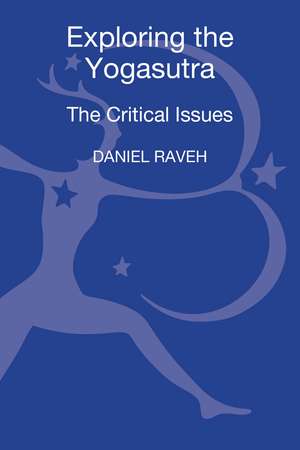
Exploring the Yogasutra: Philosophy and Translation
Autor Dr Daniel Ravehen Limba Engleză Hardback – 8 mar 2012
Patañjali's Yogasutra is an ancient canonic Indian
text composed in Sanskrit in the 3rd or 4th century. Belonging to a very
different cultural milieu, this multi-layered text is philosophical,
psychological and practical in nature. Offering a philosophical reading of
Patañjali's Yogasutra, this book discusses themes such as freedom, self-identity, time
and transcendence, and translation - between languages, cultures and eras. Drawing substantially upon contemporary Indian materials, it discusses
for the first time classical yoga as reflected upon by Daya Krishna (1924-2007)
with constant reference to Krishna Chandra Bhattacharyya's (1875-1949) studies
in yoga philosophy. The genuine attempt on behalf of these two original
thinkers to engage philosophically with Patañjala-yoga sets the tone of the
textual exploration provided here.
text composed in Sanskrit in the 3rd or 4th century. Belonging to a very
different cultural milieu, this multi-layered text is philosophical,
psychological and practical in nature. Offering a philosophical reading of
Patañjali's Yogasutra, this book discusses themes such as freedom, self-identity, time
and transcendence, and translation - between languages, cultures and eras. Drawing substantially upon contemporary Indian materials, it discusses
for the first time classical yoga as reflected upon by Daya Krishna (1924-2007)
with constant reference to Krishna Chandra Bhattacharyya's (1875-1949) studies
in yoga philosophy. The genuine attempt on behalf of these two original
thinkers to engage philosophically with Patañjala-yoga sets the tone of the
textual exploration provided here.
This book features a new annotated translation of
the Yogasutra, and the author provides a useful background to the extensive Samkhya terminology
employed by Patañjali. Daniel Raveh also offers a close reflection of the very
act of translation, and the book concludes with suggestions for further reading
and a glossary of central notions.
the Yogasutra, and the author provides a useful background to the extensive Samkhya terminology
employed by Patañjali. Daniel Raveh also offers a close reflection of the very
act of translation, and the book concludes with suggestions for further reading
and a glossary of central notions.
Preț: 915.21 lei
Preț vechi: 1234.82 lei
-26%
Puncte Express: 1373
Carte tipărită la comandă
Livrare economică 07-21 decembrie
Livrare prin curier în România Termenul estimat este afișat lângă disponibilitate.
Transport gratuit pentru acest produs Plată online sau ramburs, în funcție de opțiunile comenzii.
Retur gratuit în 14 zile Comandă securizată și suport în română.
Specificații
ISBN-13: 9781441146229
ISBN-10: 1441146229
Pagini: 184
Dimensiuni: 156 x 234 x 15 mm
Greutate: 0.44 kg
Ediția:New.
Editura: Bloomsbury Publishing
Colecția Continuum
Locul publicării:London, United Kingdom
ISBN-10: 1441146229
Pagini: 184
Dimensiuni: 156 x 234 x 15 mm
Greutate: 0.44 kg
Ediția:New.
Editura: Bloomsbury Publishing
Colecția Continuum
Locul publicării:London, United Kingdom
V-ar putea interesa
-
 Bringing Yoga to LifeDonna FarhiPreț: 99.00 lei
 -
 -21%Preț: 371.67 lei472.82 lei
 -
 Contrary Thinking: Selected Essays of Daya KrishnaDaya Krishna-30%Preț: 769.76 lei1097.79 lei
 -
 Zhuangzi - Basic WritingsZhuangziPreț: 174.23 lei
 -
 A History of Islamic Philosophy 3eMajid FakhryPreț: 357.80 lei
 -
 Preț: 125.00 lei
 -
 An Introduction to Indian Philosophy: Hindu and Buddhist Ideas from Original SourcesDr Christopher Bartley-23%Preț: 247.59 lei320.08 lei
 -
 Psychotherapy East and WestAlan Watts-19%Preț: 91.80 lei113.46 lei
 -
 -26%Preț: 569.11 lei767.45 lei
 -
 -16%Preț: 97.04 lei115.01 lei
 -
 Flight of the EagleJ. Krishnamurti-30%Preț: 73.79 lei106.04 lei
 -
 The Buddha in Me, The Buddha in YouDavid Hare-35%Preț: 88.00 lei135.83 lei
 -
 -23%Preț: 192.06 lei248.88 lei
 -
 Inside the NowThich Nhat Hanh-28%Preț: 95.45 lei133.04 lei
Cuprins
Acknowledgements
\ Abbreviations \ List of Transliteration \ Entrée: Translating the
Other: Reflections on a Fictional Dialogue \ Introduction: Yoga, Translation,
the Other \ 1. Abhyasa/Vairagya: A
Conceptual Investigation into the Process of Yoga \ 2. Revisiting avidya
and abhinivesa: A note on Yoga Psychology \ 3. Rethinking Prajña: Yogasutra 1.49 under a
Philosophical Magnifying Glass \ 4. Text as a Process: A dialogue with Daya
Krishna\ 5. "The Undeciphered Text: Anomalies,
Problems and Paradoxes in the Yogasutra" by Daya Krishna \ Concise
Glossary \ Appendix I: Introduction to the Yogasutra Translation, or: why another translation? \ Appendix II: The
Yogasutra in Transliteration \ Appendix III: The Yogasutra in Translation \
Bibliography \ Index
\ Abbreviations \ List of Transliteration \ Entrée: Translating the
Other: Reflections on a Fictional Dialogue \ Introduction: Yoga, Translation,
the Other \ 1. Abhyasa/Vairagya: A
Conceptual Investigation into the Process of Yoga \ 2. Revisiting avidya
and abhinivesa: A note on Yoga Psychology \ 3. Rethinking Prajña: Yogasutra 1.49 under a
Philosophical Magnifying Glass \ 4. Text as a Process: A dialogue with Daya
Krishna\ 5. "The Undeciphered Text: Anomalies,
Problems and Paradoxes in the Yogasutra" by Daya Krishna \ Concise
Glossary \ Appendix I: Introduction to the Yogasutra Translation, or: why another translation? \ Appendix II: The
Yogasutra in Transliteration \ Appendix III: The Yogasutra in Translation \
Bibliography \ Index
Recenzii
'Thinking anew with Patanjali: this is a modern-day translation and meditation on the spiritual praxis and philosophy of the Yogasutras, the great ancient Indian classic. Daniel Raveh's refreshing book is, at the same time, a sensitive reflection on meaningful cross-cultural and cross-epochal translation which he sees as a process of creative transformation, a process inevitable for retaining significance.'
'Raveh's thoughtful reflections on the nature of translation, his investigation of five key themes: practice, dispassion, ignorance, clinging, and yogic knowledge, as well as his skilfully rendered new translation of the Yoga Sutra make this book indispensible reading for anyone with a serious interest in the study of classical Yoga.'
'As a philosophical work attempting to answer some questions that Patañjali's YS raises, it is a refreshing change from the recent trend of Yoga books dealing mainly with "physical-Yoga".'
'Exploring the Yogasutra presents a new, engaging perspective on Patanjali from a philosophical point of view. It is a contribution invaluable for anybody interested in this authoritative source of Yoga theory.'
'Raveh undertakes an extraordinary clarification of the old, profound, paradoxical, often mysterious inward-seeking inwardness of the Yogasutra...Altogether, the book is a great didactic success in the translation of the thought and practice of one culture into the terms of another.'
'Raveh's thoughtful reflections on the nature of translation, his investigation of five key themes: practice, dispassion, ignorance, clinging, and yogic knowledge, as well as his skilfully rendered new translation of the Yoga Sutra make this book indispensible reading for anyone with a serious interest in the study of classical Yoga.'
'As a philosophical work attempting to answer some questions that Patañjali's YS raises, it is a refreshing change from the recent trend of Yoga books dealing mainly with "physical-Yoga".'
'Exploring the Yogasutra presents a new, engaging perspective on Patanjali from a philosophical point of view. It is a contribution invaluable for anybody interested in this authoritative source of Yoga theory.'
'Raveh undertakes an extraordinary clarification of the old, profound, paradoxical, often mysterious inward-seeking inwardness of the Yogasutra...Altogether, the book is a great didactic success in the translation of the thought and practice of one culture into the terms of another.'