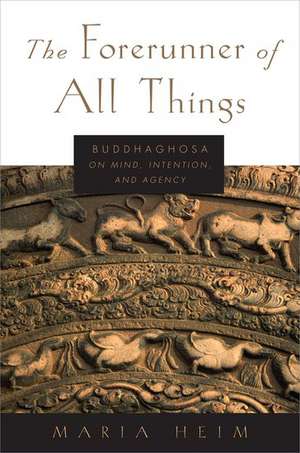
The Forerunner of All Things: Buddhaghosa on Mind, Intention, and Agency
Autor Maria Heimen Limba Engleză Paperback – 14 noi 2013
Autoarea Maria Heim, profesor de religie la Amherst College și o autoritate recunoscută în studiul tradiției Theravada, propune în The Forerunner of All Things o incursiune riguroasă în psihologia morală budistă. Această cercetare fundamentează înțelegerea karmei prin prisma intenției, explorând modul în care agenția umană este structurată în textele canonice. Putem afirma că lucrarea se distinge prin refuzul de a proiecta grile de lectură occidentale asupra filozofiei orientale, alegând în schimb să urmeze strategiile interpretative ale lui Buddhaghosa, cel mai important comentator al tradiției Pali din secolul al V-lea.
Considerăm că structura cărții este remarcabil de cuprinzătoare, acoperind toate ramurile canonului Pali — de la Tipitaka la comentariile narative precum Jataka. Spre deosebire de alte introduceri generale, Maria Heim se concentrează pe relația dintre genul literar și producerea sensului filozofic. Această abordare continuă temele explorate de autoare în Voice of the Buddha, unde a analizat autoritatea lui Buddhaghosa, și în Words for the Heart, extinzând investigația asupra emoțiilor și moralității în context indian.
Ca alternativă la What the Buddha Thought de Richard F. Gombrich pentru cursurile de filozofie orientală, volumul de față aduce avantajul unei specializări stricte pe mecanismele intenției și libertății, oferind o analiză mult mai tehnică a comentariilor clasice. În timp ce Buddhist Moral Philosophy de Christopher W. Gowans oferă o privire de ansamblu asupra disciplinei, The Forerunner of All Things rămâne singura resursă care tratează monografic viziunea lui Buddhaghosa, fiind esențială pentru înțelegerea nuanțată a conceptelor de agenție și responsabilitate morală în budismul timpuriu.
Preț: 335.33 lei
Preț vechi: 384.57 lei
-13%
Carte tipărită la comandă
Livrare economică 11-17 iunie
Specificații
ISBN-10: 0199331049
Pagini: 272
Dimensiuni: 155 x 231 x 20 mm
Greutate: 0.36 kg
Editura: Oxford University Press
Colecția OUP USA
Locul publicării:New York, United States
V-ar putea interesa
-
 The Art of WarSun Tzu-20%Preț: 70.91 lei88.97 lei
 -
 Indian Philosophy: A Very Short IntroductionSue Hamilton-21%Preț: 53.60 lei67.87 lei
 -
 -8%Preț: 305.61 lei332.25 lei
 -
 -12%Preț: 137.80 lei156.62 lei
 -
 Essence of the UpanishadsEknath EaswaranPreț: 96.81 lei
 -
 Secret Teachings of PadmasambhavaPadmasambhava-33%Preț: 89.92 lei134.49 lei
 -
 Diamond in Your PocketGangajiPreț: 112.57 lei
 -
 Degrees of Excellence: A Fatimid Treatise on Leadership in IslamArzina R. Lalani-24%Preț: 326.32 lei430.88 lei
 -
 Creativity and Taoism: A Study of Chinese Philosophy, Art and PoetryChung-yuan Chang-21%Preț: 125.46 lei158.55 lei
De ce să citești această carte
Recomandăm această carte cercetătorilor și studenților la filozofie sau studii religioase care doresc să depășească interpretările simpliste ale karmei. Cititorul câștigă o înțelegere profundă a modului în care intenția modelează experiența morală, ghidat de expertiza Mariei Heim. Este o resursă indispensabilă pentru oricine caută să studieze etica budistă prin propriile sale categorii conceptuale, fără filtrele culturii vestice.
Despre autor
Maria Heim este o distinsă profesoară de religie, specializată în gândirea intelectuală și religioasă a Indiei antice, cu un accent deosebit pe tradiția literară Pali. Opera sa include traduceri de referință, precum The Questions of Milinda, și studii aprofundate asupra emoțiilor și eticii în budism și hinduism. Prin lucrări precum Voice of the Buddha, Heim s-a stabilit ca o voce autoritară în interpretarea lui Buddhaghosa, demonstrând cum textele comentatoriale pot ilumina subtilitățile psihologiei morale și ale hermeneuticii budiste contemporane.
Descriere
Recenzii
Throughout this original, humane, and often beautiful exploration of Buddhist moral thinking, Maria Heim allows herself to be taught and guided by the great Buddhist thinker Buddhaghosa about how to read Buddhist texts well and how to think reflectively about the nature of a moral person. The result is that we are introduced to a Buddhaghosa that we have not met before: an astute humanist always alert to the complexities of the moral life, and a contemporary with us, as it were, offering us fresh resources for our own efforts to make sense of ourselves as moral persons