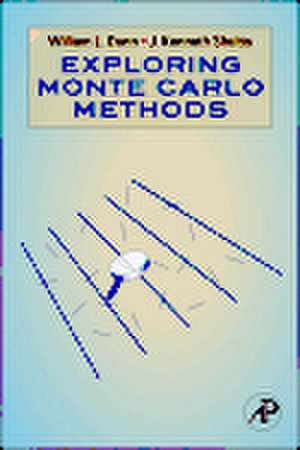
Exploring Monte Carlo Methods
Autor William L. Dunn, J. Kenneth Shultisen Limba Engleză Hardback – 10 iun 2011
Destinat nivelului de licență și masterat, Exploring Monte Carlo Methods reprezintă o resursă fundamentală pentru studenții din domeniile matematicii, fizicii și ingineriei. Remarcăm o structură didactică riguroasă, care ghidează cititorul de la fundamentele calculului diferențial către aplicații complexe de simulare numerică. Autorii, William L. Dunn și J. Kenneth Shultis, propun o abordare progresivă: primele opt capitole sunt dedicate metodelor generice, asigurând o bază solidă indiferent de domeniul de aplicare ulterior, în timp ce secțiunile finale se concentrează pe transportul particulelor neutre și aplicații în ingineria nucleară.
Descoperim aici o metodă pedagogică ingenioasă, unde celebra problemă a acului lui Buffon servește drept fir conductor pentru a exemplifica mecanismele statistice. Această a doua ediție extinde orizontul teoretic prin capitole dedicate metodelor Markov Chain Monte Carlo (MCMC) și reducerii varianței, elemente esențiale pentru eficiența simulărilor moderne. Comparabil cu Monte Carlo Methods de J. Hammersley în ceea ce privește rigoarea matematică, volumul de față se distinge prin actualizarea conținutului pentru era computațională curentă și prin includerea unor demonstrații detaliate la finalul fiecărui capitol.
Considerăm că forța acestui text rezidă în echilibrul dintre teorie și practică. Cele cinci anexe furnizează instrumente de lucru imediate, de la distribuții de probabilitate la funcții Bose-Einstein și Fermi-Dirac, transformând volumul într-o referință profesională de lungă durată pentru practicienii care utilizează coduri de transport al radiațiilor.
Preț: 560.42 lei
Preț vechi: 807.49 lei
-31%
Carte tipărită la comandă
Livrare economică 19 noiembrie-03 decembrie
Specificații
ISBN-10: 0444515755
Pagini: 398
Ilustrații: illustrations
Dimensiuni: 152 x 229 x 25 mm
Greutate: 0.61 kg
Editura: ELSEVIER SCIENCE
V-ar putea interesa
-
 -10%Preț: 144.36 lei160.88 lei
 -
 Mathematical Methods for Physicists: A Comprehensive GuideGeorge B. Arfken-32%Preț: 663.07 lei968.31 lei
 -
 -18%Preț: 527.45 lei646.10 lei
 -
 Concrete MathematicsRonald Graham-20%Preț: 560.73 lei700.91 lei
 -
 SimulationSheldon M. Ross-32%Preț: 510.46 lei749.22 lei
 -
 The Elements of Statistical LearningTrevor Hastie-20%Preț: 546.54 lei683.17 lei
 -
 Mathematical Methods in the Physical SciencesMary L. Boas-23%Preț: 1678.60 lei2180.00 lei
 -
 Handbook of Mathematical FunctionsIrene A. Stegun-19%Preț: 676.23 lei836.51 lei
 -
 Mathematical Methods for Physics and EngineeringK. F. Riley-8%Preț: 448.73 lei487.75 lei
 -
 Numerical RecipesWilliam H. Press-14%Preț: 868.69 lei1010.10 lei
 -
 -25%Preț: 171.93 lei228.29 lei
 -
 Preț: 300.02 lei
 -
 Math for ProgrammingRonald T. Kneusel-35%Preț: 244.36 lei373.43 lei
 -
 -15%Preț: 389.57 lei458.31 lei
 -
 Materials Data ScienceStefan Sandfeld-15%Preț: 591.20 lei695.53 lei
 -
 Statistics for ScientistsUmberto Michelucci-20%Preț: 275.88 lei344.84 lei
 -
 Computational PhysicsRubin H. Landau-9%Preț: 653.04 lei717.62 lei
 -
 MCMC from ScratchMasanori Hanada-20%Preț: 377.11 lei471.38 lei
Public țintă
For undergraduate or graduate courses in numerical methods and users of large, general-purpose Monte Carlo codesDe ce să citești această carte
Această carte este recomandată studenților și cercetătorilor care au nevoie de o înțelegere profundă a simulărilor numerice. Cititorul câștigă competențe practice în generarea numerelor pseudorandom și tehnici de reducere a varianței, esențiale în fizica nucleară și inginerie. Este un text ideal pentru auto-studiu, necesitând doar cunoștințe de bază de analiză matematică pentru a stăpâni metodele Monte Carlo.
Despre autor
William L. Dunn și J. Kenneth Shultis sunt experți recunoscuți în domeniul ingineriei nucleare și al metodelor computaționale. J. Kenneth Shultis este profesor emerit la Kansas State University, având o carieră dedicată cercetării în transportul radiațiilor și protecția împotriva acestora. William L. Dunn a contribuit semnificativ la dezvoltarea aplicațiilor practice ale metodelor Monte Carlo în mediul academic și industrial. Expertiza lor combinată oferă cărții o perspectivă dublă: rigoare matematică necesară în mediul universitar și o orientare pragmatică spre rezolvarea problemelor reale de inginerie.
Descriere scurtă
This book provides the basic detail necessary to learn how to apply Monte Carlo methods and thus should be useful as a text book for undergraduate or graduate courses in numerical methods. It is written so that interested readers with only an understanding of calculus and differential equations can learn Monte Carlo on their own. Coverage of topics such as variance reduction, pseudo-random number generation, Markov chain Monte Carlo, inverse Monte Carlo, and linear operator equations will make the book useful even to experienced Monte Carlo practitioners.
- Provides a concise treatment of generic Monte Carlo methods
- Proofs for each chapter
- Appendixes include Certain mathematical functions; Bose Einstein functions, Fermi Dirac functions, Watson functions
Cuprins
2 The Basis of Monte Carlo
3 Pseudorandom Number Generators
4 Sampling, Scoring, and Precision
5 Variance Reduction Techniques
6 Markov Chain Monte Carlo
7 Inverse Monte Carlo
8 Linear Operator Equations
9 The Fundamentals of Neutral Particle Transport
10 Monte Carlo Simulation of Neutral Particle Transport
Appendices
Recenzii
"Emphasizing the burgeoning practical applications rather than strict mathematical rigor of methods that have been used for about a century, this text is intended as an introduction for undergraduate or graduate courses, as a self-teaching guide, and as a reference. The first eight chapters are generic and are relevant to applications in any field. They include discussion of history and definition; the basis; sampling, scoring, and precision; variance reduction techniques; Markov chain and inverse Monte Carlo; and linear operator equations. Following are two chapters on radiation transport, a field familiar to authors William L. Dunn and J. Kenneth Shultis (both are nuclear engineers affiliated with Kansas State U.), but the focus remains on general principles that can be applied in many fields. Each chapter includes examples and problems and exercises. Five appendices contain supporting material." --Reference and Research Book News
"Overall, the book is very well written, and the contents are concisely and logically introduced. It should be very useful as a textbook for undergraduate or graduate courses in numerical methods employing Monte Carlo techniques like molecular simulations." --Contemporary Physics