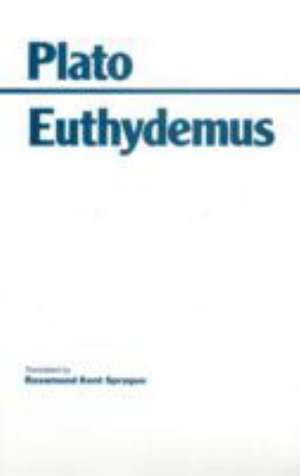
Euthydemus: Hackett Classics
Autor Plato Traducere de Rosamond Kent Spragueen Limba Engleză Paperback – 30 sep 1993
"This is the best translation available of a lively and challenging dialogue, which sets before the reader profound questions about the use and misuse of reason." --Myles Burnyeat, University of Cambridge
| Toate formatele și edițiile | Preț | Express |
|---|---|---|
| Paperback (12) | 38.26 lei 22-36 zile | |
| CreateSpace Independent Publishing Platform – | 38.26 lei 22-36 zile | |
| CREATESPACE – | 47.61 lei 22-36 zile | |
| CREATESPACE – | 52.46 lei 22-36 zile | |
| Hackett Publishing Company, In – 30 sep 1993 | 54.69 lei 22-36 zile | |
| CREATESPACE – | 80.10 lei 22-36 zile | |
| Hackett Publishing Company – 6 aug 2010 | 81.40 lei 22-36 zile | |
| CreateSpace Independent Publishing Platform – | 46.84 lei 43-57 zile | |
| Serenity Publishers, LLC – feb 2009 | 51.33 lei 43-57 zile | |
| CREATESPACE – | 75.70 lei 43-57 zile | |
| Blurb – 5 noi 2021 | 78.12 lei 43-57 zile | |
| Akasha Classics – 11 noi 2009 | 93.76 lei 43-57 zile | |
| TREDITION CLASSICS – 31 oct 2011 | 104.08 lei 43-57 zile | |
| Hardback (1) | 186.68 lei 43-57 zile | |
| Akasha Classics – 11 noi 2009 | 186.68 lei 43-57 zile |
Din seria Hackett Classics
-
 Preț: 67.63 lei
 -
 Preț: 198.33 lei
 -
 Preț: 166.78 lei
 -
 Preț: 274.90 lei
 - 12%
 Preț: 319.14 lei
 - 12%
 Preț: 118.30 lei
 - 13%
 Preț: 129.87 lei
 - 22%
 Preț: 346.32 lei
 - 14%
 Preț: 328.47 lei
 - 13%
 Preț: 301.08 lei
 - 13%
 Preț: 142.70 lei
 - 13%
 Preț: 94.98 lei
 - 17%
 Preț: 237.77 lei
 - 12%
 Preț: 303.44 lei
 - 13%
 Preț: 313.45 lei
 - 18%
 Preț: 189.49 lei
 - 11%
 Preț: 148.01 lei
 -
 Preț: 125.13 lei
 - 12%
 Preț: 341.95 lei
 - 19%
 Preț: 201.24 lei
 - 12%
 Preț: 83.99 lei
 - 12%
 Preț: 76.33 lei
 - 12%
 Preț: 319.94 lei
 -
 Preț: 218.60 lei
 - 13%
 Preț: 323.66 lei
 - 17%
 Preț: 271.03 lei
 - 17%
 Preț: 250.33 lei
 - 16%
 Preț: 277.71 lei
 - 13%
 Preț: 337.23 lei
 - 12%
 Preț: 355.82 lei
 - 18%
 Preț: 188.96 lei
 - 13%
 Preț: 328.12 lei
 - 18%
 Preț: 269.74 lei
 - 13%
 Preț: 329.84 lei
 - 18%
 Preț: 176.19 lei
 - 17%
 Preț: 272.53 lei
 - 13%
 Preț: 301.81 lei
 - 16%
 Preț: 216.46 lei
 - 17%
 Preț: 250.70 lei
 - 17%
 Preț: 254.25 lei
 - 17%
 Preț: 273.40 lei
 - 13%
 Preț: 320.77 lei
 - 12%
 Preț: 110.98 lei
 - 13%
 Preț: 74.91 lei
 - 12%
 Preț: 341.76 lei
Preț: 54.69 lei
Preț vechi: 62.50 lei
-12% Nou
Puncte Express: 82
Preț estimativ în valută:
9.68€ • 11.35$ • 8.50£
9.68€ • 11.35$ • 8.50£
Carte disponibilă
Livrare economică 19 ianuarie-02 februarie 26
Preluare comenzi: 021 569.72.76
Specificații
ISBN-13: 9780872202344
ISBN-10: 0872202348
Pagini: 96
Dimensiuni: 9 x 215 x 139 mm
Greutate: 0.11 kg
Editura: Hackett Publishing Company, In
Colecția Hackett Publishing Company, Inc.
Seria Hackett Classics
Locul publicării:United States
ISBN-10: 0872202348
Pagini: 96
Dimensiuni: 9 x 215 x 139 mm
Greutate: 0.11 kg
Editura: Hackett Publishing Company, In
Colecția Hackett Publishing Company, Inc.
Seria Hackett Classics
Locul publicării:United States
V-ar putea interesa
-
 Protagoras and MenoPlato-21%Preț: 58.75 lei74.65 lei
 -
 Timaeus and CritiasPlato-22%Preț: 58.20 lei74.31 lei
 -
 -28%Preț: 658.23 lei908.50 lei
 -
 -22%Preț: 47.83 lei60.93 lei
 -
 -12%Preț: 335.49 lei382.79 lei
 -
 Preț: 116.44 lei
 -
 Rethinking Greek ReligionJulia KindtPreț: 239.58 lei
 -
 Plato: Complete WorksPlato-21%Preț: 448.28 lei569.87 lei
 -
 Plato: Five DialoguesPlatoPreț: 101.21 lei
 -
 The Meroitic Language and Writing SystemClaude Rilly-14%Preț: 752.95 lei875.52 lei
 -
 Sport and Democracy in the Ancient and Modern WorldsPaul Christesen-11%Preț: 669.05 lei751.75 lei
 -
 -14%Preț: 690.25 lei802.62 lei
 -
 Before Forgiveness: The Origins of a Moral IdeaDavid KonstanPreț: 336.94 lei
 -
 Roman Centurions 31 BC–AD 500: The Classical and Late EmpireRaffaele D’Amato-34%Preț: 57.66 lei87.82 lei
 -
 Kalydon in Aitolia I & IISoren Dietz-15%Preț: 505.32 lei594.49 lei
Recenzii
This is the best translation available of a lively and challenging dialogue, which sets before the reader profound questions about the use and misuse of reason. --Myles Burnyeat, University of Cambridge
Notă biografică
Plato was an ancient Greek philosopher born in Athens during the Classical period in Ancient Greece. In Athens, Plato founded the Academy, a philosophical school where he taught the philosophical doctrines that would later become known as Platonism. Plato (or Platon) was a pen name derived, apparently, from the nickname given to him by his wrestling coach - allegedly a reference to his physical broadness. According to Alexander of Miletus quoted by Diogenes of Sinope his actual name was Aristocles, son of Ariston, of the deme Collytus (Collytus being a district of Athens).Plato was an innovator of the written dialogue and dialectic forms in philosophy. He raised problems for what later became all the major areas of both theoretical philosophy and practical philosophy. His most famous contribution is the Theory of forms, which has been interpreted as advancing a solution to what is now known as the problem of universals. He is also the namesake of Platonic love and the Platonic solids.His own most decisive philosophical influences are usually thought to have been, along with Socrates, the pre-Socratics Pythagoras, Heraclitus, and Parmenides, although few of his predecessors' works remain extant and much of what we know about these figures today derives from Plato himself.[a]Along with his teacher, Socrates, and his student, Aristotle, Plato is a central figure in the history of philosophy.[b] Unlike the work of nearly all of his contemporaries, Plato's entire body of work is believed to have survived intact for over 2,400 years.[6] Although their popularity has fluctuated, Plato's works have consistently been read and studied. Through Neoplatonism Plato also greatly influenced both Christian and Islamic philosophy (through e.g. Al-Farabi). In modern times, Alfred North Whitehead famously said: "the safest general characterization of the European philosophical tradition is that it consists of a series of footnotes to Plato.