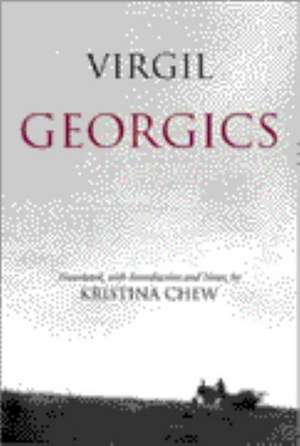
Georgics
Autor Virgil Traducere de Kristina Chewen Limba Engleză Hardback – 15 mar 2002
Rendered in an idiom drawn from present-day nature guides, gardening handbooks, how-to manuals, and scientific treatises--and in a style influenced by twentieth-century poetry--this bold new translation seeks to renew our appreciation of a work often relegated to the pigeonhole of didactic poetry about farming. In doing so, it reveals the Georgics as a remarkable window on Roman conceptions of the natural world and of the place of human life within it--and also conveys a sense of how daring were Virgil's poetics in their day. Footnotes offer a wealth of information on mythology, agriculture, wildlife, geography, and astronomy while highlighting the technical, scientific, ethnographic, and other registers of the poem.
Preț: 262.84 lei
Preț vechi: 338.35 lei
-22%
Puncte Express: 394
Carte disponibilă
Livrare economică 09-23 noiembrie
Livrare prin curier în România Termenul estimat este afișat lângă disponibilitate.
Transport gratuit de la 400.00 lei Plată online sau ramburs, în funcție de opțiunile comenzii.
Retur gratuit în 14 zile Comandă securizată și suport în română.
Specificații
ISBN-13: 9780872206106
ISBN-10: 0872206106
Pagini: 174
Dimensiuni: 140 x 216 x 6 mm
Greutate: 0.31 kg
Editura: Hackett Publishing Company,Inc
Colecția Hackett Publishing Company, Inc.
Locul publicării:United States
ISBN-10: 0872206106
Pagini: 174
Dimensiuni: 140 x 216 x 6 mm
Greutate: 0.31 kg
Editura: Hackett Publishing Company,Inc
Colecția Hackett Publishing Company, Inc.
Locul publicării:United States
V-ar putea interesa
-
 The AeneidVirgil-18%Preț: 65.61 lei79.89 lei
 -
 Works and DaysHesiod-29%Preț: 45.27 lei63.57 lei
 -
 Virgil OperaRoger MynorsPreț: 218.45 lei
 -
 The Eclogues and GeorgicsVirgil-19%Preț: 57.49 lei71.32 lei
 -
 PoeticsAristotle-19%Preț: 20.09 lei24.92 lei
 -
 Preț: 230.21 lei
 -
 Preț: 233.90 lei
 -
 Preț: 234.84 lei
 -
 Preț: 231.01 lei
 -
 Translating VirgilSusanna Morton Braund-23%Preț: 1149.55 lei1492.92 lei
 -
 A Companion to the Aeneid in Translation: Volume 2: Books 1-6Christopher Tanfield-15%Preț: 190.83 lei223.39 lei
 -
 OCR Anthology for Latin AS and A Level Shorter Verse AuthorsDr John Godwin-10%Preț: 148.78 lei165.25 lei
 -
 OCR Anthology for Latin GCSE 2027-2028Tim ChambersPreț: 108.24 lei
 -
 A Companion to the Aeneid in Translation: Volume 1: Introduction and IndicesChristopher Tanfield-30%Preț: 117.02 lei167.25 lei
 -
 A Companion to the Aeneid in Translation: Volume 3: Books 7-12Christopher Tanfield-14%Preț: 189.59 lei221.56 lei
 -
 The ProphetKahlil GibranPreț: 27.21 lei
 -
 The PastoraclasmJohn Kinsella-22%Preț: 59.98 lei76.51 lei
 -
 The Divine ComedyDante AlighieriPreț: 46.55 lei
 -
 HoraceHorace-19%Preț: 58.29 lei71.64 lei
 -
 VirgilAlison Keith-15%Preț: 157.13 lei184.87 lei
Recenzii
Chew's translation is, both in aesthetic and scholarly terms, an excellent piece of work. I find her approach refreshing and true to the spirit of the Georgics; her adventurousness strikes me as just the thing to rescue the poem from the appearance of blandness that a more straightforward style of translationese would inevitably, but misleadingly, impose upon it. This Georgics does not read much like any previous version of it. Chew helps the English reader to get a sense of Virgil's avant-garde poetics, which is the main thing that almost all translators of the Georgics work to eliminate, if indeed they are even aware of it. First-rate. --Joseph Farrell, Professor of Classical Studies, University of Pennsylvania
This is a translation with a difference, intended for readers without Latin. The most striking feature is the use of variations of type and layout. . . . Invocations are set out like memorial inscriptions; tasks or points to look for in animals come in the form of numbered or bulleted lists, assembling a plough reads like an instruction manual. Similes appear in italics, but so do the key words in some descriptive passages. The positioning of the text is used to illustrate the meaning of a quincunx, terracing, or the flight of a swarm of bees. These innovations serve to distinguish between what might be termed the poetry and the practical. Explanations are sometimes incorporated into the translation, which is in free verse, but mostly these are in the generous footnotes. . . . Chew has done considerable research into ancient and modern methods of husbandry and the notes concentrate on agriculture, astronomy, and botany. . . . Some [renderings] are particularly apt: 'the cicadas' complaining plainsong bursts the strawberry trees' for 'cantu querulae rumpent arbusta cicadae;' `'the murmur of the groves grows and grows' for 'et nemorum increbescere murmur.' . . . Chew should certainly achieve her aim of bringing the work to a wider readership. As she claims in her Introduction, 'Plain and simple, it is an American Georgics.' _—Anne Haward, The Joint Association of Classical Teachers Review
My graduate seminar members and I enjoyed Dr. Chew's rendering of the Georgics immensely. We were delighted and instructed by her playful blend of argots and typefaces, and by her artful blend of information in the notes. This translation opened the poem for me all over again—and it has long been among my favorites. Chew's translation offers a dazzling survey of musical styles in the poem. The fifteen of us send our thanks for her provocative and delightful achievement. -—Thomas A. Goodmann, University of Miami
Notă biografică
Virgil (70 BC-19 BC) was a Roman poet. He was born near Mantua in northern Italy. Educated in rhetoric, medicine, astronomy, and philosophy, Virgil moved to Rome where he was known as a particularly shy member of Catullus¿ literary circle. Suffering from poor health for most of his life, Virgil began his career as a poet while studying Epicureanism in Naples. Around 38 BC, he published the Eclogues, a series of pastoral poems in the style of Hellenistic poet Theocritus. In 29 BC, Virgil published his next work, the Georgics, a long didactic poem on farming in the tradition of Hesiod¿s Works and Days. In the last decade of his life, Virgil worked on his masterpiece the Aeneid, an epic poem commissioned by Emperor Augustus. Expanding upon the story of the Trojan War as explored in Homer¿s Iliad and Odyssey, the Aeneid follows the hero Aeneas from the destruction of Troy to the discovery of the region that would later become Rome. Posthumously considered Rome¿s national poet, Virgil¿s reputation has grown through the centuries¿in large part for his formative influence on Dante¿s Divine Comedy¿to secure his position as a foundational figure for all of Western literature.