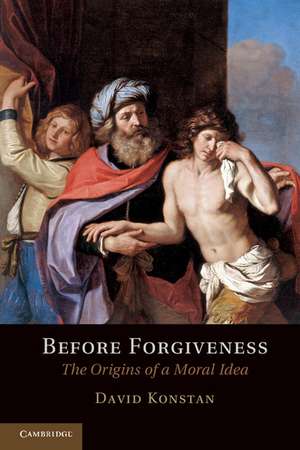
Before Forgiveness: The Origins of a Moral Idea
Autor David Konstanen Limba Engleză Paperback – 29 apr 2012
Putem afirma că David Konstan, profesor emerit la Brown University și o autoritate recunoscută în studiile clasice, propune prin Before Forgiveness o perspectivă provocatoare care răstoarnă asumpțiile contemporane despre moralitate. Bazându-se pe o cercetare riguroasă a textelor antice, Konstan argumentează că iertarea interpersonală — așa cum o înțelegem astăzi, implicând remușcare și o schimbare interioară a celui care a greșit — este o invenție relativ modernă. Autorul demonstrează că acest concept a apărut abia în secolele XVIII și XIX, prin procesul de secularizare a ideii creștine de iertare divină.
Notăm cu interes modul în care această lucrare continuă preocupările autorului pentru istoria emoțiilor, explorate anterior în Pity Transformed. Dacă în acea lucrare analiza modul în care compasiunea s-a transformat din antichitate până în prezent, în volumul de față aplică aceeași rigoare filologică și filosofică asupra mecanismelor reconcilierii. Cartea completează perspectiva oferită de Ancient Forgiveness de Charles L. Griswold, adăugând o dimensiune critică mai radicală: acolo unde Griswold caută rădăcinile iertării, Konstan subliniază absența ei formală și diferențele fundamentale de structură morală între omul antic și cel modern.
Structura volumului urmărește o progresie logică, de la analiza vinovăției și a inocenței la greci și romani, trecând prin Biblia ebraică și Noul Testament, până la scrierile părinților bisericii. Această abordare indică o acoperire exhaustivă a tranziției de la „iertarea ca prerogativă divină” la „iertarea ca trăsătură umană”. Stilul este academic, precis și lipsit de înflorituri, fiind o resursă esențială pentru înțelegerea modului în care s-au format valorile etice ale Occidentului.
Preț: 338.23 lei
Carte tipărită la comandă
Livrare economică 09-23 iulie
Specificații
ISBN-10: 1107680204
Pagini: 208
Ilustrații: black & white illustrations
Dimensiuni: 150 x 226 x 15 mm
Greutate: 0.3 kg
Editura: Cambridge University Press
Colecția Cambridge University Press
Locul publicării:New York, United States
V-ar putea interesa
-
 -27%Preț: 829.58 lei1131.02 lei
 -
 -18%Preț: 1199.16 lei1462.38 lei
 -
 Preț: 430.46 lei
 -
 The Roman Wedding: Ritual and Meaning in AntiquityKaren K. HerschPreț: 279.10 lei
 -
 The Archaeology of MeasurementIain Morley-16%Preț: 171.35 lei203.98 lei
 -
 She-Wolf: The Story of a Roman IconCristina MazzoniPreț: 188.12 lei
 -
 Roman WarfareJonathan P RothPreț: 219.54 lei
 -
 The Ancient Languages of Asia MinorRoger D. Woodard-19%Preț: 430.71 lei531.75 lei
 -
 The World of Athens: An Introduction to Classical Athenian CultureJoint Association of Classical TeachersPreț: 278.84 lei
 -
 Preț: 345.63 lei
 -
 The Horse in Human HistoryPita KeleknaPreț: 285.60 lei
 -
 Preț: 153.25 lei
 -
 Aksum and NubiaGeorge HatkePreț: 450.60 lei
 -
 Evidence of the GodsErich Von Daniken-24%Preț: 103.31 lei135.06 lei
 -
 Temple of the WorldMiroslav VernerPreț: 272.22 lei
De ce să citești această carte
Această lucrare este esențială pentru studenții și cercetătorii din domeniile istoriei ideilor, teologiei și filosofiei morale. Cititorul va câștiga o înțelegere profundă a modului în care concepte considerate „universale”, precum iertarea, sunt de fapt rezultatul unor transformări istorice și culturale specifice. Este o lectură care clarifică distincția dintre reconcilierea politică antică și iertarea morală modernă.
Despre autor
David Konstan este profesor de studii clasice la New York University și profesor emerit „John Rowe Workman” la Brown University. Cu o carieră academică de prestigiu, a servit ca președinte al American Philological Association și este membru al Academiei Americane de Arte și Științe. Expertiza sa acoperă literatura clasică, filosofia epicuriană și istoria emoțiilor în antichitate. Printre contribuțiile sale majore se numără analizele despre prietenie și milă în lumea clasică, lucrări care fundamentează autoritatea sa în deconstrucția ideilor morale antice.
Descriere scurtă
Cuprins
Recenzii
'This volume makes for fascinating reading and is a remarkable scholarly achievement.' Notre Dame Philosophical Reviews
'… this is a thought-provoking work. The author is at his best in summarizing contemporary philosophical analysis of forgiveness as a concept, and in disabusing modern readers of reading 'forgiveness' into ancient texts.' Choice
'This book is nothing less than brilliant. Every one of its chapters contains a startlingly unexpected message, and the range of the book as a whole is enormous. At every point, David Konstan makes one think philosophically about different concepts and hence about the concept of forgiveness itself. The philosophical insight he provides is based on his perceptivity about an incredible range of texts.' Richard Sorabji, University of Oxford
'Konstan's magisterial grasp of the relevant texts and thinkers from the ancient Greek and Roman periods through early Christian and Judaic sources to the Church Fathers is extraordinary. Contemporary discussions of forgiveness often make a number of unexamined assumptions about the historical sources of this crucial moral idea … It turns out, in Konstan's view, that the modern notion of interpersonal forgiveness – and with it a supporting web of ideas about morality, the emotions, and the self – is of quite recent vintage. Konstan also sheds light on crucial modern treatments of the idea such as those found in Shakespeare, Molière, Butler, Kant, and Derrida, among others. His remarkable book will challenge readers to rethink their assumptions, and therefore to sharpen their answer to the much-debated question – what is forgiveness? – that lies at the heart of his inquiry.' Charles L. Griswold, Boston University