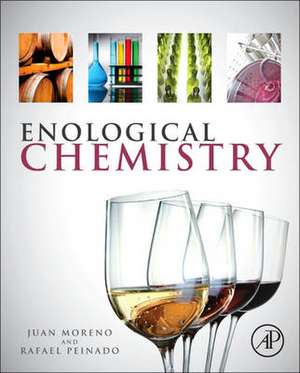
Enological Chemistry
Autor Juan Moreno, Rafael Peinadoen Limba Engleză Hardback – 30 mai 2012
În analiza volumului Enological Chemistry, notăm cu interes o abordare riguros pragmatică, unde cunoștințele teoretice sunt mapate direct pe aplicațiile tehnice din industria vinului. Considerăm că forța acestui manual rezidă în structura sa secvențială, care oglindește fidel etapele producției, începând cu analiza compoziției mustului și culminând cu procesele de învechire chimică și biologică. Spre deosebire de alte lucrări care includ digresiuni istorice, Juan Moreno și Rafael Peinado elimină orice balast informațional, concentrându-se exclusiv pe chimia aplicată necesară unui enolog profesionist.
Credem că progresia capitolelor oferă o claritate tehnică remarcabilă. De la studiul polifenolilor și al zaharurilor, până la capitole specializate despre capacitatea de tamponare a vinurilor și echilibrele de precipitare, textul ghidează cititorul prin variabilele critice care definesc profilul senzorial final. Ca și M Victoria Moreno-Arribas în Wine Chemistry and Biochemistry, autorul distilează experiență reală în principii acționabile, oferind instrumente precise pentru controlul calității analitice. De asemenea, lucrarea amintește de rigoarea din Principles and Practices of Winemaking de Roger B. Boulton, punând însă un accent mai pregnant pe mecanismele moleculare ale transformării mustului în vin.
Deși Juan Moreno a explorat în alte lucrări precum Glück ist kein Ort dimensiuni narative și de reportaj, în Enological Chemistry adoptă un ton pur academic și tehnic, ancorat în date experimentale. Această tranziție subliniază expertiza sa duală, textul de față fiind rezultatul a peste un deceniu de cursuri și sesiuni de laborator. Este o resursă esențială pentru cercetătorii care dezvoltă produse noi, oferind fundamentul chimic necesar pentru a naviga între microbiologie, fizică și chimie industrială în contextul vinificației moderne.
Preț: 544.80 lei
Preț vechi: 696.30 lei
-22%
Carte tipărită la comandă
Livrare economică 29 mai-12 iunie
Specificații
ISBN-10: 0123884381
Pagini: 442
Dimensiuni: 191 x 235 x 28 mm
Greutate: 1.02 kg
Editura: ELSEVIER SCIENCE
V-ar putea interesa
-
 The Oxford Companion to WineJulia Harding MW-15%Preț: 347.60 lei409.08 lei
 -
 Wine: A Tasting CourseMarnie Old-23%Preț: 120.50 lei157.03 leiRecomandat
 -
 Food and Wine PairingRobert J Harrington-8%Preț: 429.11 lei466.43 lei
 -
 FlawlessJamie GoodePreț: 160.48 lei
 -
 Wine from Grape to GlassJens PriewePreț: 331.95 lei
 -
 -12%Preț: 330.72 lei377.56 lei
 -
 Handbook of Enology, 2 Volume SetPascal Ribéreau-Gayon-23%Preț: 1903.99 lei2472.72 lei
 -
 Understanding Wine ChemistryAndrew L. Waterhouse-23%Preț: 645.04 lei837.72 lei
 -
 A Closer Look at Grapes, Wines and WinemakingJoni D Perez-26%Preț: 1247.55 lei1676.73 lei
 -
 Techniques in Home WinemakingDaniel PambianchiPreț: 137.28 lei
 -
 Wine: Types, Production & HealthArthur S Peeters-30%Preț: 2130.29 lei3055.46 lei
 -
 -26%Preț: 165.93 lei223.62 lei
 -
 Hugh Johnson's Pocket Wine Book 2026Hugh Johnson-27%Preț: 80.29 lei110.17 lei
 -
 One Thousand Vines: A New Way to Understand WinePascaline Lepeltier-24%Preț: 260.06 lei344.40 lei
 -
 Wine MakingJane TravisPreț: 147.76 lei
 -
 A Taste for Wine: A New Tasting Masterclass for Wine LoversRose Murray Brown MW-30%Preț: 131.31 lei187.46 lei
 -
 Making Award Winning Wines at HomeBill SmithPreț: 80.36 lei
 -
 VINES & VINIFICATIONSALLY EASTONPreț: 294.96 lei
 -
 Rooted in ChangeJane Masters MwPreț: 145.51 lei
 -
 Red Wine Enology: Tannin and Redox Management in Red WinesVolker Schneider-11%Preț: 452.05 lei507.91 lei
Public țintă
Researchers and enologists developing new wine products, some limited potential for advanced students in courses on Enology and Wine Chemistry.De ce să citești această carte
Recomandăm această carte enologilor și cercetătorilor care au nevoie de un control precis asupra proceselor chimice de vinificație. Cititorul câștigă o înțelegere profundă a interacțiunilor moleculare, de la echilibrul acido-bazic la fenomenele redox, facilitând optimizarea calității senzoriale a vinului. Este un instrument tehnic esențial pentru cei care doresc să treacă de la vinificația empirică la o abordare științifică, bazată pe controlul riguros al compușilor chimici.
Descriere scurtă
The topics in the book have been sequenced identically with the steps of the winemaking process. Thus, the book describes the most salient compounds involved in each vinification process, their properties and their balance; also, theoretical knowledge is matched with its practical application. The primary aim is to enable the reader to identify the specific compounds behind enological properties and processes, their chemical balance and their influence on the analytical and sensory quality of wine, as well as the physical, chemical and microbiological factors that affect their evolution during the winemaking process.
- Organized according to the winemaking process, guiding reader clearly to application of knowledge
- Describes the most salient compounds involved in each step enabling readers to identify the specific compounds behind properties and processes and effectively work with them
- Provides both theoretical knowledge and practical application providing a strong starting point for further research and development
Cuprins
Chapter 2. Composition of Grape Must
Chapter 3. Must Aromas
Chapter 4. Composition of Wine
Chapter 5. Polyphenols
Chapter 6. Sugars: Structure and Classification
Chapter 7. Sugars in Must
Chapter 8. Carboxylic Acids: Structure and Properties
Chapter 9. Grape Acids
Chapter 10. The Relationship between Must Composition and Quality
Chapter 11. The Transformation of Must Into Wine
Chapter 12. Nitrogen Compounds
Chapter 13. Acid–Base Equilibria in Wine
Chapter 14. Buffering Capacity of Wines
Chapter 15. Precipitation Equilibria in Wine
Chapter 16. Changes in Acidity After Fermentation
Chapter 17. Redox phenomena in Must and Wine
Chapter 18. The Colloidal State
Chapter 19. Wine Colloids
Chapter 20. Inorganic Material and Metal Casse
Chapter 21. Chemical Aging
Chapter 22. Aging
Chapter 23. Biological Aging