
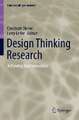
Design Thinking Research: Interrogating the Doing: Understanding Innovation
Editat de Christoph Meinel, Larry Leiferen Limba Engleză Paperback – 29 mar 2022
This volume provides readers with tools to bridge the gap between research and practice in design thinking with varied real world examples. Several different approaches to design thinking are presented in this volume. Acquired frameworks are leveraged to understand design thinking team dynamics. The contributing authors lead the reader through new approaches and application fields and show that design thinking can tap the potential of digital technologies in a human-centered way. In a final section, new ideas in neurodesign at Stanford University andat Hasso Plattner Institute in Potsdam are elaborated upon thereby challenging the reader to consider newly developed methodologies and provide discussion of how these insights can be applied to various sectors.
Special emphasis is placed on understanding the mechanisms underlying design thinking at the individual and team levels. Design thinking can be learned. It has a methodology that can be observed across multiple settings and accordingly, the reader can adopt new frameworks to modify and update existing practice. The research outcomes compiled in this book are intended to inform and provide inspiration for all those seeking to drive innovation – be they experienced design thinkers or newcomers.
| Toate formatele și edițiile | Preț | Express |
|---|---|---|
| Paperback (6) | 560.49 lei 6-8 săpt. | |
| Springer International Publishing – 19 ian 2019 | 560.49 lei 6-8 săpt. | |
| Springer International Publishing – 9 sep 2023 | 618.83 lei 6-8 săpt. | |
| Springer International Publishing – 29 mar 2022 | 914.22 lei 6-8 săpt. | |
| Springer International Publishing – 5 oct 2020 | 961.24 lei 6-8 săpt. | |
| Springer – 21 sep 2024 | 1027.25 lei 38-45 zile | |
| Springer International Publishing – 13 aug 2022 | 1068.30 lei 6-8 săpt. | |
| Hardback (6) | 625.85 lei 6-8 săpt. | |
| Springer – 8 sep 2022 | 625.85 lei 6-8 săpt. | |
| Springer International Publishing – 10 oct 2018 | 755.74 lei 6-8 săpt. | |
| Springer International Publishing – 27 mar 2021 | 920.13 lei 6-8 săpt. | |
| Springer – 5 oct 2019 | 967.84 lei 6-8 săpt. | |
| Springer International Publishing – 12 aug 2021 | 1074.06 lei 6-8 săpt. | |
| Springer Nature Switzerland – 20 sep 2023 | 1076.62 lei 6-8 săpt. |






Preț: 914.22 lei
Preț vechi: 1114.91 lei
-18%
Puncte Express: 1371
Preț estimativ în valută:
161.69€ • 187.67$ • 139.58£
161.69€ • 187.67$ • 139.58£
Carte tipărită la comandă
Livrare economică 24 aprilie-08 mai
Specificații
ISBN-13: 9783030620394
ISBN-10: 3030620395
Pagini: 425
Ilustrații: VIII, 425 p. 106 illus., 28 illus. in color.
Dimensiuni: 155 x 235 mm
Greutate: 0.61 kg
Ediția:1st ed. 2021
Editura: Springer International Publishing
Colecția Springer
Seria Understanding Innovation
Locul publicării:Cham, Switzerland
ISBN-10: 3030620395
Pagini: 425
Ilustrații: VIII, 425 p. 106 illus., 28 illus. in color.
Dimensiuni: 155 x 235 mm
Greutate: 0.61 kg
Ediția:1st ed. 2021
Editura: Springer International Publishing
Colecția Springer
Seria Understanding Innovation
Locul publicării:Cham, Switzerland
V-ar putea interesa
-
 Change by Design, Revised and UpdatedTim BrownPreț: 137.84 lei
 -
 Notes on the Synthesis of FormChristopher AlexanderPreț: 218.19 lei
 -
 Preț: 220.48 lei
 -
 The Design Thinking PlaybookMichael LewrickPreț: 209.82 lei
 -
 The Design Thinking ToolboxMichael LewrickPreț: 174.63 lei
 -
 Preț: 129.88 lei
 -
 User Experience ResearchMarty Gage-20%Preț: 168.18 lei210.22 lei
 -
 InspirationAp DijksterhuisPreț: 158.64 lei
 -
 -37%Preț: 147.89 lei234.32 lei
 -
 Graphic Design ThinkingEllen Lupton-12%Preț: 121.41 lei138.11 lei
 -
 Hbr's 10 Must Reads on Design Thinking (with featured article "Design Thinking" By Tim Brown)Harvard Business ReviewPreț: 122.61 lei
 -
 -20%Preț: 65.47 lei82.12 lei
 -
 Designing Your Work LifeBill Burnett-20%Preț: 81.83 lei102.91 lei
 -
 The Thinking MachineStephen WittPreț: 117.30 lei
 -
 This is Service Design Thinking: Basics, Tools, CasesMarc Stickdorn-21%Preț: 175.54 lei222.73 lei
 -
 Design. Think. Make. Break. Repeat.: A Handbook of MethodsMartin Tomitsch-28%Preț: 168.89 lei234.57 lei
 -
 Design. Think. Make. Break. Repeat.: Revised editionMartin Tomitsch-22%Preț: 170.96 lei219.78 lei
 -
 Preț: 152.12 lei
 -
 -21%Preț: 155.31 lei197.14 lei
Cuprins
Theoretical Foundations of Design Thinking.- Part I: Effective Design Thinking Training and Practice.- Part II: Understanding Design Thinking Dynamics.- Part III: Design Thinking in Practice - New Approaches and Application Fields.- Part IV: Emerging of Neurodesign.
Recenzii
“This is a very comprehensive collection of diverse ideas on design thinking research, composed of well-written chapters by practitioners. It is like a research manifesto for design thinking. I recommend the book to anyone seriously thinking about or working on design thinking or a related field.” (M. M. Tanik, Computing Reviews, November 3, 2022)
Notă biografică
Professor Dr. Christoph Meinel is Director and CEO of the Hasso Plattner Institute for Digital Engineering gGmbH (HPI) and a full professor for computer science and serves as department chair of Internet Technologies and Systems at HPI. He teaches at the HPI School of Design Thinking and is Dean of the Digital Engineering Faculty of the University of Potsdam . In addition he is an honorary professor at the Department of Computer Sciences at Beijing University of Technology, guest professor at Shanghai University and concurrent professor at Nanjing University. Christoph Meinel is a research fellow at the Interdisciplinary Centre for Security, Reliability and Trust (SnT) at the University of Luxembourg. Meinel is a member of acatech, the German “National Academy of Science and Engineering”, and numerous scientific committees and supervisory boards. Together with Larry Leifer from Stanford University he is program director of the HPI-Stanford Design Thinking Research Program.
Larry Leifer is professor of Mechanical Engineering at Stanford University, CA, USA. Dr. Leifer's engineering design thinking research is focused on instrumenting design teams to understand, support, and improve design practice and theory. Specific issues include: design-team research methodology, global team dynamics, innovation leadership, interaction design, design-for-wellbeing, and adaptive mechatronic systems. He has started many design initiatives at Stanford including the Smart-Product Design Program, Stanford-VA Rehabilitation Engineering Center, Stanford Learning Laboratory, and most recently the Center for Design Research (CDR).
Textul de pe ultima copertă
The practice of design thinking has become widespread over the last years, and an increasing number of people and institutions have experienced its innovative power. However, the success story of the approach has also meant that the term has evolved into something of an overused, or even misused, buzzword. The demand for an in-depth, evidence-based understanding of the way design thinking works has increased by leaps and bounds. This challenge is addressed by the Hasso Plattner Design Thinking Research Program. Summarizing the outcome of the 11th program year, this book presents a broad range of scientific insights gained by researchers at Hasso Plattner Institute in Potsdam and Stanford University in California, through their investigations, experiments and studies.
Special emphasis is placed on exploring new approaches to design thinking education, making headway on the goal of the research program, namely to fuel creativity and establish improved content for the teaching andlearning of design thinking. This volume also presents a broad range of findings on effective team interaction. Moreover, researchers present their findings on tools that support design thinking practices in addition to application showcases.
The results of this rigorous academic research are not meant to be discussed exclusively within the scientific community. The findings will hopefully find their way to those who seek to support innovation through collaboration, be it in businesses or in society.
The results of this rigorous academic research are not meant to be discussed exclusively within the scientific community. The findings will hopefully find their way to those who seek to support innovation through collaboration, be it in businesses or in society.
Caracteristici
Based on scientific evidence from the Hasso Plattner Design Thinking Research Program Provides outlook on the emerging field of neurodesign research Highlights how design thinking can tap the potential of digital technologies in a human-centered way
Descriere
Descriere de la o altă ediție sau format:
Extensive research conducted at the Hasso Plattner Design Thinking Research Program at Stanford University in Palo Alto, California, USA, and at the Hasso Plattner Institute in Potsdam, Germany, has yielded valuable insights on why and how design thinking works.
Extensive research conducted at the Hasso Plattner Design Thinking Research Program at Stanford University in Palo Alto, California, USA, and at the Hasso Plattner Institute in Potsdam, Germany, has yielded valuable insights on why and how design thinking works.