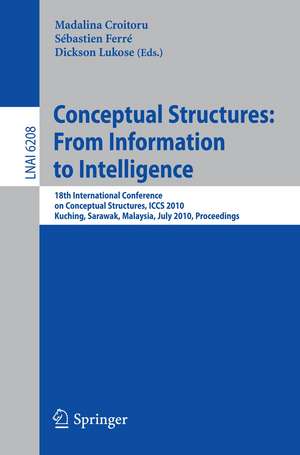
Conceptual Structures: From Information to Intelligence: 18th International Conference on Conceptual Structures, ICCS 2010, Kuching, Sarawak, Malaysia, July 26-30, 2010, Proceedings: Lecture Notes in Computer Science, cartea 6208
Editat de Madalina Croitoru, Sébastien Ferré, Dickson Lukoseen Limba Engleză Paperback – 7 iul 2010
Subliniem necesitatea stringenta de a optimiza structurile de reprezentare si rationament (KRR) intr-un context in care performanta infrastructurii de calcul redefineste limitele inteligentei artificiale. Conceptual Structures: From Information to Intelligence abordeaza direct aceasta tranzitie, oferind solutii tehnice pentru transformarea datelor brute in structuri cognitive capabile de rationament logic complex. Suntem de parere ca valoarea acestui volum rezida in capacitatea de a unifica teorii diverse, precum grafurile conceptuale ale lui Sowa, analiza formala a conceptelor si tehnologiile Semantic Web.
Notam cu interes organizarea riguroasa a continutului, care debuteaza cu perspective teoretice asupra entitatilor si surogatelor in reprezentarea cunoasterii, avansand spre aplicatii practice de „graph mining” si interogari bazate pe cuvinte cheie. Pe linia practica a volumului Conceptual Structures: Knowledge Visualization and Reasoning, dar cu un focus distinct pe capacitatile de executie si puterea de reprezentare, lucrarea editata de Madalina Croitoru si colegii sai se distinge prin abordarea interdisciplinara. In contextul operei editorului, acest volum face tranzitia de la bazele teoretice explorate in Graph-Based Representation and Reasoning catre provocari moderne de procesare a limbajului natural si descoperire a cunoasterii (Knowledge Discovery).
Fiecare capitol investigheaza o problema tehnica specifica, de la traducerile intre RDF si grafuri conceptuale, pana la utilizarea ontologiilor pentru intelegerea interogarilor in limbaj natural. Ritmul este unul academic, dens in formalism matematic si structuri de tip latice, fiind un instrument esential pentru inginerii de sisteme si cercetatorii care dezvolta aplicatii de inteligenta artificiala bazate pe logica si rationament diagramatic.
Din seria Lecture Notes in Computer Science
- 20%
 Preț: 558.53 lei
 - 20%
 Preț: 571.88 lei
 - 20%
 Preț: 675.83 lei
 - 20%
 Preț: 1020.28 lei
 - 20%
 Preț: 620.33 lei
 - 20%
 Preț: 560.93 lei
 - 20%
 Preț: 633.70 lei
 - 20%
 Preț: 678.21 lei
 - 20%
 Preț: 1359.66 lei
 - 20%
 Preț: 560.93 lei
 - 20%
 Preț: 733.68 lei
 - 20%
 Preț: 828.44 lei
 - 15%
 Preț: 558.12 lei
 - 20%
 Preț: 793.92 lei
 - 20%
 Preț: 560.93 lei
 - 20%
 Preț: 748.63 lei
 - 20%
 Preț: 562.49 lei
 - 20%
 Preț: 1246.46 lei
 - 20%
 Preț: 449.81 lei
 - 20%
 Preț: 556.96 lei
 - 20%
 Preț: 562.49 lei
 - 20%
 Preț: 851.78 lei
 - 20%
 Preț: 313.10 lei
 - 18%
 Preț: 945.44 lei
 - 20%
 Preț: 314.86 lei
 - 20%
 Preț: 560.93 lei
 - 20%
 Preț: 313.87 lei
 - 20%
 Preț: 1033.45 lei
 - 20%
 Preț: 563.29 lei
 - 20%
 Preț: 733.68 lei
 - 20%
 Preț: 1137.10 lei
 - 20%
 Preț: 735.28 lei
 - 20%
 Preț: 1079.23 lei
 - 20%
 Preț: 584.42 lei
 - 20%
 Preț: 791.54 lei
 - 15%
 Preț: 672.87 lei
 - 20%
 Preț: 1032.47 lei
 - 20%
 Preț: 617.17 lei
 - 20%
 Preț: 1022.15 lei
 - 20%
 Preț: 984.64 lei
 - 20%
 Preț: 620.33 lei
 - 20%
 Preț: 402.28 lei
 - 20%
 Preț: 316.28 lei
 - 20%
 Preț: 663.69 lei
 - 20%
 Preț: 320.24 lei
 - 20%
 Preț: 343.12 lei
 - 20%
 Preț: 606.22 lei
Preț: 317.05 lei
Preț vechi: 396.31 lei
-20%
Carte disponibilă
Livrare economică 29 octombrie-12 noiembrie
Specificații
ISBN-10: 364214196X
Pagini: 219
Ilustrații: XII, 207 p. 51 illus.
Greutate: 0.34 kg
Ediția:2010
Editura: Springer Berlin, Heidelberg
Colecția Springer
Seriile Lecture Notes in Computer Science, Lecture Notes in Artificial Intelligence
Locul publicării:Berlin, Heidelberg, Germany
V-ar putea interesa
-
 The Infinite AlphabetCésar A. HidalgoPreț: 191.96 lei
 -
 Preț: 382.25 lei
 -
 Artificial Intelligence: A Guide to Intelligent SystemsMichael Negnevitsky-20%Preț: 645.15 lei806.45 lei
 -
 Agentic AI For DummiesPam Baker-20%Preț: 145.74 lei182.17 lei
 -
 The Essential Book of AIAnne Rooney-20%Preț: 74.61 lei93.27 lei
 -
 Knowledge Graphs and LLMs in ActionAlessandro Negro-20%Preț: 347.90 lei434.88 lei
 -
 Further with Knowledge GraphsM. Alam-20%Preț: 617.07 lei771.34 lei
 -
 Introduction to Knowledge OrganisationClaudio Gnoli-19%Preț: 472.53 lei583.37 lei
 -
 The AI ConEmily M. BenderPreț: 151.99 lei
 -
 The Semantic Web - ISWC 2023Terry R. Payne-20%Preț: 552.76 lei690.95 lei
 -
 The Semantic WebAlbert Meroño Peñuela-20%Preț: 437.83 lei547.29 lei
 -
 Conceptual Knowledge StructuresInma P. Cabrera-20%Preț: 434.33 lei542.91 lei
 -
 The Semantic Web: Research and ApplicationsLora Aroyo-20%Preț: 343.97 lei429.96 lei
 -
 -20%Preț: 324.19 lei405.23 lei
 -
 -20%Preț: 662.85 lei828.56 lei
 -
 -20%Preț: 638.44 lei798.05 lei
 -
 -20%Preț: 321.81 lei402.26 lei
 -
 -20%Preț: 333.68 lei417.09 lei
 -
 -20%Preț: 333.68 lei417.09 lei
 -
 -20%Preț: 337.06 lei421.33 lei
Public țintă
Professional/practitionerDe ce să citești această carte
Pentru profesionistii din informatica si inteligenta artificiala, acest volum ofera o foaie de parcurs tehnica pentru implementarea sistemelor de rationament bazate pe grafuri. Veti castiga o intelegere aprofundata a modului in care analiza formala a conceptelor poate fi aplicata in descoperirea cunoasterii si in procesarea limbajului natural, beneficiind de expertiza globala reunita in seria ICCS.