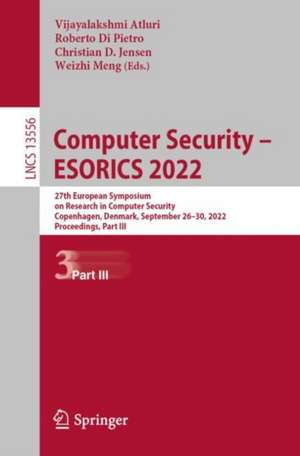
Computer Security - ESORICS 2022: Lecture Notes in Computer Science, cartea 13556
Editat de Vijayalakshmi Atluri, Roberto Di Pietro, Christian D. Jensen, Weizhi Mengen Limba Engleză Paperback – 24 sep 2022
Part I: Blockchain security; privacy; crypto; attacks; sidechannels; Part II: Anonymity; cloud security; access control; authentication; digital signatures; IoT security; applications;
Part III: Formal analysis; Web security; hardware security; multiparty computation; ML techniques; cyber-physical systems security; network and software security; posters.
Din seria Lecture Notes in Computer Science
- 20%
 Preț: 558.53 lei
 - 20%
 Preț: 617.17 lei
 - 20%
 Preț: 571.88 lei
 - 20%
 Preț: 1020.28 lei
 - 20%
 Preț: 851.78 lei
 - 20%
 Preț: 560.93 lei
 - 20%
 Preț: 633.70 lei
 - 20%
 Preț: 675.83 lei
 - 20%
 Preț: 1359.66 lei
 - 20%
 Preț: 620.33 lei
 - 20%
 Preț: 733.68 lei
 - 18%
 Preț: 945.44 lei
 - 15%
 Preț: 558.12 lei
 - 20%
 Preț: 793.92 lei
 - 20%
 Preț: 560.93 lei
 - 20%
 Preț: 748.63 lei
 - 20%
 Preț: 562.49 lei
 - 20%
 Preț: 1032.47 lei
 - 20%
 Preț: 731.82 lei
 - 20%
 Preț: 556.96 lei
 - 20%
 Preț: 1022.15 lei
 - 20%
 Preț: 562.49 lei
 - 20%
 Preț: 560.93 lei
 - 20%
 Preț: 313.10 lei
 - 20%
 Preț: 828.44 lei
 - 20%
 Preț: 560.93 lei
 - 20%
 Preț: 314.86 lei
 - 20%
 Preț: 1033.45 lei
 - 20%
 Preț: 563.29 lei
 - 20%
 Preț: 733.68 lei
 - 20%
 Preț: 1137.10 lei
 - 20%
 Preț: 735.28 lei
 - 20%
 Preț: 1079.23 lei
 - 20%
 Preț: 584.42 lei
 - 20%
 Preț: 854.16 lei
 - 15%
 Preț: 672.87 lei
 - 20%
 Preț: 606.22 lei
 - 20%
 Preț: 1246.46 lei
 - 20%
 Preț: 449.81 lei
 - 20%
 Preț: 984.64 lei
 - 20%
 Preț: 620.33 lei
 - 20%
 Preț: 402.28 lei
 - 20%
 Preț: 316.28 lei
 - 20%
 Preț: 663.69 lei
 - 20%
 Preț: 320.24 lei
 - 20%
 Preț: 343.12 lei
 - 20%
 Preț: 313.87 lei
Preț: 362.51 lei
Preț vechi: 453.15 lei
-20%
Puncte Express: 544
Carte tipărită la comandă
Livrare economică 27 noiembrie-11 decembrie
Livrare prin curier în România Termenul estimat este afișat lângă disponibilitate.
Transport gratuit de la 400.00 lei Plată online sau ramburs, în funcție de opțiunile comenzii.
Retur gratuit în 14 zile Comandă securizată și suport în română.
Specificații
ISBN-13: 9783031171420
ISBN-10: 303117142X
Pagini: 816
Ilustrații: XXIII, 789 p. 248 illus., 173 illus. in color.
Dimensiuni: 155 x 235 x 44 mm
Greutate: 1.21 kg
Ediția:1st edition 2022
Editura: Springer
Colecția Lecture Notes in Computer Science
Seria Lecture Notes in Computer Science
Locul publicării:Cham, Switzerland
ISBN-10: 303117142X
Pagini: 816
Ilustrații: XXIII, 789 p. 248 illus., 173 illus. in color.
Dimensiuni: 155 x 235 x 44 mm
Greutate: 1.21 kg
Ediția:1st edition 2022
Editura: Springer
Colecția Lecture Notes in Computer Science
Seria Lecture Notes in Computer Science
Locul publicării:Cham, Switzerland
V-ar putea interesa
-
 DevSecOps in Oracle CloudAhmed Aboulnaga-20%Preț: 409.39 lei511.73 lei
 -
 Cryptography: A Very Short IntroductionSean Murphy-36%Preț: 48.77 lei75.86 lei
 -
 Systematic Security: A CISO’s PlaybookTimur Qader-20%Preț: 367.98 lei459.97 leiRecomandat
 -
 Cryptography ApocalypseRoger A. Grimes-20%Preț: 172.96 lei216.21 lei
 -
 Security EngineeringRoss Anderson-20%Preț: 392.75 lei490.94 lei
 -
 -20%Preț: 139.09 lei173.87 lei
 -
 Cryptography and Network SecurityWilliam Stallings-20%Preț: 634.17 lei792.71 lei
 -
 Preț: 123.51 lei
 -
 Serious Cryptography, 2nd Edition: A Practical Introduction to Modern EncryptionJean-Philippe Aumasson-36%Preț: 298.89 lei464.51 lei
 -
 Computer Security and the InternetPaul C. van Oorschot-20%Preț: 453.22 lei566.53 lei
 -
 Cryptography and CodingElizabeth A. Quaglia-20%Preț: 420.77 lei525.96 lei
 -
 Mobile Web and Intelligent Information SystemsMuhammad Younas-20%Preț: 433.53 lei541.91 lei
 -
 Advances in Cryptology - CRYPTO 2024Leonid Reyzin-20%Preț: 468.25 lei585.31 lei
 -
 -15%Preț: 672.87 lei791.62 lei
 -
 -20%Preț: 670.30 lei837.87 lei
 -
 Preț: 377.68 lei
 -
 -20%Preț: 402.28 lei502.84 lei
 -
 AI Applications in Cyber Security and Communication NetworksChaminda Hewage-20%Preț: 1466.35 lei1832.94 lei
 -
 Security, Privacy and Data AnalyticsUdai Pratap Rao-20%Preț: 1217.26 lei1521.58 lei
 -
 Cyber Security and Digital ForensicsNihar Ranjan Roy-20%Preț: 977.80 lei1222.25 lei
Cuprins
Formal Analysis.- A Formal Analysis of the FIDO2 Protocols.- Composable Security Treatment of ECVRF and Batch Verifications.- Effcient Proofs of Knowledge for Threshold Relations.- A tale of two models: formal verification of KEMTLS via Tamarin.- Web Security.- Browser-based CPU Fingerprinting.- Polymorphic Protocols at the Example of Mitigating Web Bots.- Unlinkable Delegation of WebAuthn Credentials.- Large Scale Analysis of DoH Deployment on the Internet.- Equivocal URLs: Understanding the Fragmented Space of URL Parser Implementations.- Exploring the Characteristics and Security Risks of Emerging Emoji Domain Names.- Hardware Security.- CPU Port Contention Without SMT.- Protocols for a Two-Tiered Trusted Computing Base.- Using Memristor Arrays as Physical Unclonable Functions.- Multiparty Computation.- SecureBiNN: 3-Party Secure Computation for Binarized Neural Network Inference.- MixedTechnique Multi-Party Computations Composed of Two-Party Computations.- PEA: Practical Private Epistasis Analysis using MPC.- ML Techniques.- Hide and Seek: on the Stealthiness of Attacks against Deep Learning Systems.- Precise Extraction of Deep Learning Models via Side-Channel Attacks on Edge/Endpoint Devices.- Real-time Adversarial Perturbations against Deep Reinforcement Learning Policies: Attacks and Defenses.- FLMJR: Improving Robustness of Federated Learning via Model Stability.- MaleficNet: Hiding Malware into Deep Neural Networks using Spread-Spectrum Channel Coding.- Long-Short History of Gradients is All You Need: Detecting Malicious and Unreliable Clients in Federated Learning.- MLFM: Machine Learning Meets Formal Method for Faster Identification of Security Breaches in Network Functions Virtualization (NFV).- Cyber-Physical Systems Security.- Perspectives from a Comprehensive Evaluation of Reconstruction-based Anomaly Detection in Industrial Control Systems.- A Novel High-performance Implementation of CRYSTALS-Kyber with AI Accelerator.- From Click To Sink: utilizing AIS for command and control in maritime cyber attacks.- Effcient Hash-Based Redactable Signature for Smart Grid Applications.- Can Industrial Intrusion Detection Be SIMPLE.- For your Voice Only: Exploiting Side Channels in Voice Messaging for Environment Detection.- Towards Effcient Auditing for Real-Time Systems.- Network and Software Security.- Towards a Systematic and Automatic Use of State Machine Inference to Uncover Security Flaws and Fingerprint TLS Stacks.- PanoptiCANs - Adversary-resilient Architectures for Controller Area Networks.- Detecting Cross-Language Memory Management Issues in Rust.- Reach Me if You Can: On Native Vulnerability Reachability in Android Apps.- Extensible Virtual Call Integrity.- Posters.- Is your password sexist? A gamification-based analysis of the cultural context of leaked passwords.- A Fast, Practical and Simple Shortest Path Protocol for Multiparty Computation.- Audio Spoofing Detection Using Constant-Q Spectral Sketches and Parallel-Attention SE-ResNet.- MixCT: Mixing Confidential Transactions from Homomorphic Commitment.- Multi-Freq-LDPy: Multiple Frequency Estimation Under Local Differential Privacy in Python.- The Devil is in the GAN: Backdoor Attacks and Defenses in Deep Generative Models.