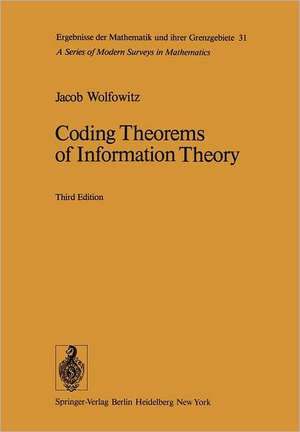
Coding Theorems of Information Theory
Autor J. Wolfowitzen Limba Engleză Paperback – 15 noi 2011
Preț: 640.18 lei
Preț vechi: 753.16 lei
-15%
Puncte Express: 960
Carte tipărită la comandă
Livrare economică 05-19 decembrie
Livrare prin curier în România Termenul estimat este afișat lângă disponibilitate.
Transport gratuit pentru acest produs Plată online sau ramburs, în funcție de opțiunile comenzii.
Retur gratuit în 14 zile Comandă securizată și suport în română.
Specificații
ISBN-13: 9783642668241
ISBN-10: 3642668240
Pagini: 192
Ilustrații: XII, 176 p.
Dimensiuni: 170 x 244 x 11 mm
Greutate: 0.34 kg
Ediția:Third Edition 1978
Editura: Springer
Locul publicării:Berlin, Heidelberg, Germany
ISBN-10: 3642668240
Pagini: 192
Ilustrații: XII, 176 p.
Dimensiuni: 170 x 244 x 11 mm
Greutate: 0.34 kg
Ediția:Third Edition 1978
Editura: Springer
Locul publicării:Berlin, Heidelberg, Germany
V-ar putea interesa
-
 -31%Preț: 818.61 lei1194.69 lei
 -
 The Oxford Dictionary of Statistical TermsYadolah Dodge-17%Preț: 373.36 lei448.57 lei
 -
 Bayesian Statistics 8J. M. Bernardo-31%Preț: 784.33 lei1129.94 lei
 -
 Models for Discrete Longitudinal DataGeert Molenberghs-18%Preț: 1289.25 lei1572.26 lei
 -
 Probability Through ProblemsMarek Capiński-18%Preț: 1029.18 lei1255.10 lei
 -
 Efficient and Adaptive Estimation for Semiparametric ModelsPeter J. Bickel-20%Preț: 789.51 lei986.89 lei
 -
 Probability with MartingalesDavid WilliamsPreț: 370.11 lei
 -
 New Camb Statistical Tables 2edD. V. LindleyPreț: 140.34 lei
 -
 Asymptotic StatisticsA. W. Van Der Vaart-11%Preț: 483.13 lei542.85 lei
 -
 Applied Regression AnalysisJohn O. Rawlings-15%Preț: 587.18 lei690.80 lei
 -
 Introduction to Stochastic ProcessesGregory F. Lawler-18%Preț: 812.46 lei990.81 lei
 -
 Fourier Analysis and Stochastic ProcessesPierre BrémaudPreț: 272.57 lei
 -
 Séminaire de Probabilités XLVICatherine Donati-MartinPreț: 405.14 lei
 -
 Concentration Inequalities and Model SelectionPascal Massart-15%Preț: 477.23 lei561.45 lei
 -
 Fluctuations in Markov ProcessesTomasz Komorowski-15%Preț: 655.08 lei770.67 lei
 -
 -15%Preț: 680.99 lei801.16 lei
Public țintă
ResearchCuprins
1. Heuristic Introduction to the Discrete Memoryless Channel.- 2. Combinatorial Preliminaries.- 2.1. Generated sequences.- 2.2. Properties of the entropy function.- Remarks.- 3. The Discrete Memoryless Channel.- 3.1. Description of the channel.- 3.2. A coding theorem.- 3.3. The strong converse.- 3.4. Strong converse for the binary symmetric channel.- 3.5. The finite-state channel with state calculable by both sender and receiver.- 3.6. The finite-state channel with state calculable only by the sender.- Remarks.- 4. Compound Channels.- 4.1. Introduction.- 4.2. The canonical channel.- 4.3. A coding theorem.- 4.4. Strong converse.- 4.5. Compound d.m.c. with c.p.f. known only to the receiver or only to the sender.- 4.6. Channels where the c.p.f. for each letter is stochastically determined.- 4.7. Proof of Theorem 4.6.4.- 4.8. The d.m.c. with feedback.- Remarks.- 5. The Discrete Finite-Memory Channel.- 5.1. The discrete channel.- 5.2. The discrete finite-memory channel.- 5.3. The coding theorem for the d.f.m.c..- 5.4. Strong converse of the coding theorem for the d.f.m.c.- 5.5. Rapidity of approach to C in the d.f.m.c.- 5.6. Discussion of the d.f.m.c.- Remarks.- 6. Channels with Arbitrarily Varying Channel Probability Functions.- 6.1. Introduction.- 6.2. Necessary and sufficient conditions for a positive rate of transmission.- 6.3. Remarks on the capacity of an arbitrarily varying channel.- 6.4. The capacity C of an arbitrarily varying channel when b = 2.- 6.5. Certain results for the general arbitrarily varying channel.- Remarks.- 7. General Discrete Channels.- 7.1. Alternative description of the general discrete channel.- 7.2. The method of maximal codes.- 7.3. The method of random codes.- 7.4. Weak converses.- 7.5. Digression on the d.m.c.- 7.6. Discussion of the foregoing.- 7.7. Channels without a capacity.- 7.8. Strong converses.- 7.9. The strong converse for the d.m.c. revisited.- Remarks.- 8. The Semi-Continuous Memoryless Channel.- 8.1. Introduction.- 8.2. A coding theorem and its strong converse.- 9. Continuous Channels with Additive Gaussian Noise.- 9.1. A continuous memoryless channel with additive Gaussian noise.- 9.2. Message sequences within a suitable sphere.- 9.3. Message sequences on the periphery of the sphere or within a shell adjacent to the boundary.- 9.4. Another proof of Theorems 9.2.1 and 9.2.2.- Remarks.- 10. Mathematical Miscellanea.- 10.1. Introduction.- 10.2. The asymptotic equipartition property.- 10.3. Admissibility of an ergodic input for a discrete finite-memory channel.- 11. Fundamentals of Rate Distortion Theory.- 11.1. Introduction.- 11.2. The approximation theorem.- 11.3. Converse of the approximation theorem.- 11.4. Summary of the previous results.- 11.5. The rate distortion function when side information is available.- Remarks.- 12. Source Coding.- 12.1. Separate coding to span the product of two spaces.- 12.2. Source coding with side information at the decoder.- 12.3. Encoding assisted by a common channel.- Remarks.- 13. Source Coding and Rate Distortion.- 13.1. The problem of Section 12.3 for rate distortion.- 13.2. The rate distortion function for source coding with side information at the decoder.- 14. Multiple Access Channels.- 14.1. Description of the problem.- 14.2. A coding theorem.- 14.3. Converse of the coding theorem.- 14.4. Miscellaneous remarks.- 15. Degraded Broadcast Channels.- 15.1. Formulation of the problem.- 15.2. A coding theorem.- 15.3. Beginning of the proof of the strong converse.- 15.4. Proof of the weak converse.- 15.5. Miscellaneous remarks.- References.