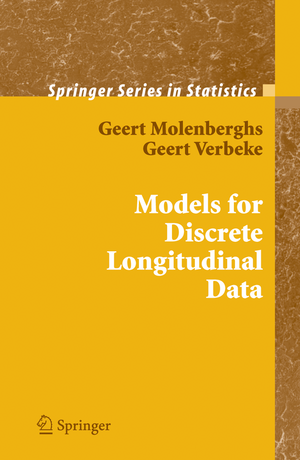
Models for Discrete Longitudinal Data
Autor Geert Molenberghs, Geert Verbekeen Limba Engleză Hardback – 4 aug 2005
Analiza datelor longitudinale discrete reprezintă o provocare statistică majoră, iar capitolul dedicat modelelor marginale și ecuațiilor de estimare generalizate (GEE) din această lucrare oferă claritatea necesară cercetătorilor care trec de la datele continue la cele categorice sau de tip numărătoare. Models for Discrete Longitudinal Data reprezintă o extensie naturală a cercetărilor anterioare ale autorilor Geert Molenberghs și Geert Verbeke, care au fost premiați de American Statistical Association pentru cursurile lor despre date incomplete și longitudinale. Observăm că structura volumului este riguros organizată, pornind de la modele liniare generalizate și avansând spre modele mixte cu efecte aleatorii și modele de tip „joint” pentru răspunsuri continue și discrete. Un element distinctiv al cărții este echilibrul între teorie și aplicabilitate; deși fundamentele matematice sunt solide, autorii demonstrează constant cum pot fi implementate aceste tehnici în pachetul SAS, oferind soluții pentru situații complexe de eșantionare. Acoperă aceeași arie tematică precum Methods and Applications of Longitudinal Data Analysis, dar cu o abordare mult mai axată pe datele discrete și pe gestionarea riguroasă a datelor lipsă prin metode precum imputarea multiplă și algoritmul EM. De asemenea, spre deosebire de Linear Mixed Models in Practice, care se concentrează pe modelele gaussiene, această ediție din 2005 extinde metodologia către modelele non-liniare și ierarhice. Credem că includerea studiilor de caz despre epilepsie și trialuri clinice de analgezice transformă conceptele abstracte în instrumente de lucru indispensabile pentru biostatisticieni.
Preț: 1246.61 lei
Preț vechi: 1520.26 lei
-18%
Carte tipărită la comandă
Livrare economică 27 noiembrie-11 decembrie
Specificații
ISBN-10: 0387251448
Pagini: 687
Ilustrații: XXII, 687 p.
Dimensiuni: 166 x 245 x 43 mm
Greutate: 1.17 kg
Ediția:2005
Editura: Springer
Locul publicării:New York, NY, United States
V-ar putea interesa
-
 How to Lie with StatisticsDarrell Huff-33%Preț: 61.38 lei91.39 lei
 -
 The Evaluation of Surrogate EndpointsTomasz Burzykowski-5%Preț: 1174.25 lei1236.05 lei
 -
 Linear Mixed Models in PracticeGeert Verbeke-5%Preț: 784.54 lei825.83 lei
 -
 S ProgrammingWilliam Venables-15%Preț: 675.09 lei794.23 lei
 -
 Clustering Methodology for Symbolic DataLynne Billard-8%Preț: 575.98 lei626.06 lei
 -
 Preț: 267.88 lei
 -
 Advances in Statistical Methods for the Health SciencesJean-Louis Auget-18%Preț: 1119.80 lei1365.61 lei
 -
 Introduction to Statistical Analysis of LaboratoryDataAlfred Bartolucci-9%Preț: 773.55 lei850.05 lei
 -
 -23%Preț: 515.43 lei669.39 lei
 -
 A Panorama of StatisticsEric SoweyPreț: 371.55 lei
 -
 History Mathematical StatisticGorroochurn-9%Preț: 865.51 lei951.11 lei
 -
 A Course in Statistics with RPrabhanjan N Tattar-20%Preț: 690.29 lei862.86 lei
 -
 Statistics from A to ZJawlikPreț: 328.96 lei
 -
 Handbook of Missing Data MethodologyGeert Molenberghs-18%Preț: 922.21 lei1124.64 lei
 -
 Time Series: Theory and MethodsPeter J. Brockwell-18%Preț: 904.05 lei1102.50 lei
 -
 -18%Preț: 941.35 lei1147.98 lei
 -
 Longitudinal Data AnalysisGarrett Fitzmaurice-18%Preț: 1142.55 lei1393.35 lei
 -
 -15%Preț: 550.34 lei647.45 lei
Public țintă
ResearchDe ce să citești această carte
Această lucrare este esențială pentru cercetătorii și statisticienii care lucrează cu seturi de date complexe, unde observațiile sunt repetate în timp și nu urmează o distribuție normală. Cititorul câștigă o înțelegere profundă a modelelor mixte și marginale, primind în același timp ghidaj practic pentru utilizarea SAS în analiza datelor incomplete, un avantaj competitiv în cercetarea clinică și socială.
Cuprins
Recenzii
"Strengths of this book include its breadth of topics, excellent organization and clarity of writing...I highly recommend this book to my colleagues and students." -Justine Shults for the Journal of Biopharmaceutical Statistics, Issue 3, 2006
"Models for Discrete Longitudinal Data is an excellent choice for any statistician with an interest in analyzing discrete longitudinal data. It covers all of the theoretical and applied aspects in this area and is organized in such a way to serve as a handy reference guide for applied statisticians, especially those in biomedical fields. I learned a great deal from this book, and I recommend it highly to others." -John Williamson for the Journal of the American Statistical Association, September 2006
"This book complements Verbeke and Molenberghs (2000), which focused on models based on the multivariate normal distribution. … This book covers the alternative models and approaches in a methodical and accessible manner. The emphasis in the book is on presenting methods for solving practical problems, and the authors succeed admirably in this. … The material is clearly presented … . This book is very welcome, and will undoubtedly prove to be useful and influential." (B. J. T. Morgan, Short Book Reviews, Vol. 26 (2), 2006)
"This book provides a comprehensive treatment of modeling approaches for non-Gaussian repeated measures … . the book shows how the different approaches can be implemented within the SAS software package. The text is so organized that the reader can skip the software-oriented chapters and sections without breaking the logical flow. … It is a very important, modern and useful book for statisticians." (T. Postelnicu, Zentralblatt MATH, Vol. 1093 (19), 2006)
"This book … concentrates on models for non-normally distributed longitudinal data, like binary or categorical data. … The book under review is a comprehensivecollection of latest models for non-normally distributed longitudinal data. … Models for Discrete Longitudinal Data addresses interested (and experienced) students and lectures as well as practitioners looking for solutions of everyday problems." (K. Webel, Advances in Statistical Analysis, Vol. 91 (2), 2007)
Textul de pe ultima copertă
The authors consider a variety of extensions, such as models for multivariate longitudinal measurements, random-effects models with serial correlation, and mixed models with non-Gaussian random effects. They sketch the general principles for how to deal with the commonly encountered issue of incomplete longitudinal data. The authors critique frequently used methods and propose flexible and broadly valid methods instead, and conclude with key concepts of sensitivity analysis.
Without putting too much emphasis on software, the book shows how the different approaches can be implemented within the SAS software package. The text is organized so the reader can skip the software-oriented chapters and sections without breaking the logical flow.
Geert Molenberghs is Professor of Biostatistics at the Universiteit Hasselt in Belgium and has published methodological work on surrogate markers in clinical trials, categorical data, longitudinal data analysis, and the analysis of non-response in clinical and epidemiological studies. He served as Joint Editor for AppliedStatistics (2001–2004) and as Associate Editor for several journals, including Biometrics and Biostatistics. He was President of the International Biometric Society (2004–2005). He was elected Fellow of the American Statistical Association and received the Guy Medal in Bronze from the Royal Statistical Society.
Geert Verbeke is Professor of Biostatistics at the Biostatistical Centre of the Katholieke Universiteit Leuven in Belgium. He has published a number of methodological articles on various aspects of models for longitudinal data analyses, with particular emphasis on mixed models. Geert Verbeke is Past President of the Belgian Region of the International Biometric Society, International Program Chair for the International Biometric Conference in Montreal (2006), and Joint Editor of the Journal of the Royal Statistical Society, Series A (2005–2008). He has served as Associate Editor for several journals including Biometrics and Applied Statistics.
The authors also wrote a monograph on linear mixed models for longitudinal data (Springer, 2000) and received the American Statistical Association's Excellence in Continuing Education Award, based on short courses on longitudinal and incomplete data at the Joint Statistical Meetings of 2002 and 2004.