
Cinema I: The Movement-Image: Bloomsbury Revelations
Autor Gilles Deleuzeen Limba Engleză Paperback – 24 oct 2013
Deși adesea perceput de publicul larg ca un critic de film neconvențional, Gilles Deleuze se raportează la cinema nu ca la un obiect de recenzie, ci ca la un veritabil laborator de gândire filosofică. În Cinema I, observăm cum autorul refuză să trateze filmul ca pe o simplă ilustrare a unor idei preexistente, propunând în schimb o „logică a cinematografului” care extrage concepte pure din însăși substanța imaginilor în mișcare. Considerăm că această abordare transformă experiența vizionării într-un act de cunoaștere senzorială profundă.
Ca și Deleuze and Cinema de Felicity Colman, acest volum pune în valoare complexitatea imaginii mișcate, dar cu un accent pe rigoarea clasificării taxonomice a semnelor vizuale. Structura cărții reflectă o progresie fascinantă, de la comentariile asupra lui Henri Bergson la analiza minuțioasă a „imaginii-afecțiune” prin intermediul planului apropiat sau a „imaginii-acțiune” în formele sale mari și mici. Cuprinsul ne ghidează printr-o geografie a privirii, unde regizori precum Hitchcock sau Eisenstein devin parteneri de dialog filosofic.
Această lucrare ocupă un loc central în opera autorului, făcând trecerea de la ontologia din Difference and Repetition la o estetică aplicată. Dacă în Francis Bacon autorul explora senzația în pictură, în Cinema I el analizează modul în care montajul și încadrarea redefinesc percepția noastră asupra timpului. Apreciem calitatea ediției de față, care reușește să redea claritatea unui text dens, esențial pentru oricine dorește să înțeleagă fundamentele poststructuraliste ale teoriei media contemporane.
Din seria Bloomsbury Revelations
- 24%
 Preț: 193.25 lei
 - 19%
 Preț: 172.26 lei
 - 17%
 Preț: 161.17 lei
 - 25%
 Preț: 173.62 lei
 - 21%
 Preț: 211.80 lei
 - 21%
 Preț: 145.07 lei
 - 22%
 Preț: 201.55 lei
 - 13%
 Preț: 171.37 lei
 - 22%
 Preț: 150.47 lei
 - 19%
 Preț: 169.96 lei
 - 20%
 Preț: 161.25 lei
 - 23%
 Preț: 187.41 lei
 - 21%
 Preț: 130.18 lei
 - 18%
 Preț: 187.71 lei
 - 23%
 Preț: 148.23 lei
 - 24%
 Preț: 192.68 lei
 - 18%
 Preț: 187.53 lei
 - 23%
 Preț: 197.19 lei
 - 26%
 Preț: 188.61 lei
 - 19%
 Preț: 184.26 lei
 - 24%
 Preț: 179.63 lei
 - 17%
 Preț: 200.20 lei
 - 20%
 Preț: 161.11 lei
 - 17%
 Preț: 166.71 lei
 - 23%
 Preț: 180.35 lei
 - 18%
 Preț: 176.90 lei
 - 23%
 Preț: 188.72 lei
 - 23%
 Preț: 188.76 lei
 - 14%
 Preț: 119.74 lei
 - 14%
 Preț: 146.96 lei
 - 20%
 Preț: 159.71 lei
 - 39%
 Preț: 168.51 lei
 - 23%
 Preț: 198.09 lei
 - 20%
 Preț: 131.90 lei
 - 24%
 Preț: 189.48 lei
 - 19%
 Preț: 171.54 lei
 - 24%
 Preț: 195.50 lei
 - 24%
 Preț: 178.60 lei
 - 25%
 Preț: 187.49 lei
 - 24%
 Preț: 145.14 lei
 - 24%
 Preț: 190.86 lei
 - 22%
 Preț: 114.34 lei
 - 18%
 Preț: 177.90 lei
 - 25%
 Preț: 171.92 lei
 - 22%
 Preț: 185.44 lei
 - 24%
 Preț: 180.76 lei
 - 19%
 Preț: 192.37 lei
 - 25%
 Preț: 191.11 lei
 - 8%
 Preț: 121.19 lei
 - 8%
 Preț: 119.59 lei
Preț: 171.63 lei
Preț vechi: 211.51 lei
-19%
Carte disponibilă
Livrare economică 16-30 noiembrie
Livrare express 30 octombrie-05 noiembrie pentru 68.22 lei
Specificații
ISBN-10: 1472508300
Pagini: 304
Dimensiuni: 138 x 212 x 24 mm
Greutate: 0.39 kg
Editura: Bloomsbury Publishing
Colecția Bloomsbury Academic
Seria Bloomsbury Revelations
Locul publicării:London, United Kingdom
V-ar putea interesa
-
 Jean-Luc Godard, Cinema HistorianMichael WittPreț: 268.13 lei
 -
 Interaction of Color: 50th Anniversary EditionJosef AlbersPreț: 125.97 lei
 -
 Ansel Adams' 400 PhotographsAnsel Adams-22%Preț: 217.37 lei279.18 lei
 -
 Children of DuneFrank HerbertPreț: 79.32 lei
 -
 Deleuze, Cinema and National IdentityDavid Martin-Jones-16%Preț: 237.08 lei281.36 lei
 -
 Deleuze and FilmDavid Martin-Jones-15%Preț: 213.00 lei252.00 lei
 -
 Deleuze and the Concepts of CinemaDaniela Angelucci-9%Preț: 144.43 lei158.66 lei
 -
 The Real GazeTodd McGowanPreț: 288.00 lei
 -
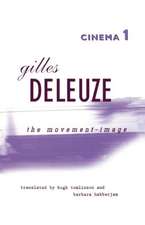 Cinema 1: The Movement-ImageGilles DeleuzePreț: 185.64 lei
 -
 New Philosophies of Film: An Introduction to Cinema as a Way of ThinkingDr Robert Sinnerbrink-17%Preț: 171.56 lei206.60 lei
 -
 Danse MacabreStephen KingPreț: 101.63 lei
 -
 Cinema II: The Time-ImageGilles Deleuze-19%Preț: 171.54 lei211.01 lei
 -
 -25%Preț: 58.93 lei79.09 lei
 -
 Film FablesJacques Rancière-20%Preț: 161.11 lei201.48 lei
 -
 Deleuze's Cinema BooksDavid Deamer-9%Preț: 170.68 lei188.17 lei
 -
 The Boy, The Mole, The Fox and The HorseCharlie Mackesy-24%Preț: 120.91 lei159.67 lei
 -
 50 Film Ideas You Really Need to KnowHelen O’Hara-28%Preț: 50.70 lei70.25 lei
 -
 Jean-Luc Godard: Philosopher/InsurgentJonathan Scott Lee-31%Preț: 512.45 lei744.22 lei
 -
 The Boy, The Mole, The Fox and The HorseCharlie Mackesy-23%Preț: 42.95 lei55.57 lei
 -
 Signs and Meaning in the CinemaPeter Wollen-24%Preț: 186.06 lei244.80 lei
 -
 Deleuze and Cinema: The Film ConceptsFelicity Colman-23%Preț: 242.98 lei317.23 lei
 -
 A Cinematic Mode of Existence: Perspectival Analytic of the ImageHalbe Hessel Kuipers-32%Preț: 628.64 lei926.98 lei
 -
 Read Frame Type FilmCatherine De Smet-17%Preț: 296.70 lei356.80 lei
De ce să citești această carte
Recomandăm Cinema I cititorilor care doresc să depășească nivelul analizei narative a filmelor pentru a înțelege „mecanica” gândirii vizuale. Veți câștiga un vocabular filosofic nou și o capacitate sporită de a descifra modul în care marii regizori manipulează timpul și mișcarea. Este o lectură fundamentală pentru studenții la filosofie și film care caută o alternativă riguroasă la critica de film tradițională.
Despre autor
Gilles Deleuze (1925-1995) a fost profesor de filosofie la Universitatea Paris VIII și este recunoscut ca una dintre cele mai influente figuri ale poststructuralismului secolului XX. Opera sa vastă, care include 25 de volume, explorează intersecția dintre filosofie, artă și politică. Lucrările sale celebre, precum Anti-Oedipus (scrisă împreună cu Félix Guattari) sau The Logic of Sense, demonstrează capacitatea sa unică de a crea concepte noi prin analizarea literaturii, picturii și, în cazul seriei Cinema, a artei filmului, pe care o consideră o formă autonomă de gândire.
Descriere
Gilles Deleuze was one of the most influential figures in twentieth-century philosophy, well known for his works on the philosophy of art and for his master-works, Difference and Repetition and - with Felix Guattari - A Thousand Plateaus and Anti-Oedipus.Cinema I is the first volume of Deleuze's revolutionary work on the theory of cinema (concluded in Cinema II, also available in the Bloomsbury Revelations series). Drawing on the philosophy of Henri Bergson, Deleuze identified his work as "a logic of the cinema", setting out to "isolate certain cinematographic concepts" philosophically. To do this, he brings together diverse examples from a variety of major filmmakers, including Ingmar Bergman, Charlie Chaplin, Sergei Eisenstein and Alfred Hitchcock, among many others.
Cuprins
Preface to the English edition \ Translators' Introduction \Preface to the French Edition \ 1. Theses on Movement: First Commentary onBergson \ 2. Frame and Short, Framing and Cutting \ 3. Montage \ 4. TheMovement-Image and its Three Varieties: Second Commentary on Bergson \ 5. ThePerception-Image \ 6. The Affection-Image Face and Close-Up \ 7. TheAffection-Image: Qualities, Powers, Any-Space-Whatevers \ 8. From Affect toAction: The Impulse Image \ 9. The Action-Image: The Large Form \ 10. The Action-Image:The Small Form \ 11. Figures, or the Transformation of Forms \ 12. The Crisisof the Action-Image \ Glossary \ Notes \ Index.
Recenzii
"Cinema I and Cinema II must be understood as works of philosophy, not of film criticism. They are Deleuze's reflection on the new ways the cinema enables us to think about time and movement, opening up insights into semiotics and our ideological construction of a world increasingly experienced through representational media.... The main purpose of these books is to identify and explore the implications of a vital shift from classical, pre-World War II cinema of the movement-image to post-World War II cinema of the time-imaging.... "Cinema 1 and Cinema 2 perhaps ultimately have more to teach us about philosophy, conceptions of subjectivity, and hermeneutics than to say something about any specific film. These books are challenging because they develop their own vocabulary in dialogue with the history of philosophy, and they assume a wide knowledge of films from the Soviet, European and Hollywood traditions. They reward the effort required to read them, however, for the original tools with which they provide us to understand cinema and semiotics more generally. Deleuze concludes that it is important to think of cinema not as a language, but as a way of bringing to light 'intelligible content' which is a condition through which language constructs its objects (Cinema 2, p.251). Thus, purely optical and sound images which do not extend into action might be one way in which aesthetics might help us break outside of the determining structure of linguistic systems, enabling us to imagine the world otherwise. Deleuze helps us to see cinema as more than just a collection of texts but as additionally 'a new practice of images and signs, whose theory philosophy must produce as conceptual practice' (Cinema 2, p. 269)."- Sherryl Vint, Film International, Issue 27v
Caracteristici
Notă biografică
Gilles Deleuze (1925-1995) was one of the key figures in poststructuralism, and one of the most influential philosophers of the twentieth century. His major works include, with Felix Guattari, A Thousand Plateaus and Anti-Oedipus.