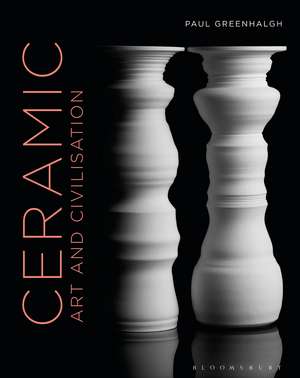
Ceramic, Art and Civilisation: Bloomsbury Visual Arts
Autor Paul Greenhalghen Limba Engleză Hardback – 11 mar 2021
"Passionately written." Apollo
"An extraordinary accomplishment." Edmund de Waal
"Monumental." Times Literary Supplement
"An epic reshaping of ceramic art." Crafts
"An important book." The Arts Society Magazine
In his major new history, Paul Greenhalgh tells the story of ceramics as a story of human civilisation, from the Ancient Greeks to the present day. As a core craft technology, pottery has underpinned domesticity, business, religion, recreation, architecture, and art for millennia. Indeed, the history of ceramics parallels the development of human society.
This fascinating and very human history traces the story of ceramic art and industry from the Ancient Greeks to the Romans and the medieval world; Islamic ceramic cultures and their influence on the Italian Renaissance; Chinese and European porcelain production; modernity and Art Nouveau; the rise of the studio potter, Art Deco, International Style and Mid-Century Modern, and finally, the contemporary explosion of ceramic making and the postmodern potter. Interwoven in this journey through time and place is the story of the pots themselves, the culture of the ceramics, and their character and meaning. Ceramics have had a presence in virtually every country and historical period, and have worked as a commodity servicing every social class. They are omnipresent: a ubiquitous art. Ceramic culture is a clear, unique, definable thing, and has an internal logic that holds it together through millennia. Hence ceramics is the most peculiar and extraordinary of all the arts. At once cheap, expensive, elite, plebeian, high-tech, low-tech, exotic, eccentric, comic, tragic, spiritual, and secular, it has revealed itself to be as fluid as the mud it is made from.
Ceramics are the very stuff of how civilized life was, and is, led. This then is the story of human society's most surprising core causes and effects.
Din seria Bloomsbury Visual Arts
- 33%
 Preț: 118.78 lei
 - 16%
 Preț: 162.81 lei
 - 36%
 Preț: 565.96 lei
 - 36%
 Preț: 587.87 lei
 - 38%
 Preț: 196.60 lei
 - 24%
 Preț: 184.91 lei
 - 48%
 Preț: 122.69 lei
 - 27%
 Preț: 216.63 lei
 - 27%
 Preț: 193.31 lei
 - 30%
 Preț: 526.48 lei
 - 26%
 Preț: 220.06 lei
 - 23%
 Preț: 200.65 lei
 - 36%
 Preț: 554.37 lei
 - 18%
 Preț: 178.39 lei
 - 36%
 Preț: 553.25 lei
 - 34%
 Preț: 106.70 lei
 - 32%
 Preț: 720.05 lei
 - 35%
 Preț: 637.35 lei
 - 27%
 Preț: 214.46 lei
 - 27%
 Preț: 184.73 lei
 - 24%
 Preț: 185.09 lei
 - 32%
 Preț: 563.30 lei
 - 30%
 Preț: 521.94 lei
 - 21%
 Preț: 334.64 lei
 - 19%
 Preț: 172.96 lei
 - 33%
 Preț: 591.67 lei
 - 22%
 Preț: 222.27 lei
 - 36%
 Preț: 590.19 lei
 - 31%
 Preț: 455.20 lei
 - 9%
 Preț: 244.61 lei
 - 45%
 Preț: 154.27 lei
 - 36%
 Preț: 553.77 lei
 - 9%
 Preț: 303.14 lei
 - 25%
 Preț: 215.17 lei
 - 31%
 Preț: 508.35 lei
 -
 Preț: 317.03 lei
 - 28%
 Preț: 202.84 lei
 - 32%
 Preț: 601.53 lei
 - 19%
 Preț: 186.85 lei
 - 36%
 Preț: 565.15 lei
 - 21%
 Preț: 267.18 lei
 - 25%
 Preț: 211.62 lei
 - 7%
 Preț: 223.90 lei
 - 17%
 Preț: 157.49 lei
 - 30%
 Preț: 544.72 lei
 - 25%
 Preț: 212.63 lei
 - 24%
 Preț: 162.59 lei
 - 18%
 Preț: 180.93 lei
Preț: 233.62 lei
Preț vechi: 354.25 lei
-34%
Puncte Express: 350
Carte disponibilă
Livrare economică 10-24 noiembrie
Livrare express 24-30 octombrie pentru 247.17 lei
Livrare prin curier în România Termenul estimat este afișat lângă disponibilitate.
Transport gratuit de la 400.00 lei Plată online sau ramburs, în funcție de opțiunile comenzii.
Retur gratuit în 14 zile Comandă securizată și suport în română.
Specificații
ISBN-13: 9781474239707
ISBN-10: 1474239706
Pagini: 512
Ilustrații: 409 colour illus
Dimensiuni: 220 x 278 x 34 mm
Greutate: 2.22 kg
Editura: Bloomsbury Publishing
Colecția Bloomsbury Visual Arts
Seria Bloomsbury Visual Arts
Locul publicării:London, United Kingdom
ISBN-10: 1474239706
Pagini: 512
Ilustrații: 409 colour illus
Dimensiuni: 220 x 278 x 34 mm
Greutate: 2.22 kg
Editura: Bloomsbury Publishing
Colecția Bloomsbury Visual Arts
Seria Bloomsbury Visual Arts
Locul publicării:London, United Kingdom
V-ar putea interesa
-
 -8%Preț: 473.43 lei514.60 lei
 -
 Ceramic GlazesBrian Taylor-21%Preț: 158.36 lei199.54 lei
 -
 ClayAmber Creswell Bell-21%Preț: 176.31 lei222.80 lei
 -
 Contemporary CeramicsEmmanuel Cooper-17%Preț: 237.25 lei285.27 lei
 -
 -17%Preț: 264.78 lei318.17 lei
 -
 Clay: A Human HistoryJennifer Lucy Allan-27%Preț: 68.29 lei93.10 lei
 -
 The Teabowl: East and WestBonnie Kemske-45%Preț: 203.01 lei366.72 lei
 -
 How to Read Chinese CeramicsDenise Patry LeidyPreț: 178.55 lei
 -
 Preț: 112.09 lei
 -
 A History of the World in 50 PiecesTom ServicePreț: 192.10 lei
 -
 Precious beyond Measure: A History of Korean CeramicsBeth McKillop-19%Preț: 257.70 lei317.39 lei
 -
 Ceramics: A Green ApproachKevin Millward-43%Preț: 137.14 lei239.01 lei
 -
 -24%Preț: 124.16 lei162.64 lei
 -
 Preț: 219.35 lei
 -
 ThrownLilly Maetzig-23%Preț: 115.15 lei149.20 lei
 -
 The Great Pottery Throw DownThe Great Pottery ThrowdownPreț: 196.94 lei
 -
 A World History of Art: Revised 7th EditionHugh Honour-19%Preț: 403.49 lei500.43 lei
 -
 Ceramics for the Home During the Celtic RevivalAisling MolloyPreț: 255.83 lei
 -
 The History of Chinese CeramicsLili Fang-20%Preț: 966.26 lei1207.82 lei
Cuprins
Acknowledgements
Prologue: A History in Shards
CHAPTER 1. WHAT CERAMIC IS
1. Fundamentals
2. Stuff of the Earth
3. The Art of Heat
4. The Potter
5. Nomenclature and Culture
6. The Ceramic Continuum
7. Transformers: Classicism, Islam, China, and the Modern
8. The Discipline
9. Industry and the Levels of Production
10. Ubiquity: The Plastic of the Ancient World
11. Telling Stories
12. Civilisation, Power, and Domestic Life
13. Conclusion: Western Ceramic
CHAPTER 2: THE VALUE OF THE GREEK POTTER
1. The World in Black and Red
2. Positioning the Pots
3. The Earlier Greek World
4. Reducing Iron and Oxygen
5. Who Were These People?
6. Secular Life
7. Anachronism, the Value, and the Price of Things
8. The Value and the Price of Things
9. Conclusion: The Spread of Red and Black
CHAPTER 3: ROME AND THE ARRIVAL OF THE MEDIEVAL WORLD
1. The Feel of Roman Pots
2. Red Gloss
3. The Pots of Empire
4. Greece, Rome, and the Classical Idea
5. Standardisation
6. Dark, Light, an End and a Beginning
7. Europe: The Coarse and the Local
8. Revivalism and the Vernacular
9. Conclusion: The Classical Heritage
CHAPTER 4: RENAISSANCES OF TIN
1. The Chemistry of Islam
2. Islam and Ceramic History
3. The Pottery Revolution
4. Islam in Europe
5. Renaissance Pots
6. Colour, Line and Life
7. Secular Life
8. Pottery and Painting
9. Quantity, Quality, and Status
10. The Arrival of the Meal
11. Sculptural Form
12. Italian Potters and Potteries
13. Renaissances
14. Conclusion: a European Ethos
CHAPTER 5: THE ENLIGHTENED REIGN OF WHITE
1. Chinese Pots
2. Technology, Style, Confidence
3. Porcelain City
4. China in Europe
5. The Quest for a European Porcelain
6. The Porcelain Explosion
7. Blue, White, War, and Peace
8. Delftware
9. Frivolity and Melancholy: the Figurine Reinvented
10. The Rise of Staffordshire
11. Conclusion: Modern Whiteness
CHAPTER 6: THE NATURAL AND THE INDIVIDUAL: LEAD, SLIP, STONE, SALT
1. History, the Collective, and the Individual
2. The Renaissance Man
3. The Palissystes
4. The Salt Renaissance
5. Prose and Poetry
6. The Nature of Slip
7. Configuring Life
8. The Arrival of America
9. Conclusion: The Ingredients of Modernity
CHAPTER 7: THE ACCELERATION OF STYLE AND THE ARRIVAL OF THE MODERN
1. Decoration, Complication, and Anxiety
2. The Last Transformer: Another Modernity
3. Institutionalisation
4. Exhibitions
5. Ugliness and the Era
6. The Invention of Style
7. Design Reform and the Ingredients of Modern Design
8. The Meaning of Majolica
9. The Vortex of Large-scale Production
10. The Republic of Tile
11. Ceramic Hell
12. Gender
13. Exoticism
14. The Designer
15. The Art Nouveau style
16. Conclusion: High Eclecticism to Art Nouveau
CHAPTER 8: THE STUDIO ARRIVES
1. A Modern Place
2. Art Pottery
3. Defining Art
4. The Invention of Craft
5. The Completeness of Existence
6. The Artist-potter
7. Émigrés
8. Art Deco
9. The International Style
10. Mid-century Modern
11. Potters and Painters
12. Conclusion: A World is Formed
CHAPTER 9: THE CREATIVE EXPLOSION
1. Thunderous Emotion
2. Another Modernity
3. The World of Funk
4. Conceptualism and Minimalism
5. A New Arena
6. New American Symbolism
7. The Ceramic Landscape
8. Abstract Vessels
9. Postmodernism
10. The New Ornamentalism
11. Conclusion: The Potter Now
Postscript: Attica to California
Notes
Bibliography
Index
About the Author
Prologue: A History in Shards
CHAPTER 1. WHAT CERAMIC IS
1. Fundamentals
2. Stuff of the Earth
3. The Art of Heat
4. The Potter
5. Nomenclature and Culture
6. The Ceramic Continuum
7. Transformers: Classicism, Islam, China, and the Modern
8. The Discipline
9. Industry and the Levels of Production
10. Ubiquity: The Plastic of the Ancient World
11. Telling Stories
12. Civilisation, Power, and Domestic Life
13. Conclusion: Western Ceramic
CHAPTER 2: THE VALUE OF THE GREEK POTTER
1. The World in Black and Red
2. Positioning the Pots
3. The Earlier Greek World
4. Reducing Iron and Oxygen
5. Who Were These People?
6. Secular Life
7. Anachronism, the Value, and the Price of Things
8. The Value and the Price of Things
9. Conclusion: The Spread of Red and Black
CHAPTER 3: ROME AND THE ARRIVAL OF THE MEDIEVAL WORLD
1. The Feel of Roman Pots
2. Red Gloss
3. The Pots of Empire
4. Greece, Rome, and the Classical Idea
5. Standardisation
6. Dark, Light, an End and a Beginning
7. Europe: The Coarse and the Local
8. Revivalism and the Vernacular
9. Conclusion: The Classical Heritage
CHAPTER 4: RENAISSANCES OF TIN
1. The Chemistry of Islam
2. Islam and Ceramic History
3. The Pottery Revolution
4. Islam in Europe
5. Renaissance Pots
6. Colour, Line and Life
7. Secular Life
8. Pottery and Painting
9. Quantity, Quality, and Status
10. The Arrival of the Meal
11. Sculptural Form
12. Italian Potters and Potteries
13. Renaissances
14. Conclusion: a European Ethos
CHAPTER 5: THE ENLIGHTENED REIGN OF WHITE
1. Chinese Pots
2. Technology, Style, Confidence
3. Porcelain City
4. China in Europe
5. The Quest for a European Porcelain
6. The Porcelain Explosion
7. Blue, White, War, and Peace
8. Delftware
9. Frivolity and Melancholy: the Figurine Reinvented
10. The Rise of Staffordshire
11. Conclusion: Modern Whiteness
CHAPTER 6: THE NATURAL AND THE INDIVIDUAL: LEAD, SLIP, STONE, SALT
1. History, the Collective, and the Individual
2. The Renaissance Man
3. The Palissystes
4. The Salt Renaissance
5. Prose and Poetry
6. The Nature of Slip
7. Configuring Life
8. The Arrival of America
9. Conclusion: The Ingredients of Modernity
CHAPTER 7: THE ACCELERATION OF STYLE AND THE ARRIVAL OF THE MODERN
1. Decoration, Complication, and Anxiety
2. The Last Transformer: Another Modernity
3. Institutionalisation
4. Exhibitions
5. Ugliness and the Era
6. The Invention of Style
7. Design Reform and the Ingredients of Modern Design
8. The Meaning of Majolica
9. The Vortex of Large-scale Production
10. The Republic of Tile
11. Ceramic Hell
12. Gender
13. Exoticism
14. The Designer
15. The Art Nouveau style
16. Conclusion: High Eclecticism to Art Nouveau
CHAPTER 8: THE STUDIO ARRIVES
1. A Modern Place
2. Art Pottery
3. Defining Art
4. The Invention of Craft
5. The Completeness of Existence
6. The Artist-potter
7. Émigrés
8. Art Deco
9. The International Style
10. Mid-century Modern
11. Potters and Painters
12. Conclusion: A World is Formed
CHAPTER 9: THE CREATIVE EXPLOSION
1. Thunderous Emotion
2. Another Modernity
3. The World of Funk
4. Conceptualism and Minimalism
5. A New Arena
6. New American Symbolism
7. The Ceramic Landscape
8. Abstract Vessels
9. Postmodernism
10. The New Ornamentalism
11. Conclusion: The Potter Now
Postscript: Attica to California
Notes
Bibliography
Index
About the Author
Recenzii
Greenhalgh describes the fluctuating status of pots and potters throughout history in connection with the technical development of ceramic as an industry and the emergence of the artist potter. [He] takes us from ancient Greece to the wilder shores of Conceptual Art, Post-Modernism and Californian Funk. Full of surprises [and] provocative
Passionately written. At the end of his book, Greenhalgh writes that, 'far more than religion, or war, or academic treatises, skill shaped civilisation'. So true, and there is no better example than ceramics. One closes this compendious history with a breathless feeling: what will potters come up with next?
This is an extraordinary accomplishment. It animates the history of world ceramics in a manner that has not been achieved before. It is full of remarkable insight and beautiful details and will reach a huge and appreciative audience.
This is an important book. History has not examined the ceramic consistently. It has not always given the medium of clay credence for the part it has played in art. Greenhalgh puts this to rights. He gives the ceramic its rightful context and underlines its importance, telling its story from around 600 BC to the contemporary. And he tackles fundamentals: examining what ceramic is and how it featured in the Classical world, Middle Ages, Renaissance and on through Modernism to now.
Ambitious [and] indeed monumental. Greenhalgh's enthusiasm for his subject is persuasively infectious and the narrative rarely flags over the book's more than 500 pages. The text is enhanced by 409 superb illustrations, intelligently arranged on the page and so captioned to make the reader look, and look again.
An epic reshaping of ceramic art. an adventure that I am already impatient to revisit.
This comprehensive text on ceramics - and the culture surrounding it - discussed its critical role in civilization over millennia, historical era in ceramic art, and the contemporary role of the potter.
A fresh, eloquent and persuasive polemic that reads like a thriller.
If you're after some excellent lockdown reading, Paul Greenhalgh's fascinating book could just fit the bill.
A glorious edition ... The photographs of excellent ceramic examples, the clear historical explanations and the pages of other interesting ceramic related information are enchanting.
This is a splendid production, lavishly illustrated with superb images. It is a book to be 'dipped into' for reference, information, or simple fascination ... For art historians and ceramic enthusiasts, this is an outstanding book.
Fascinating.
Greenhalgh's scholarship brings the rapture he feels for ceramics to life in this beautifully written and readable book. It provokes, delights, informs and exposes ceramic's complicity in civilization's birth, moving on to the present with the author's contemporary, witty and ruthlessly critical voice.
Not for a long time has there been such a comprehensive account of the history of ceramics. In this book Paul Greenhalgh captures the importance of the material to our human experience.
Masterful. Paul Greenhalgh has engaged the epic span of ceramic art history with a maker's hands, shaping it into a magnificent, vibrant form, filled to capacity with the voices of individuals, both unknown and known, who devoted their lives to earth and fire . Greenhalgh's text is a remarkable container of sophisticated insight. It offers a longed-for coherent structure upon which to build an understanding of ceramic art as it has unfolded across the near immeasurable scope of human civilization.
Greenhalgh fills a major gap in the ceramics field where technique most often sets the content. His writing elevates the conversation and takes ceramics beyond its formal history to where it is effectively placed in a cultural context. His curatorial eye adds a perspective on the work not often found in such a survey. Thoroughly researched, expansive in both its timeline and depth, this book is a welcome resource for researchers and serious students of clay, as well as those with a general interest in ceramics.
Paul Greenhalgh takes the reader on a multi-faceted voyage exploring the long, complex history of a commonplace material and its intimate connection to human life. From humble to high society, hand or machine, meaning and function, this book is a revelatory celebration of the creativity, invention and skill of individuals and societies producing and using ceramic.
Since the earliest of times, across myriad civilisations that have come and gone, ceramics endure. Each sherd tells us of the discipline's discreet history, but also so much more. Ceramics form the fabric of societies and their anthropological connections to individuals and societies paint detailed and intimate pictures. Paul Greenhalgh takes the reader across the centuries citing links and dialogues between the modern and the ancient. To be able to step back and take in the panoply of this vast subject and select appropriate and relevant examples is an affirming indicator of a deep, specialist and eloquent knowledge. There are very few people qualified to take on a task such as this. Greenhalgh is one of a few and probably the best equipped to do so.
Passionately written. At the end of his book, Greenhalgh writes that, 'far more than religion, or war, or academic treatises, skill shaped civilisation'. So true, and there is no better example than ceramics. One closes this compendious history with a breathless feeling: what will potters come up with next?
This is an extraordinary accomplishment. It animates the history of world ceramics in a manner that has not been achieved before. It is full of remarkable insight and beautiful details and will reach a huge and appreciative audience.
This is an important book. History has not examined the ceramic consistently. It has not always given the medium of clay credence for the part it has played in art. Greenhalgh puts this to rights. He gives the ceramic its rightful context and underlines its importance, telling its story from around 600 BC to the contemporary. And he tackles fundamentals: examining what ceramic is and how it featured in the Classical world, Middle Ages, Renaissance and on through Modernism to now.
Ambitious [and] indeed monumental. Greenhalgh's enthusiasm for his subject is persuasively infectious and the narrative rarely flags over the book's more than 500 pages. The text is enhanced by 409 superb illustrations, intelligently arranged on the page and so captioned to make the reader look, and look again.
An epic reshaping of ceramic art. an adventure that I am already impatient to revisit.
This comprehensive text on ceramics - and the culture surrounding it - discussed its critical role in civilization over millennia, historical era in ceramic art, and the contemporary role of the potter.
A fresh, eloquent and persuasive polemic that reads like a thriller.
If you're after some excellent lockdown reading, Paul Greenhalgh's fascinating book could just fit the bill.
A glorious edition ... The photographs of excellent ceramic examples, the clear historical explanations and the pages of other interesting ceramic related information are enchanting.
This is a splendid production, lavishly illustrated with superb images. It is a book to be 'dipped into' for reference, information, or simple fascination ... For art historians and ceramic enthusiasts, this is an outstanding book.
Fascinating.
Greenhalgh's scholarship brings the rapture he feels for ceramics to life in this beautifully written and readable book. It provokes, delights, informs and exposes ceramic's complicity in civilization's birth, moving on to the present with the author's contemporary, witty and ruthlessly critical voice.
Not for a long time has there been such a comprehensive account of the history of ceramics. In this book Paul Greenhalgh captures the importance of the material to our human experience.
Masterful. Paul Greenhalgh has engaged the epic span of ceramic art history with a maker's hands, shaping it into a magnificent, vibrant form, filled to capacity with the voices of individuals, both unknown and known, who devoted their lives to earth and fire . Greenhalgh's text is a remarkable container of sophisticated insight. It offers a longed-for coherent structure upon which to build an understanding of ceramic art as it has unfolded across the near immeasurable scope of human civilization.
Greenhalgh fills a major gap in the ceramics field where technique most often sets the content. His writing elevates the conversation and takes ceramics beyond its formal history to where it is effectively placed in a cultural context. His curatorial eye adds a perspective on the work not often found in such a survey. Thoroughly researched, expansive in both its timeline and depth, this book is a welcome resource for researchers and serious students of clay, as well as those with a general interest in ceramics.
Paul Greenhalgh takes the reader on a multi-faceted voyage exploring the long, complex history of a commonplace material and its intimate connection to human life. From humble to high society, hand or machine, meaning and function, this book is a revelatory celebration of the creativity, invention and skill of individuals and societies producing and using ceramic.
Since the earliest of times, across myriad civilisations that have come and gone, ceramics endure. Each sherd tells us of the discipline's discreet history, but also so much more. Ceramics form the fabric of societies and their anthropological connections to individuals and societies paint detailed and intimate pictures. Paul Greenhalgh takes the reader across the centuries citing links and dialogues between the modern and the ancient. To be able to step back and take in the panoply of this vast subject and select appropriate and relevant examples is an affirming indicator of a deep, specialist and eloquent knowledge. There are very few people qualified to take on a task such as this. Greenhalgh is one of a few and probably the best equipped to do so.